.svg&w=384&q=75 "Pitchgist logo")
Argentina Edges England 2–1 in Tactical Showdown
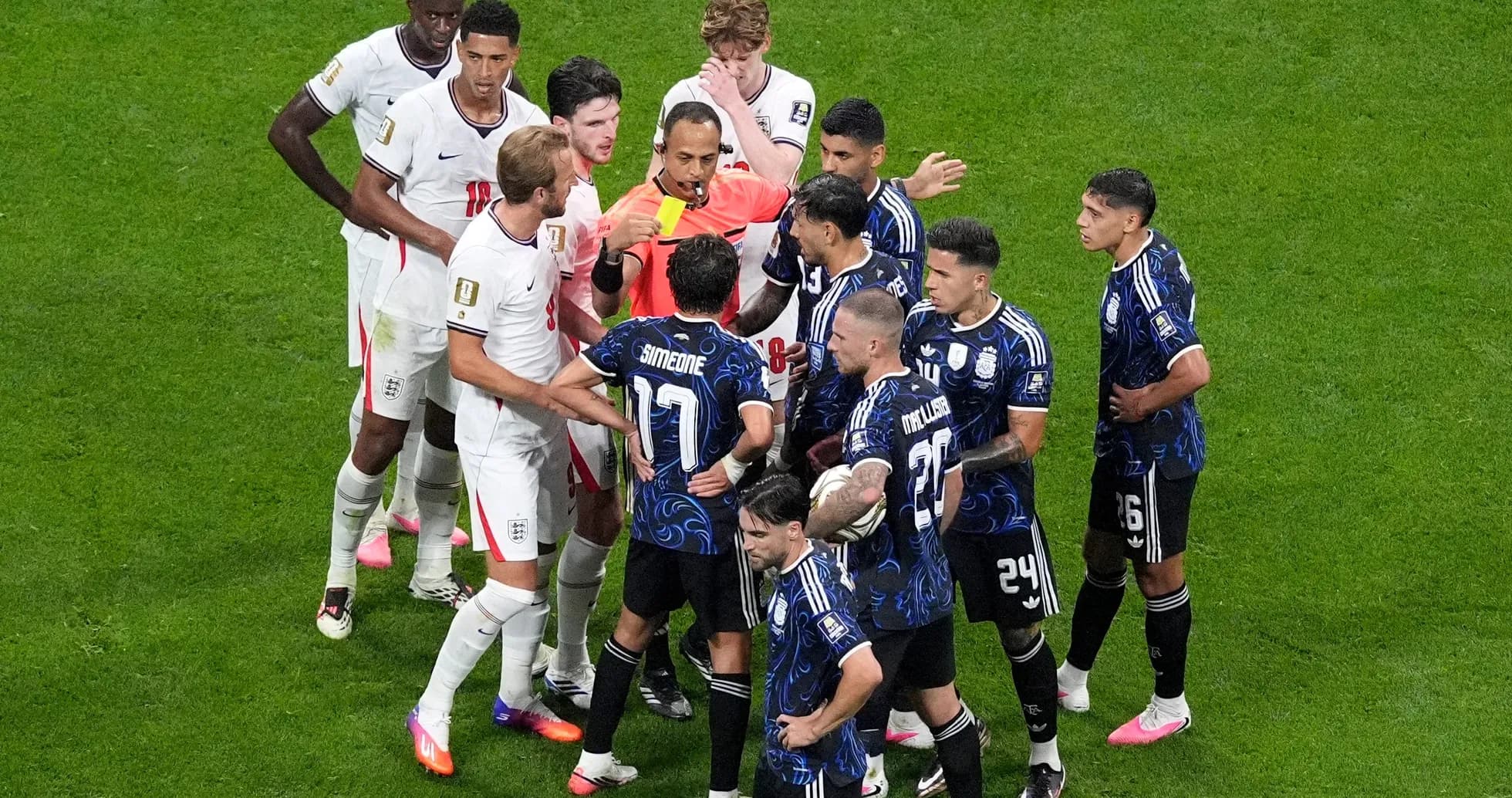
The night in Atlanta closed with Argentina edging England 2–1, a semi-final decided not by chaos but by the slow, suffocating application of structure. At Mercedes-Benz Stadium, two teams who had marched almost flawlessly through the World Cup collided with their clearest tactical identities on full display – and it was Lionel Scaloni’s more adaptable machine that found the extra layer of control.
I. The Big Picture – Two Perfect Arcs Collide
Heading into this game, both sides carried the weight of near-perfect tournaments. England had navigated the group stage from Group L as leaders with 7 points and a goal difference of +4, scoring 6 and conceding 2 across 3 matches. Overall in this World Cup, they had played 7 fixtures, winning 5, drawing 1 and losing 1 before this semi-final, with 14 goals scored and 8 conceded. Their attacking profile was balanced: at home they averaged 1.8 goals per match and on their travels 2.3, for an overall average of 2.0, while allowing 1.3 at home and 1.0 away, 1.1 in total.
Argentina, kings of Group J, arrived with a cleaner, colder dominance. They topped their group with 9 points and a goal difference of +7, scoring 8 and conceding just 1. Across the tournament they had been perfect: 7 fixtures, 7 wins, no draws, no defeats. Their attack was even more ruthless than England’s – at home they averaged 2.8 goals per match, away 2.5, for a total of 2.7 – while conceding a flat 1.0 goal on average in every dimension. The statistical shape of this semi-final was clear: England’s high-functioning but occasionally porous side against an Argentina that simply did not bend.
On the night, the scoreline reflected that edge. England’s 4-2-3-1 under Thomas Tuchel was built around control and vertical surges from Jude Bellingham and Anthony Gordon, while Argentina’s 4-1-4-1, a less-used but carefully chosen structure from Scaloni, revolved around Lionel Messi as the final blade and a disciplined midfield line.
II. Tactical Voids – Absence and Discipline
The most notable absence belonged to England. J. Quansah, already a figure in the disciplinary narrative of their tournament with a red card to his name, was unavailable through suspension. His missing presence subtly reshaped Tuchel’s defensive choices. With J. Stones and M. Guehi starting as the centre-back pairing, supported by R. James and D. Spence, England fielded a back four that was mobile but lacked the extra aerial presence and aggression Quansah could have provided in the chaos moments Argentina so often manufacture.
Disciplinary trends framed the risk landscape. England’s tournament card profile showed a tendency to collect yellows in the 31–45 and 61–75 minute windows, each accounting for 25.00% of their total cautions. There was also a red card in the 46–60 minute range, underlining how dangerous their intensity can become just after half-time. D. Rice, who anchored midfield again here, had already taken 2 yellow cards in the tournament and featured among the top red card statistics as well, though without a dismissal in that second dataset. His role was always going to be played on a tightrope.
Argentina’s caution map was stranger: a late-game surge of yellow cards, with 44.44% arriving between 91–105 minutes and 22.22% between 106–120. In regular time, they spread their few bookings thinly – 11.11% in each of 31–45, 46–60 and 76–90. The message: they stay calm in the 90, but extra time turns them combative. In a semi-final that stayed within the regular 90 minutes, that latent volatility never fully surfaced.
III. Key Matchups – Hunter vs Shield, Engine Room vs Enforcer
The headline duel was always going to be Messi against England’s defensive structure. As the tournament’s top scorer, Messi came into this fixture with 8 goals and 4 assists in 7 appearances, a staggering rating of 9.07 and 28 shots, 18 on target. His creative volume – 314 passes with 26 key passes, 35 dribbles attempted and 24 completed – made him both hunter and architect.
England’s shield against that was multi-layered. J. Pickford in goal, Stones and Guehi centrally, and Rice patrolling in front. Rice’s tournament numbers – 240 passes at 91% accuracy, 4 tackles, 2 blocks, 2 interceptions – framed him as the enforcer whose positional discipline would be tested by Messi’s drifting. The challenge was not just stopping shots, but cutting the supply lines from E. Fernandez and A. Mac Allister, who both started as interior threats in Argentina’s 4-1-4-1.
Further forward, the “Engine Room” belonged to Bellingham. With 6 goals and 1 assist in 7 appearances, 15 shots (11 on target), 223 passes and 8 key passes, he operated as England’s all-court midfielder, linking D. Rice to H. Kane. His duel with L. Paredes at the base of Argentina’s midfield was a strategic hinge: if Bellingham could turn Paredes and carry into the half-spaces, England’s 4-2-3-1 would tilt into a 4-2-4 in possession, with Gordon and M. Rogers joining the front line.
On the flanks, Anthony Gordon’s role was to stretch and cut. His 3 assists in the tournament, supported by 6 key passes and 25 dribbles attempted, made him the natural outlet against N. Molina and N. Tagliafico. With Kane’s penalty record – 2 scored from 2 taken – and 6 goals overall, England’s plan was clear: draw fouls in advanced zones, allow Gordon and B. Saka (from the bench) to isolate defenders, and let Bellingham arrive late into the box.
Argentina, however, had their own hunter’s pack. J. Alvarez, starting nominally as a midfielder but effectively operating as a second forward from the right half-space, and G. Simeone as a high-running interior, were tasked with pinning England’s full-backs and preventing R. James and Spence from dominating the wide channels. Behind them, C. Romero and L. Martinez formed a centre-back pairing comfortable stepping high into Kane’s zone, knowing that England’s structure rarely left him completely isolated.
IV. Statistical Prognosis and Tactical Verdict
From a pure statistical lens heading into the semi-final, Argentina’s edge was subtle but decisive. Both teams boasted identical numbers of clean sheets in total – 2 each – but Argentina had never failed to score in the tournament, while England had one blank. Argentina’s goal difference across all fixtures stood at +12 (19 scored, 7 conceded), compared to England’s +6 (14 scored, 8 conceded). The attacking averages told a similar story: Argentina’s 2.7 goals per match overall outpaced England’s 2.0, while both conceded at roughly 1 goal per game.
The penalty narrative added another layer of tension. England had been perfect from the spot in this World Cup, scoring 2 of 2 penalties. Argentina, by contrast, had a fraught relationship with penalties: 3 awarded, only 1 scored, 2 missed, both by Messi. That 66.67% miss rate was a rare statistical blemish on their otherwise pristine campaign and a potential psychological fault line if the match had gone to a shootout. Instead, Argentina settled the argument in open play.
In the end, the 2–1 scoreline felt like the logical convergence of those arcs. England’s 4-2-3-1 gave them moments of control and surging verticality through Bellingham and Gordon, but Argentina’s 4-1-4-1, with its compact central box and Messi as the free attacker, better exploited the marginal spaces between England’s lines. Stones and Guehi were drawn into duels they could not always dictate; Rice was forced to shuttle sideways more than step forward; Kane, despite his finishing pedigree, found his touches too often away from the penalty area.
Following this result, the numbers confirm what the eye suggested: Argentina remain the tournament’s most complete side, statistically superior in attack, resilient in defence, and able to carry the burden of Messi’s missed penalties without psychological collapse. England depart as a high-quality, modern tournament team – structured, dangerous, but ultimately outmanoeuvred by a side whose blend of individual genius and collective balance was just one tier higher on the night.