.svg&w=384&q=75 "Pitchgist logo")
Rodri's Inspiring Journey from Injury to World Cup Glory
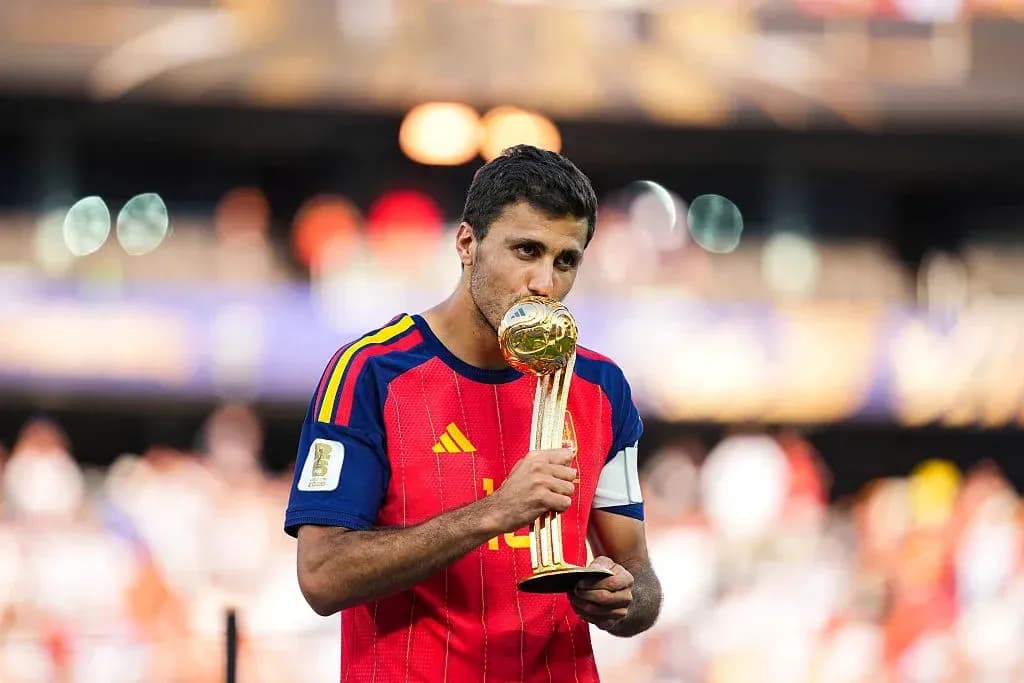
Rodri stood in the mixed zone with a World Cup medal around his neck and the Golden Ball in his hands, but his mind was somewhere else entirely – back in a treatment room, back on a training pitch where his knee refused to cooperate, back in September 2024 when the idea of nights like this felt a long way off.
Hours earlier, he had driven Spain through a brutal, attritional final, helping his side edge past Argentina 1-0 in extra time to lift the World Cup. Now, with the trophy secured and the stadium still humming, the midfielder tried to explain a journey that has been anything but smooth.
“We're a bit shocked right now, even myself,” he told Fox Sports, still riding the adrenaline of the final whistle. “I cannot express with words. I think now we're like in a cloud but, for me, it's been a very tough time.”
The numbers will say he was the tournament’s outstanding player, the Golden Ball winner who controlled games and suffocated opponents. The story behind those numbers is harsher. A serious knee injury in September 2024, followed by setbacks that kept dragging him back, forced him into long, lonely months of rehab while others played on.
That is why this triumph carries a different weight for him. It is not just a medal. It is a rebuttal.
He wants it to be more than that, too.
“I just want the new generations to see my example as an opportunity,” he said. “When you go down, you can rise again. This is my philosophy for my entire life.”
This is Rodri distilled. No drama, no theatrics, just a clear code: fall, then rise. He has lived it in silence for months, and now he wants younger players to see the arc laid out in front of them in the most public way possible – from injury table to World Cup podium.
“Of course, sometimes things go well, things go wrong, but always the positiveness,” he added.
That mindset bled into Spain’s performance in the final. Facing Argentina, with all the weight and narrative that fixture always brings, Rodri set the tone before a ball had even been kicked. In the dressing room, as tension wrapped itself around every conversation, he went straight at it.
“I said to the lads before the game, ‘we have to go for the game.’ We need to face them, we have to look to their eyes. We want this game.”
No sitting back, no fear. Spain met Argentina head-on, and in extra time, the pressure finally told. The 1-0 scoreline will be remembered as a cagey classic, but inside it was a statement of character, built on the same refusal to retreat that carried Rodri through his recovery.
“And then life gives you the World Cup or not,” he said, “but we were brave and I was brave in that moment I was down, so I want to thank all the people that helped me. But I want to thank myself, to be honest, in those moments.”
It is a rare admission from a modern footballer, and a revealing one. He knows the physios, doctors, coaches and family played their part. He also knows that, at 7am in the gym when the knee aches and the doubts creep in, nobody can do the work for you.
On this night, with the world watching and the trophy secured, Rodri allowed himself that small, honest nod to the fight only he truly understands.
For Spain’s next generation, the image is powerful: the midfield general who limped out of the spotlight a year ago now standing at the very top of the game, Golden Ball in hand, World Cup won, and a simple message cutting through all the noise – when you go down, you can rise again.