.svg&w=384&q=75 "Pitchgist logo")
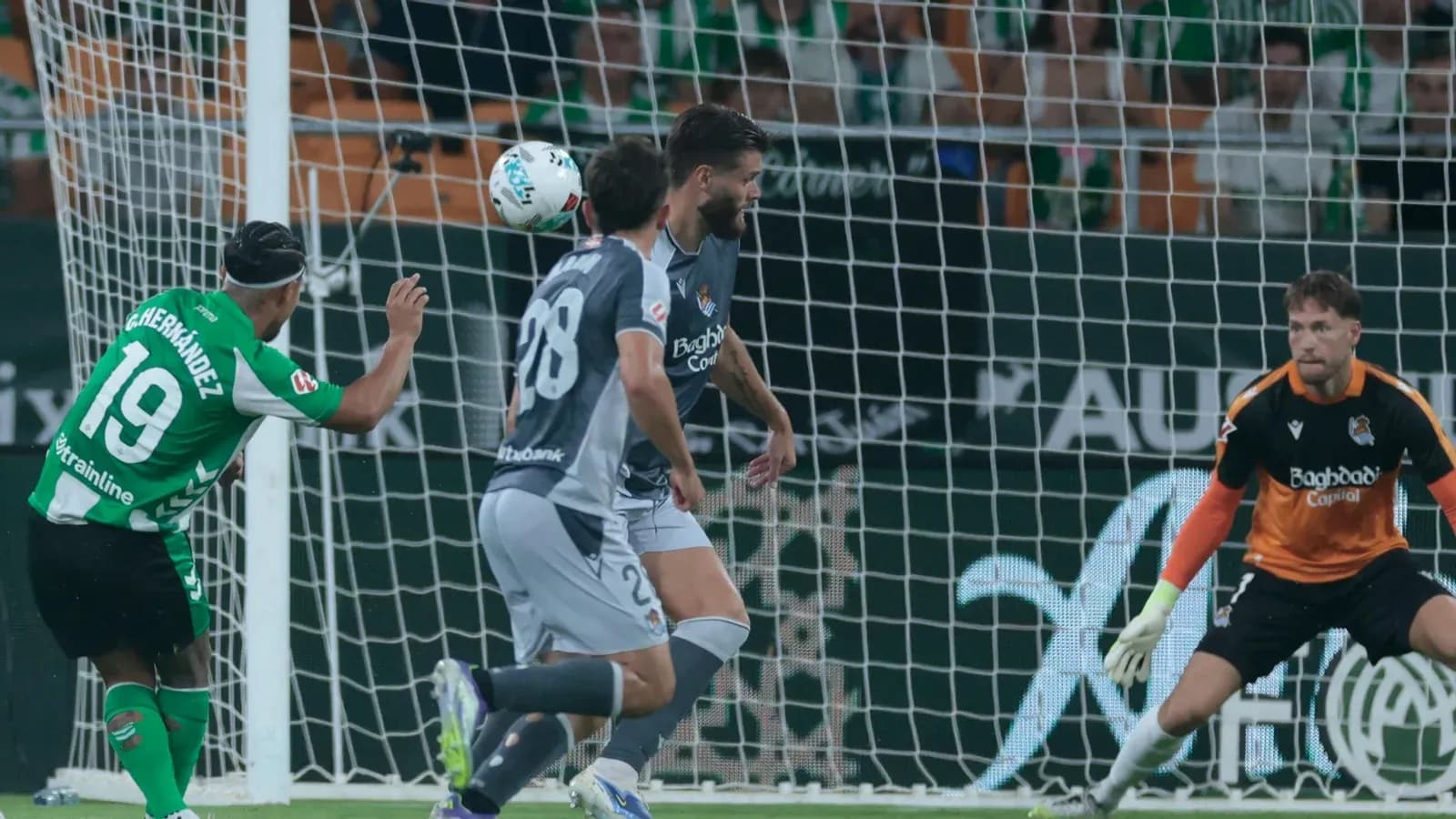
Real Sociedad vs Real Betis: A 2-2 Draw Reflecting Season Identities
The Reale Arena under lights, La Liga’s Regular Season - 35, and a meeting of two sides whose seasons have been shaped by fine margins. Real Sociedad, 8th in the table with 44 points and a goal difference of -1 (54 scored, 55 conceded overall), hosted a Real Betis side sitting 5th on 54 points with a goal difference of 11 (54 for, 43 against overall). The final 2-2 scoreline felt entirely in keeping with their seasonal DNA: Sociedad’s volatility against Betis’ controlled chaos.
I. The Big Picture – Structures and Season Identities
Pellegrino Matarazzo set Real Sociedad up in a 4-4-2, doubling down on what has been his most-used structure this season (12 league matches with this shape). At home, heading into this game, Sociedad had won 8, drawn 5 and lost 5 from 18, scoring 34 and conceding 27 at Reale Arena. That home attacking average of 1.9 goals per match is aggressive, but the 1.5 goals conceded at home underlines why their overall goal difference is negative.
Opposite him, Manuel Pellegrini stayed loyal to Real Betis’ 4-2-3-1, the formation they have used 25 times in the league. On their travels, Betis arrived with 5 wins, 9 draws and just 4 defeats from 18 away games, scoring 24 and conceding 26. That away pattern – 1.3 goals scored and 1.4 conceded per match – speaks of a side comfortable living in tight contests and leaning on individual quality to tilt them.
The match narrative followed those season arcs: Sociedad’s front-foot ambition and structural bravery against a Betis team that trusts its double pivot and three creative midfielders to find moments in transition.
II. Tactical Voids – Absences and Discipline
Both squads came into this fixture scarred by absences that shaped the tactical map.
Real Sociedad were without J. Aramburu (suspended for yellow cards), along with G. Guedes (toe injury), J. Karrikaburu (ankle), A. Odriozola (knee), I. Ruperez (knee) and I. Zubeldia (muscle injury). The Aramburu absence was especially significant: a defender who has played 32 times, making 96 tackles and blocking 9 shots, and who lives on the disciplinary edge with 10 yellow cards. His aggression on the flank and in duels (340 overall, 193 won) is a key part of Sociedad’s pressing identity. Without him, Matarazzo turned to A. Elustondo and S. Gomez in the back four, with J. Martin and D. Caleta-Car forming the central axis. It made the defensive line more positional, less feral.
For Betis, M. Bartra (heel injury) and A. Ortiz (hamstring) were missing, removing depth and experience from Pellegrini’s defensive options. That placed a heavier burden on D. Llorente and V. Gomez as the central pairing, protected by S. Altimira and M. Roca in the double pivot.
Disciplinary profiles also framed the contest. Heading into this game, Sociedad’s yellow-card distribution showed a pronounced spike after the break: 21.62% of their yellows came between 46-60 minutes and 17.57% between 76-90, with an additional 10.81% in added time (91-105). Red cards were heavily clustered late as well: 50.00% between 76-90 and 25.00% in the 46-60 window. Betis, by contrast, had their largest yellow-card surge between 76-90 minutes at 24.64%, and a remarkable 17.39% in added time, while their only reds (100.00%) arrived between 91-105. This was always likely to be a match that frayed as it wore on.
III. Key Matchups – Hunter vs Shield, and the Engine Room
The headline duel was always going to be Mikel Oyarzabal against the Betis back line. Oyarzabal came in as one of La Liga’s elite forwards this season: 15 goals and 3 assists from 31 appearances, with 61 shots (36 on target) and 40 key passes. He is not just a finisher but a connector, and his 7 penalties scored from 7 attempts underlines his composure in decisive moments.
Against him stood a Betis defence that, overall, had conceded 43 goals in 35 matches – just 1.2 per game – but was more vulnerable on their travels with 26 conceded away. The central pairing of Llorente and V. Gomez had to manage not only Oyarzabal’s movement between the lines but also the runs of O. Oskarsson, while tracking the wide threats of T. Kubo and A. Barrenetxea.
On the other side, Real Betis’ attacking “hunter” was Cucho Hernandez, supported by a devastating creative triangle: Antony, Pablo Fornals and A. Ezzalzouli. Cucho arrived with 10 league goals and 3 assists, a forward who combines penalty-box instincts with relentless work rate (266 duels, 121 won). Ezzalzouli, though, is the true chaos agent: 9 goals, 8 assists, 80 dribbles attempted with 38 successful, and 66 fouls drawn. He is both progressor and foul magnet, ideal for a team that thrives in broken phases.
The shield for Sociedad was a back four that, without Zubeldia and Aramburu, lacked its usual blend of aggression and leadership. D. Caleta-Car’s aerial presence and J. Martin’s positional discipline had to compensate, while the double axis in midfield – J. Gorrotxategi and C. Soler – were tasked with blocking passing lanes into Fornals and Ezzalzouli.
In the engine room, the duel between Fornals and the Sociedad midfield was quietly decisive. Fornals has been a metronome this season: 1675 passes with 82 key passes, at an 86% accuracy. His job in the 4-2-3-1 is to receive between the lines, turn under pressure and release runners wide or Cucho through the channels. Sociedad’s 4-4-2, with Kubo and Barrenetxea tucking infield, tried to compress those spaces, but that naturally left their full-backs exposed to Betis’ wide overloads.
IV. Statistical Prognosis and Tactical Verdict
From a statistical perspective, this 2-2 draw sits squarely within the parameters of both teams’ seasons. Overall, each side averages 1.5 goals scored per match, and the combined defensive records – 1.6 goals conceded per game for Sociedad, 1.2 for Betis – point towards a contest where xG would likely hover around the 1.3–1.6 band for each.
Sociedad’s home attacking average of 1.9 and Betis’ away attacking average of 1.3 naturally project a multi-goal game. Meanwhile, the late-card surges for both teams suggest a second half where pressing intensity and fatigue open up space. That’s exactly the tactical environment in which players like Oyarzabal, Kubo, Ezzalzouli and Antony thrive: broken lines, tired legs, and the chance to attack unbalanced defences.
Following this result, the story of the match is one of two systems revealing their truths. Matarazzo’s 4-4-2 delivered volume and threat but could not fully protect a back line already weakened by injuries and suspension. Pellegrini’s 4-2-3-1 again showcased Betis’ layered creativity, yet their away fragility resurfaced, conceding twice despite a generally solid seasonal defensive record.
In the end, the 2-2 at Reale Arena felt less like an anomaly and more like a crystallisation of who these teams have been all season: Sociedad, wild and dangerous; Betis, controlled yet vulnerable when forced into a shootout. The numbers had warned us; the pitch merely confirmed it.