.svg&w=384&q=75 "Pitchgist logo")
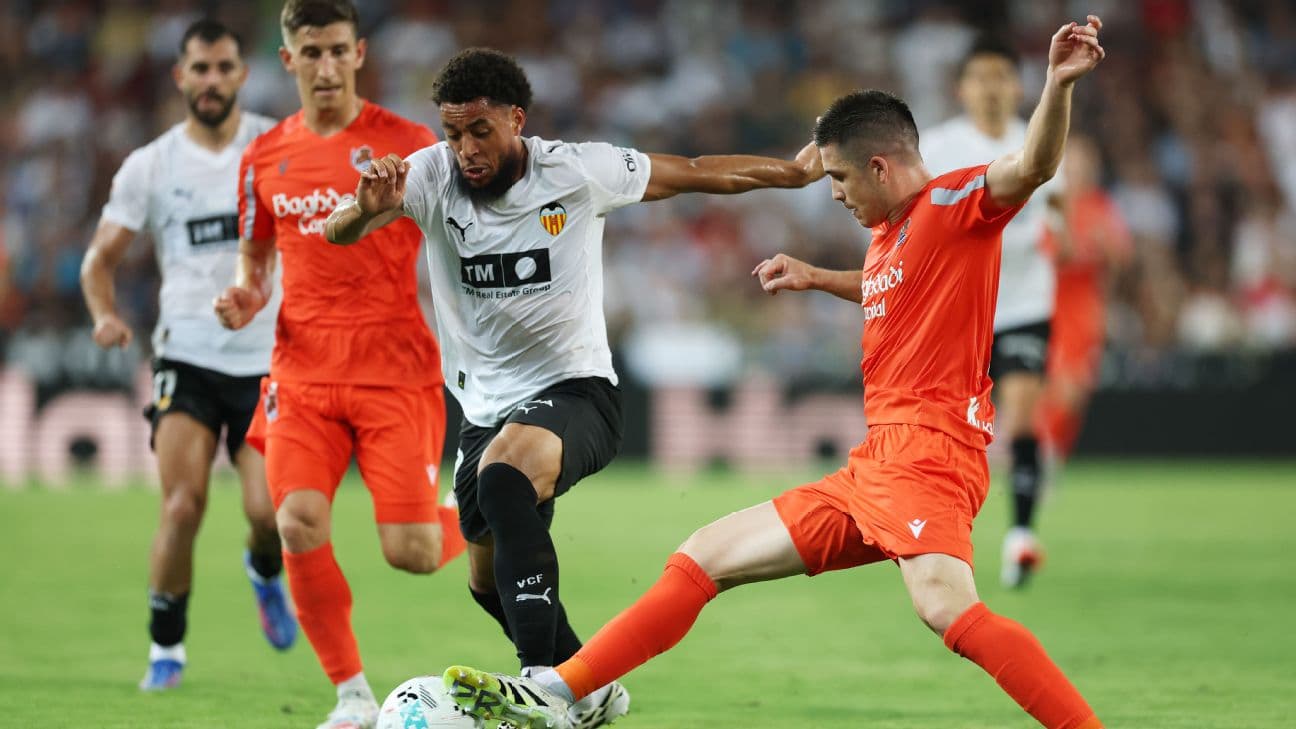
Real Sociedad vs Valencia: Key La Liga Clash for European Ambitions
Real Sociedad host Valencia at Anoeta on 17 May 2026 in a La Liga clash that could define European ambitions and mid-table positioning. With two games left in the regular season, Real Sociedad sit 8th on 45 points and are still within reach of Europa League qualification, while 11th-placed Valencia, on 43 points, are looking to secure a top-half finish and avoid being dragged into late drama.
Context and stakes
In the league, Real Sociedad’s position (8th, goal difference -1) reflects an inconsistent campaign: 11 wins, 12 draws and 13 defeats across 36 matches, with a surprisingly leaky defence (56 conceded) for a side usually associated with control and structure. Their recent form line of “DDLDL” underlines a stuttering run at precisely the wrong time.
Valencia, 11th with 43 points and a goal difference of -12, have matched La Real’s 11 wins but lost more (15) and scored significantly fewer goals (39). Their “DWLWD” form suggests a team oscillating between resilience and fragility, but with enough momentum to travel north with quiet confidence.
With only two points separating them, this fixture has clear table implications: a Real Sociedad win would open a five-point gap and all but guarantee finishing above Valencia; an away victory would see the visitors leapfrog the hosts going into the final day.
Real Sociedad: attacking threat, defensive frailty
Across all phases, Real Sociedad have been far more comfortable at Anoeta. In the league, they have 8 wins, 5 draws and 5 defeats at home, scoring 34 and conceding 27 in 18 games. Their home attack averages 1.9 goals per game, but the 1.5 goals conceded per home match points to a side that gives opponents chances.
Their broader season statistics reinforce that profile: 54 goals scored in 35 league matches and 55 conceded, with only 3 clean sheets in total (2 at home). They have failed to score just twice at Anoeta, a strong indicator that they usually find a way onto the scoresheet, even when not at their best.
Tactically, Real Sociedad have favoured a back four. The 4-4-2 has been their most-used shape (12 times), closely followed by 4-2-3-1 (11) and 4-1-4-1 (10). That flexibility within a four-man defence suggests they can tweak the midfield line depending on Valencia’s structure: either double pivots to protect a fragile back line or a more aggressive 4-1-4-1 to press high.
Key to their attacking edge is Mikel Oyarzabal. The Spain international has 15 league goals and 3 assists in 31 appearances, with a strong underlying profile: 61 shots (36 on target), 40 key passes and 59 dribble attempts with 34 successes. His 7 penalties scored from 7 attempts underline his reliability from the spot, matching the team’s overall penalty record (8 scored from 8). Whether operating as a wide forward or a second striker in the 4-4-2, Oyarzabal is the primary reference point in the final third.
However, Real Sociedad’s recent form line in the extended stats (“DDLLLWLLDWWDWLLLDDWWWDWLDWLWLWDLDLD”) shows frequent swings in results and long runs without clean sheets. They have endured losing streaks of up to three games and only rarely put together more than a three-match winning run. That volatility makes game management a major question: can they protect a lead if they get one?
Discipline could also be a factor. Their yellow cards cluster heavily between minutes 46–60 and 76–90, indicating a tendency to pick up cautions as intensity rises late on. Red cards have also arrived in the second half (one between 46–60, two between 76–90, one in added time), something to watch in a tight contest.
Valencia: compact, reactive, and better on the road than the table suggests
Valencia’s away record in the league (4 wins, 4 draws, 10 defeats, 15 scored and 29 conceded) looks modest, but there are encouraging signs beneath the surface. They have kept 5 away clean sheets and failed to score in 6 of 18 road games, which hints at a low-margin, risk-averse style: when they are compact and organised, they can frustrate opponents; when they concede first, they often struggle to chase games with an attack averaging just 0.8 goals per away match.
Across all phases, they have scored 38 and conceded 50, again pointing to a team built more on structure than firepower. Their most common formation is also 4-4-2 (21 times), followed by 4-2-3-1 (9), with occasional switches to three- or five-man defences. This suggests that in San Sebastian, they are likely to mirror Real Sociedad’s back four but may drop into a deeper mid-block, especially given the hosts’ attacking numbers at home.
Valencia’s biggest away win this season (2-0) and biggest away defeat (0-6) illustrate their variability on the road. When their defensive block holds, they can be efficient; when it collapses, it can do so heavily.
Their disciplinary profile shows a lot of late yellow cards (16 between 76–90, 11 between 91–105) and two reds overall, one in the 16–30 minute range and one unspecified. This could matter if Real Sociedad, who often increase tempo in second halves, push hard in the closing stages.
From the spot, Valencia have converted 5 penalties out of 5, giving them a strong weapon in tight games, even if no individual penalty takers are listed in the provided data.
Absences and selection headaches
Both squads are hit by significant absences.
For Real Sociedad, A. Barrenetxea is listed as a missing fixture due to yellow cards and also as questionable with injury, but the duplication reinforces that he is very likely out. G. Guedes (toe injury), A. Odriozola (knee injury) and I. Ruperez (knee injury) are also ruled out. That removes a direct wide threat (Barrenetxea), a dynamic forward option (Guedes) and a depth full-back (Odriozola), which may narrow the coach’s choices on the flanks and in rotation.
Valencia are without L. Beltran (knee injury), J. Copete (ankle injury), M. Diakhaby (muscle injury) and D. Foulquier (knee injury). That list hits both central defence and full-back depth, as well as midfield options. On top of that, club captain J. Gaya and Renzo Saravia are both questionable with injuries, leaving the left-back and right-back positions potentially short of first-choice options. If either or both are missing, Valencia’s usual defensive solidity could be compromised in wide areas, exactly where Oyarzabal likes to operate.
Head-to-head: slight Real Sociedad edge
The last five competitive La Liga meetings between these sides show a finely balanced rivalry, with a narrow Real Sociedad advantage:
- 16 August 2025, Estadio de Mestalla: Valencia 1-1 Real Sociedad – draw.
- 19 January 2025, Estadio de Mestalla: Valencia 1-0 Real Sociedad – Valencia win.
- 28 September 2024, Reale Arena: Real Sociedad 3-0 Valencia – Real Sociedad win.
- 16 May 2024, Reale Arena: Real Sociedad 1-0 Valencia – Real Sociedad win.
- 27 September 2023, Estadio de Mestalla: Valencia 0-1 Real Sociedad – Real Sociedad win.
Over these five, Real Sociedad have 3 wins, Valencia 1, and there has been 1 draw. Notably, in the two most recent meetings at Reale Arena (in 2024), the hosts won 3-0 and 1-0 respectively, both clean sheets.
Tactical battle zones
Given both teams’ heavy use of 4-4-2 and 4-2-3-1, the central midfield battle and wide channels are likely to be decisive:
- Real Sociedad in possession: Expect them to try to establish control through a double pivot, using full-backs to provide width if Barrenetxea and Guedes are indeed out. Oyarzabal’s movement between the lines and into the left half-space will be critical, especially if Valencia are forced to field a makeshift full-back pairing due to injuries.
- Valencia in transition: With a modest away goals record but several clean sheets, their plan is likely to revolve around compactness and fast breaks. The 4-4-2 shape gives them two outlets up front and two banks of four to protect the box. They will look to exploit Real Sociedad’s defensive numbers (55 conceded, just 3 clean sheets across all phases), particularly when the hosts push their full-backs high.
Set pieces and penalties could also be important. Both teams have flawless penalty conversion records this season based on the data provided (Real Sociedad 8/8, Valencia 5/5; Oyarzabal 7/7 individually), so any spot-kick awarded is likely to be converted.
The verdict
On balance, Real Sociedad’s stronger home record, superior attacking numbers at Anoeta and recent head-to-head dominance in San Sebastian give them a slight edge. Their ability to score regularly at home, combined with Oyarzabal’s form and penalty reliability, suggests they are well placed to take three points.
However, their defensive vulnerability and patchy recent form leave the door open for Valencia, especially if the visitors can keep the game tight and exploit transitions against a back line that concedes 1.5 goals per home match.
Expect a competitive, tactically cagey encounter where Real Sociedad see more of the ball and create the clearer chances, but Valencia’s structure and counter-attacking threat mean a narrow home win or a draw are the most logical outcomes.