.svg&w=384&q=75 "Pitchgist logo")
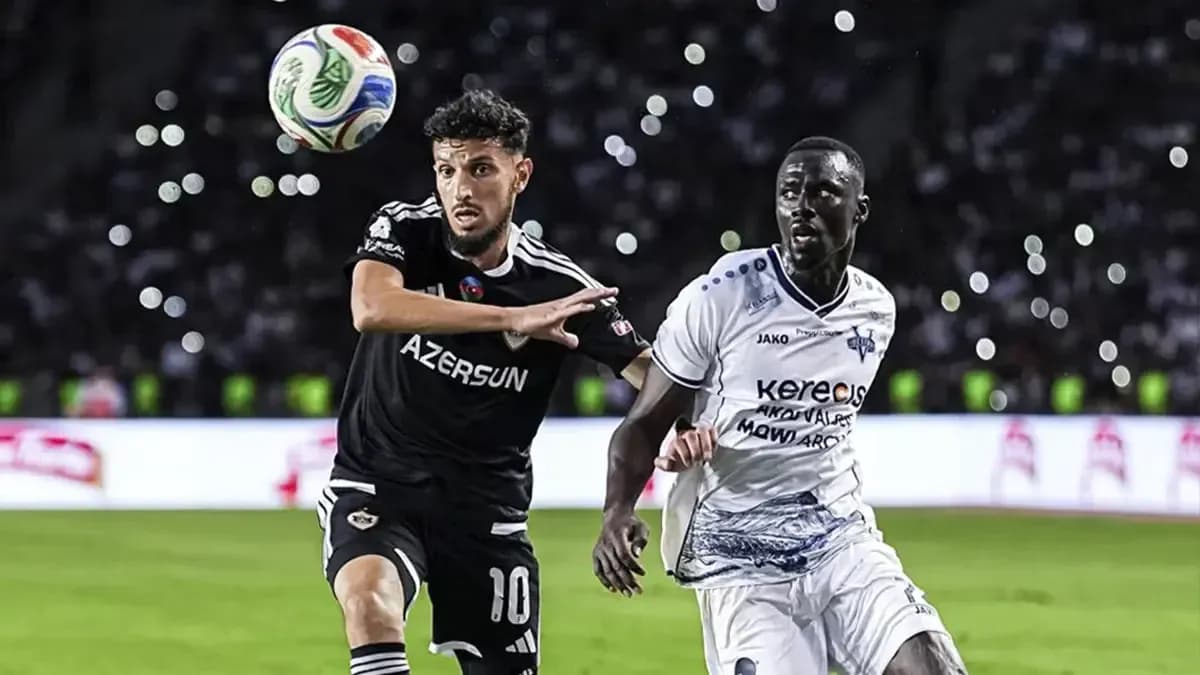
Qarabag Dominates Vestri in UEFA Europa League Qualifier
Vestri’s 0-3 home defeat to Qarabag at Throttarvollur in the UEFA Europa League 1st Qualifying Round was defined less by raw numbers – most of which are absent – and more by the clear tactical hierarchy between the sides. Qarabag imposed a recognisable 4-2-3-1 structure from the opening whistle, while Vestri, without a declared formation, looked more like a defensive block pieced together to survive rather than to control.
Qarabag’s back four of Matheus Silva, B. Huseynov, B. Varkonyi and B. Langa underpinned everything. With Pedro Bicalho and M. Jankovic as the double pivot, they created a stable 2+2 platform in build-up. That allowed the advanced trio of J. Mouaddib (right), Kady Borges (central) and A. Zoubir (left) to operate high between the lines, with Z. Sawo stretching the last line. The early goal at 5' from Mouaddib, assisted by Sawo, was a direct product of this structure: Qarabag progressed through midfield, pinned Vestri’s back line and exploited the half-space before the hosts could compact vertically.
Vestri’s starting shape, inferred from personnel, resembled a back five or at least a very flat defensive line: defenders Edson Eduardo, G. Einarsson, S. Fall, M. Hagbardsson and B. Eydal were all listed as defenders in the XI, with midfielders like J. Stensson, A. Johannsson, J. Selven and E. Duah trying to bridge an enormous gap to lone outlets. The consequence was immediate: the home side dropped deep, compressing their own half but leaving no natural release points. With no recorded shots or possession figures, the qualitative picture still suggests a team spending long stretches without the ball, reacting rather than dictating.
Qarabag’s second goal on 29' – Bicalho finishing from another Sawo assist – underlined the visitors’ superiority between the lines. The double pivot drew Vestri’s first line out, while the three attacking midfielders rotated positions, dragging markers and opening central lanes. Sawo’s ability to receive and turn under minimal pressure exposed Vestri’s lack of a dedicated holding midfielder capable of screening passes into feet. The 0-2 half-time score reflected Qarabag’s control and Vestri’s inability to disrupt their rhythm.
After the break, Qarabag did not change their basic structure but adjusted the emphasis. The third goal on 56' came with the pattern inverted: this time Sawo was the finisher, Kady Borges the provider. It illustrated how Qarabag’s 4-2-3-1 could morph into a 4-2-4 in attacking phases, with Sawo and the nominal “10” both occupying central channels while wide midfielders tucked in. Vestri’s back line, already under strain, struggled to pass runners on and maintain compactness.
The substitution wave around 63' was telling. Vestri made three changes at once: G. Hauksson (IN) came on for J. Stensson (OUT), B. Hermannsson (IN) came on for E. Gardarsson (OUT), and K. Cheshmedjiev (IN) came on for S. Fall (OUT). These moves hinted at a search for more energy and perhaps a shift towards a back four with extra midfield legs, trying to contest second balls and shorten the distances between lines. But with the game already at 0-3, the changes were more about damage limitation and preserving legs than about turning the tie.
Qarabag’s own triple substitution at 63' – O. Kashchuk (IN) for J. Mouaddib (OUT), R. Cephas (IN) for A. Zoubir (OUT), and S. Lobato (IN) for Pedro Bicalho (OUT) – was a classic game-state management move. With the contest effectively decided, Qurban Qurbanov refreshed both wings and one pivot, preserving key starters while maintaining the same 4-2-3-1 structure. Kashchuk and Cephas offered fresh running in transition, while Lobato could sit alongside Jankovic to keep control of central spaces.
Further changes followed: for Vestri, T. G. Hafthorsson (IN) came on for J. Selven (OUT) at 69' and C. Morfelt (IN) for B. Eydal (OUT) at 78', continuing the trend of rotating wide and midfield roles without fundamentally changing the team’s reactive posture. Qarabag, meanwhile, introduced C. Makreckis (IN) for B. Huseynov (OUT) and E. Cafarquliyev (IN) for B. Langa (OUT) at 74', refreshing both full-back zones. This preserved the width and ensured that even in the final quarter, Qarabag could keep Vestri pinned rather than retreating into their own third.
Discipline-wise, both sides finished without yellow or red cards, which supports the picture of a match controlled by Qarabag’s structure rather than by physical duels or tactical fouling. With no recorded fouls, corners or offsides data, we cannot quantify specific phases, but the absence of bookings suggests Qarabag rarely needed to break up counters cynically, and Vestri lacked the sustained pressure that typically provokes cards.
From a strategic standpoint, Qarabag used this first leg as a statement of hierarchy and professionalism. Their 4-2-3-1 functioned as a complete system: secure first phase, fluid occupation of the half-spaces, and a centre-forward in Sawo who could both create and finish. The timing and pattern of substitutions showed a coach confident enough to manage minutes without compromising control.
For Vestri, the match exposed the limits of a deep, defender-heavy selection against a technically and structurally superior opponent. Without a clear pressing scheme or a reliable outlet to relieve pressure, they spent long periods in their own half, and the 0-3 scoreline matched the tactical story: Qarabag dictating terms, Vestri surviving rather than competing on equal footing.