.svg&w=384&q=75 "Pitchgist logo")
NWSL's Historic Night at Citi Field: Gotham FC Triumphs
Ten years ago, a National Women’s Soccer League match at a baseball stadium meant something had gone wrong. It meant a shrunken pitch squeezed into a minor-league ballpark, players railing against “shocking and embarrassing” conditions, and a league still fighting to be taken seriously.
On Wednesday night in Queens, the same idea meant something entirely different.
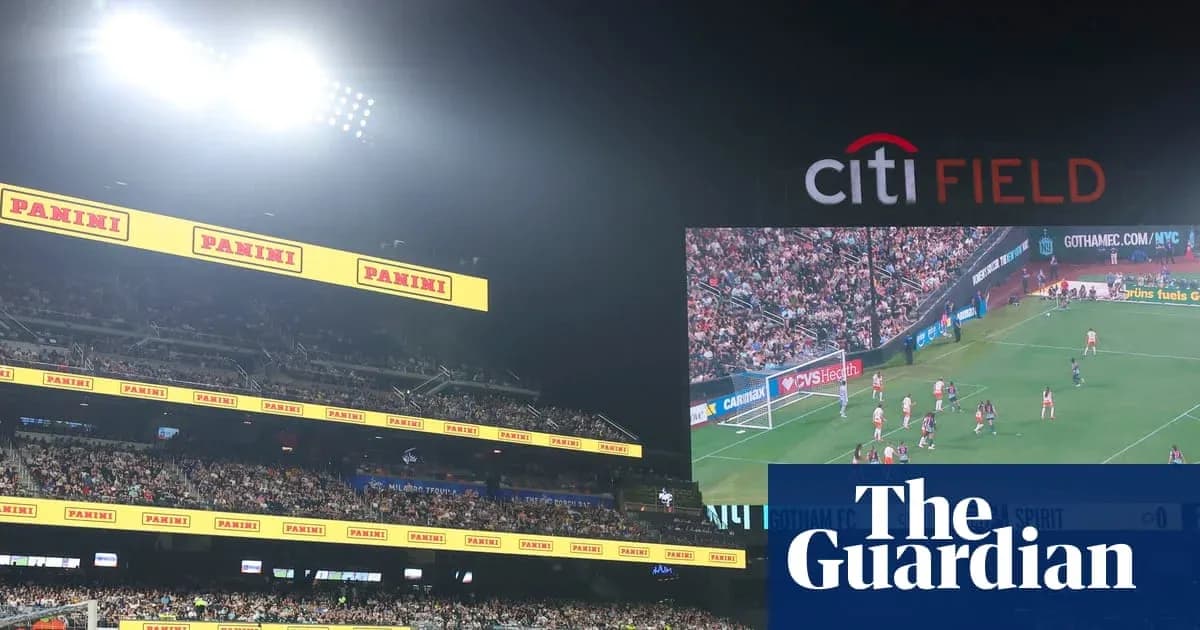
At Citi Field, home of the New York Mets, 42,175 people filed in through the turnstiles to watch Gotham FC beat the Washington Spirit 1-0. It was the second-largest crowd in NWSL history and the biggest attendance ever for a women’s sporting event in New York City. A decade ago, the league hid in baseball stadiums. Now, it sells them out.
A stage fit for a table-setter
The NWSL had been on pause for a month during the men’s World Cup. If any game was going to reset the tone for the stretch run, it was this one: a rematch of last year’s final, between two clubs that have come to define the league’s competitive peak.
San Diego still sit atop the table, but Gotham’s win dragged them level on points with the Spirit and the Portland Thorns. Washington hold second on goal difference; the margins are thin, the stakes anything but. Between them over the past three seasons, Gotham and the Spirit have produced two championships (both Gotham’s), two runners-up finishes (both Spirit’s) and three more trophies in other competitions. This is a rivalry built on hardware, not hype.
They call this fixture the Queens Classic now. It fits. It felt like a showcase of everything the NWSL has become in its 14th season: high stakes, star power, huge ambition – and just enough mess around the edges to remind everyone how quickly this has all happened.
Lavelle’s touch of class
On a hot, hazy night, one moment of quality separated the teams.
In the 37th minute, Rose Lavelle found the space she needed and bent a gorgeous curler into the net, a finish worthy of the occasion and entirely in keeping with her habit of deciding big games. She scored the winner in last year’s final. Here, she did it again, with the same unhurried precision, the same sense that the game would bend to her left foot eventually.
The crowd leaned heavily Gotham, but the stands were dotted with No 2 Spirit jerseys. Trinity Rodman, as usual, drew eyes and defenders. She rattled off five shots, threatened constantly, but never quite found the finish. On a night this tight, that was the difference.
The loudest roar, though, came not for the goal, nor for a near miss, but for a substitution.
In the 63rd minute, Sam Kerr stepped onto an NWSL pitch again. Her first minutes for Gotham since signing after six-and-a-half years at Chelsea, her first league appearance since the days when this club was still called Sky Blue. Back then, she scored for fun in front of a few thousand fans and chaos off the field. On Wednesday, she returned to a club almost unrecognizable from the one she left, greeted by tens of thousands.
Lavelle admitted she feels “spoiled” by the talent Gotham keep pulling in, name-checking Kerr, Ireland captain Denise O’Sullivan and Norwegian midfielder Guro Reiten as the latest arrivals in a dizzying transfer window. Rodman, ever the competitor, joked she told Kerr at a corner, “Welcome back, but chill.”
No one was chilling. Not on this stage.
From running-water problems to subway ads
To grasp how far Gotham have come, you have to remember what they were.
When Kerr departed in 2018, the headlines around Sky Blue weren’t about record crowds or star signings. They were about training grounds without running water, about limited resources and middling results, about a club that symbolized the league’s fragile foundations.
That version feels like ancient history now. The rebrand to Gotham FC brought new colors, new leadership, and, crucially, new standards. Last week, the club announced it will relocate to New York City proper in 2028, moving into the future Etihad Park just around the corner.
The buildup to this Citi Field game underlined that shift. Subway ads. Promotions. A $15 ticket offer spearheaded by Mayor Zohran Mamdani. The club says 70% of ticket-buyers were “new fans” – people walking into a Gotham game for the first time.
“It was really special just to see how many people were there that that was their first Gotham game,” midfielder Jaedyn Shaw said. For a franchise that once struggled to draw 3,000, that’s not a marketing note. It’s a turning point.
It also felt fitting that Washington were on the other side of the halfway line. The Spirit, too, have rebuilt from the bottom up, leaning into ambition in a league whose structure can make such boldness difficult. Two clubs that refused to settle for survival met in a baseball cathedral and filled it.
“At many levels, this is like a full-circle moment,” commissioner Jessica Berman said at half-time. “We know that with investment, if you build it they will come, and this is a proof point for that.”
Growth, with a sting in the air
The NWSL is in a sprinting phase. Over the past 12 months, it has set new records in attendance, TV viewership and expansion fees. The league that once scraped by is now the subject of bidding wars.
The acceleration, though, comes with friction.
Nearly 10 years on from that notorious tiny pitch at a minor-league park, both teams at Citi Field agreed on one thing: the field wasn’t a disaster, but it wasn’t exactly pristine either. Lavelle summed it up with a shrug: “That’s showbiz, baby.”
The broadcast had its own stumble. The match aired in primetime on ESPN, but Lavelle’s decisive strike arrived while the network had the screen split for an interview. The commentators talked over each other as the ball hit the net, a perfect metaphor for a league still learning how to handle its biggest moments.
The weather added another layer of tension.
A suffocating heatwave pushed temperatures into the 80s and 90s Fahrenheit, with a heat index over 100. Smoke from Canadian wildfires drifted south, turning the sky a murky orange-brown as the sun dipped behind the Citi Field stands. The smell of smoke hung in the air throughout the night. Much of New York spent the day under an air quality alert.
The NWSL has postponed games for air quality before. It has also been hammered for playing through brutal conditions, most notably last year when a nationally televised Orlando Pride–Kansas City Current match went ahead in extreme heat and more than a dozen fans ended up in hospital.
This time, the numbers sat in a gray zone. The air quality index hovered above 150 – “unhealthy” by Environmental Protection Agency standards, but below the league’s own thresholds of 180–200 for a potential delay and 200+ for postponement. The compromise: two hydration breaks in each half.
Spirit coach Adrián González made no secret of his frustration with the constant stoppages, saying they killed the game’s rhythm, even as he acknowledged they were necessary. Rodman echoed that conflict.
“I think on both sides, we were just like, ‘Damn, another break, another break, another break,’” she said. “If we have to have a hydration break every 15 minutes, then we shouldn’t be playing the game, and that’s my opinion. … But at the end of the day, there’s 40,000 people, it’s a whole event. So it is really tough. I think it was a really hard situation for everybody to work around.”
That’s the tightrope the NWSL now walks: balancing player safety and spectacle, health and history.
A night that rewrites the baseline
By the final whistle, the storylines had stacked up. Gotham had their statement win. Lavelle had another big-game goal. Kerr had her welcome-back ovation. The Spirit had points dropped but a performance that suggested they’ll be there at the end again.
The numbers told their own story. The Citi Field crowd more than doubled the total attendance across Gotham’s entire 12-game home slate in their debut 2013 season. What once felt unimaginable is now a midweek reality.
To understand this moment, you have to hold two truths at once. The league has come a long way. The league still has a long way to go. Both are visible in the same frame: a packed ballpark, a hazy sky, a chopped-up pitch, and a world-class midfielder curling in a winner on national TV.
As veteran Spirit midfielder Andi Sullivan put it, nights like this are the realization of a dream – or maybe something even bigger than the dream itself.
“It’s pretty cool when you’re out there and you realize that this is your job,” she said, “and that this is what your dreams looked like, or maybe what they haven’t looked like along the way.”
For the NWSL, the question now isn’t whether they can fill a baseball stadium. It’s what they dare to build next.