.svg&w=384&q=75 "Pitchgist logo")
Norway's Unique Strategy for Haaland Ahead of World Cup
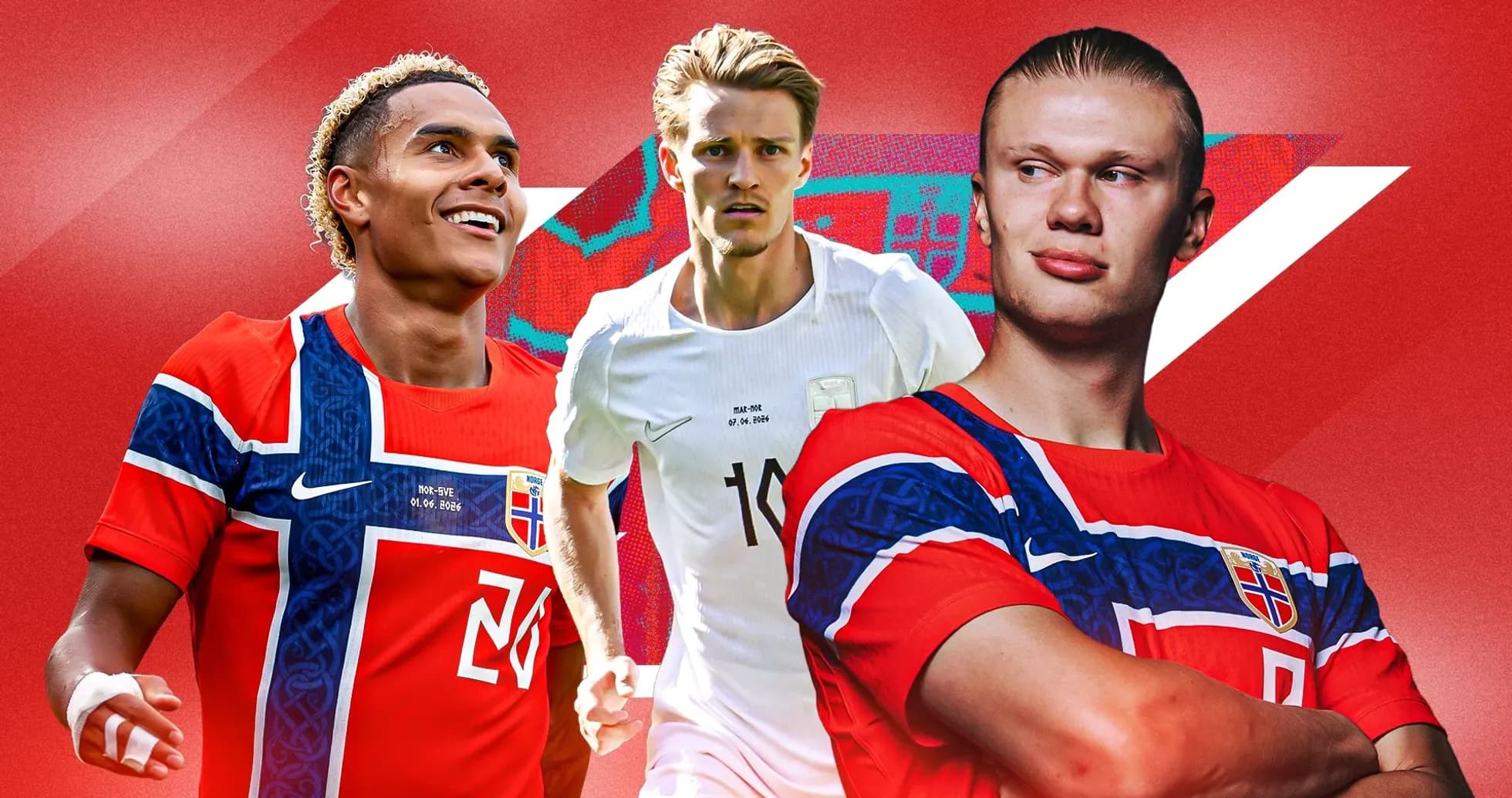
Erling Haaland will dominate every pre-World Cup conversation about Norway. That much is inevitable. But the real intrigue with Stale Solbakken’s side lies in how they plan to feed their phenomenon – and the answer is anything but conventional.
This is not a team built on old-fashioned chalk-on-the-boots wingers. Norway stretch you in strange ways, tilt the pitch, and then let their right-back tear you apart.
Wing Craft: Youth, Flair and a Giant Out Wide
On the left, Antonio Nusa looks set to carry the weight of expectation. At 21, the RB Leipzig winger already plays like a man who knows he can embarrass defenders. He drifts past markers, rides contact, and keeps going. Six goal contributions in six qualifying games underline the point; he didn’t just decorate matches, he decided them.
Italy learned that the hard way. Nusa scored and assisted in a 3-0 win, then popped up with another contribution in a 4-1 demolition in the return fixture. Those aren’t padded numbers against soft opposition. Those are statement performances on the road to North America.
Waiting behind him is Andreas Schjelderup, another left-sided talent with a rising reputation. The 22-year-old arrives at the tournament on the back of a strong second half of the season under Jose Mourinho at Benfica, where he produced 10 goals and assists across 14 league games. He also struck twice against Real Madrid in the Champions League in January – the sort of stage where pretenders are usually found out.
Schjelderup is unlikely to start ahead of Nusa, but inside Norwegian football circles he is widely tipped to become a superstar. Solbakken has the luxury of choosing between two high-ceiling left-sided forwards, each capable of changing a game in a few touches.
The right flank is where Norway rip up the script. Alexander Sorloth, all 6'5" of him, often starts wide on paper but plays like a second centre-forward when Norway attack. He drifts inside, crowds the box alongside Haaland, and turns the right side into a launchpad for chaos.
The numbers from qualifying back up his importance: eight goal contributions in eight games. He isn’t a decoy. He’s a fully-fledged threat, just delivered from an unusual angle.
Oscar Bobb offers a more traditional wide option on that side, even if his start at Fulham has been slower than he would have liked. Behind him, Jens Petter Hauge forces his way into the squad after an eye-catching spell at Bodo/Glimt. He played no part in qualifying, but his form – highlighted by contributions in famous Champions League wins over Man City and Inter – convinced Solbakken to make room for him.
Odegaard’s Stage
If Haaland is the finisher, Martin Odegaard is the conductor. Everything in Norway’s midfield flows through the Arsenal captain, and at international level he tends to strip away the inconsistency that sometimes dogs him at his club.
In a qualifying campaign disrupted by injury, Odegaard still produced seven assists in just five appearances, including three in one match against Israel. No player in Europe laid on more goals in qualifying. When he pulls the strings for his country, the numbers spike and the tempo rises.
Solbakken surrounds him with power and balance. Sander Berge, now at Fulham, anchors the midfield with his defensive presence and Premier League know-how. Alongside him, Fredrik Aursnes of Benfica offers the legs and intelligence of a modern No.8, equally comfortable knitting play together or shuttling into space.
Aursnes is one of the more intriguing stories in this squad. Two years ago, he walked away from international football, saying he wanted more time and freedom to prioritise life beyond the game. In February, he reversed that decision. Without a single minute in qualifying, he now looks set to start at the World Cup. Norway gain a Champions League-hardened midfielder just as the stakes rise.
Behind the first-choice trio sits real depth. Patrick Berg, the composed Bodo/Glimt captain, brings control and calm on the ball. Kristian Thorstvedt and Morten Thorsby, both based in Italy, add energy, physicality and tactical flexibility.
Still, everything returns to Odegaard. His link with the wide players, his ability to slide passes into Haaland’s path, his timing between the lines – Norway’s attacking structure depends on him seeing pictures quicker than everyone else. In North America, they will need his best version, not just his tidy one.
Life After Haaland? Norway Are Ready
Haaland will start every game if fitness allows. That’s the plan, and nobody pretends otherwise. But Solbakken has quietly built a striker unit that can cope with the unthinkable.
Sorloth stands first in line to replace him through the middle. The Atletico Madrid forward arrives off a 20-goal season despite not always being a guaranteed starter in Spain. His international record is solid, and his manager knows exactly what he brings.
“Alexander brings a lot of physicality, and he's a loyal player that can play in different positions up front,” Solbakken told FIFA. “Sometimes he plays together with Erling, sometimes he plays a little to the right. He's a goal threat, but he's also an assist threat. But the best thing is that he works so hard for the team, sometimes in a position that he maybe doesn't prefer.”
The other option is Crystal Palace’s Jorgen Strand Larsen, who has impressed since arriving in the Premier League in 2024. The 26-year-old tuned up for the World Cup with a brace in a friendly against Sweden and also scored against Italy in qualifying. Even if Haaland starts every match, Strand Larsen is expected to see minutes, particularly with Sorloth often stationed wide on the teamsheet.
Norway, for the first time in decades, can look beyond their main striker and still see firepower.
The Secret Weapon: A Right-Back Who Plays Like a Winger
The most unconventional piece of Solbakken’s puzzle is Julian Ryerson. On paper, he is the right-back. On the pitch, he’s often the most dangerous wide attacker in the team.
The entire structure bends to suit him. When Norway have the ball, Sorloth steps inside to join Haaland, clogging the central channels and pinning centre-backs. That movement clears the lane for the Borussia Dortmund defender to surge forward down the right.
Once there, Ryerson delivers. His 18 Bundesliga assists in the 2025-26 season are staggering for a full-back and tell you everything about his final-ball quality. With Haaland and an inverted Sorloth as towering targets, his crosses and cut-backs become a constant threat.
Set pieces only deepen the danger. Ryerson’s dead-ball delivery produced a significant share of those assists. Corners, free-kicks, wide restarts – all become attacking platforms for Norway. In a tournament where margins shrink and nerves tighten, a right-back with that level of production becomes a genuine weapon.
Opponents will obsess over Haaland. They’ll track Odegaard’s movement. If they don’t also do their homework on Ryerson, they’ll suffer.
A Nation Returns, Eyes Wide Open
This World Cup marks Norway’s first appearance on the biggest stage in 28 years. For a generation, the tournament has been something to watch, not something to join. That wait has bitten deep.
“I think it means a lot for the whole nation, especially the common supporter,” Solbakken told FIFA. “I think it's been hard for everyone to sit home at every World Cup back to when I played in 1998. Fifty-thousand fans came to meet us [after qualification was confirmed] on a Monday in minus four [degrees], so that says it all. They have waited for this moment for so long, and now it's finally here.”
They don’t arrive shouting about destiny. Solbakken refuses to dress his team up as contenders.
“I don't think we are dark horses to get all the way,” he said. “I think we are dark horses in terms of, on our day, we can maybe beat a stronger opponent. But to say that we are dark horses for the whole tournament is too far. We are in a very hard group. I think it will be very tight and hopefully we have the organisation and the match-winners to get through.”
The draw has given them France, Senegal and Iraq – a so-called Group of Death and a ruthless test of Norway’s new identity. This is not the rigid, conservative side of old. Solbakken wants a front-foot team, one that attacks with ambition and relies on individuals willing to work for each other.
“For Norway, this is the World Cup to express themselves – to show the world that we play, maybe, a different kind of football than what we have done before, and that we are an offensive team with good individuals that work hard for each other,” he added. “My dream scenario? I won't talk about it, because my dreams are for myself. But hopefully we can get the best out of the team and on our day, then we can beat anyone.”
Haaland’s goals will define the headlines. Odegaard’s passes, Nusa’s dribbles, Sorloth’s movement and Ryerson’s raids will decide whether those headlines are about a brief cameo – or the start of something far bigger for Norwegian football.