.svg&w=384&q=75 "Pitchgist logo")
Nigeria’s Super Falcons Gear Up for WAFCON 2026 in Morocco
Nigeria’s Super Falcons have drawn their battle lines for Morocco.
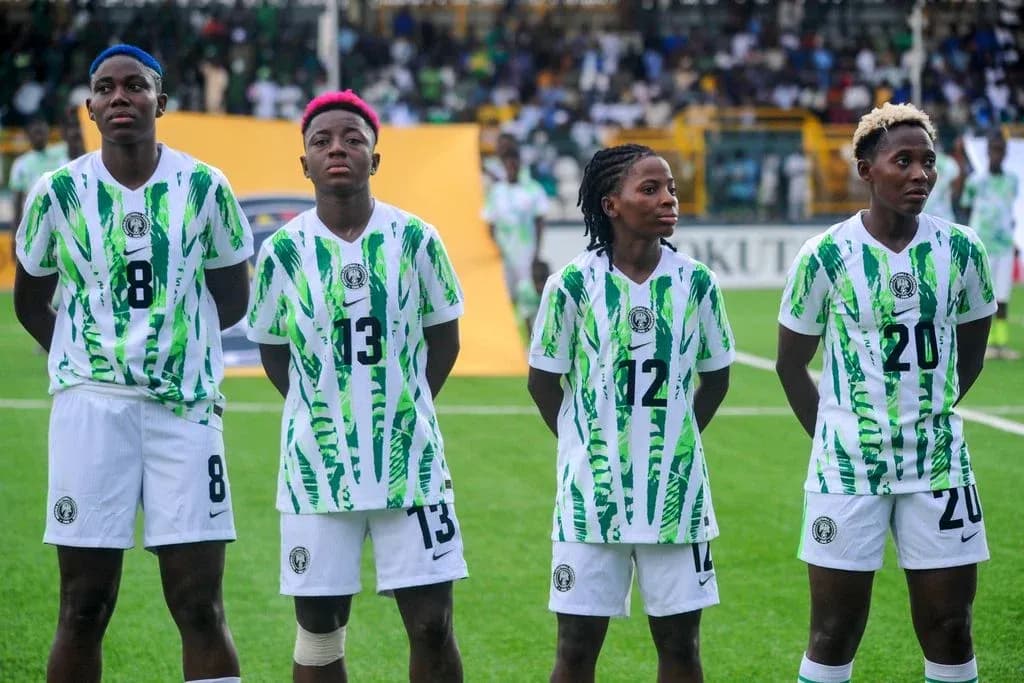
Head coach Justine Madugu has named his 25-woman squad for the 2026 Women’s Africa Cup of Nations, a group built to chase a record-extending 11th continental crown and defend the title they prised away in Morocco last time out.
Ajibade and Oshoala lead a loaded cast
At the heart of it all is captain Rasheedat Ajibade, now the emotional and tactical reference point of this team. Around her, Madugu has stacked experience, pace and power.
Six-time African Women’s Player of the Year Asisat Oshoala is in, still the headline act in attack and still the player every defender circles first on the teamsheet. Behind them, Brighton & Hove Albion’s Chiamaka Nnadozie anchors the group from goal, established as Nigeria’s undisputed No. 1 after a string of commanding displays for club and country.
There is one notable absence. Star defender Ashleigh Plumptre misses out as she continues her recovery from surgery, a significant loss for a back line that had grown used to her calm authority. Madugu will have to re-balance his defence without one of his most composed ball-playing options.
A squad built for another long run
Madugu’s list is clear in its structure: three goalkeepers, eight defenders, five midfielders and nine forwards. It is not a cautious squad. It is a squad picked to win games on the front foot.
In goal, Nnadozie is joined by Portsmouth Ladies’ Comfort Erhabor and Abia Angels’ Fatima Oloko, both pushing from behind but fully aware of the standard in front of them.
The defence blends hardened campaigners and emerging names. Osinachi Ohale brings years of tournament know-how, Michelle Alozie her relentless energy, with Oluwatosin Demehin, Rofiat Imuran, Shukurat Oladipo, Glory Ogbonna, Sikiratu Isah and Christy Ucheibe filling out a unit that will be asked to both defend high and cover big spaces.
Midfield is where Ajibade’s influence stretches deepest. She is listed among the midfielders and will be joined by Halimatu Ayinde, Deborah Abiodun, Toni Payne and Jennifer Echegini. Between them, they offer bite, balance and line-breaking runs, the sort of mix that can tilt tight knockout games.
Then comes the firepower.
Oshoala headlines a forward line that looks built to overwhelm. Folashade Ijamilusi, Esther Okoronkwo, Chinwendu Ihezuo, Francisca Ordega, Gift Monday, Uchenna Kanu, Omorinsola Babajide and Joy Omewa give Madugu options for every scenario: width, aerial threat, runners in behind, and experienced big-game performers.
Many of these players arrive from Europe’s top leagues; others come from North America, Asia and the Nigerian Women’s Football League. The dressing room will carry accents from different continents, but the target is singular.
Group C: familiar foes and a fresh face
Nigeria walk into Morocco as the giants of African women’s football. Ten titles already. The last one secured in dramatic fashion with a 3-2 win over hosts Morocco in the previous edition’s final. History is on their side; complacency cannot be.
They have been drawn in Group C with Zambia, Egypt and Malawi.
The campaign opens against tournament debutants Malawi on Tuesday, July 28, at Al Madina Stadium in Rabat. It will be the first-ever senior competitive meeting between the two nations, a fixture Nigeria are expected to control but cannot afford to treat as a formality with the world watching and World Cup slots on the line.
Then comes the grudge match.
On Saturday, August 1, at the same venue, the Super Falcons face Zambia. Nigeria have won two of the three previous meetings between the sides at this level, yet the most recent memory belongs to the Copper Queens: a 1-0 victory in the third-place playoff at WAFCON 2022. That defeat stung. This rematch carries the feel of a reckoning.
Nigeria close out the group against Egypt on Wednesday, August 5, at Rabat Region Stadium. The only previous WAFCON clash between the two ended in a brutal 6-0 win for the Falcons back in 1998 at the inaugural African Women’s Championship. Egypt, though, have invested heavily in their women’s programme since then. This will not be a stroll down memory lane.
Continental glory and a ticket to Brazil
The stakes in Morocco stretch beyond the trophy.
WAFCON 2026 doubles as Africa’s qualification route to the 2027 FIFA Women’s World Cup in Brazil. Reach the semi-finals, and a ticket to the global stage is guaranteed. Anything less, and the pressure ratchets up in play-offs that no heavyweight wants to face.
For the Super Falcons, that equation is simple and ruthless: stay among Africa’s last four, or risk seeing their World Cup aura questioned.
Madugu has shown his hand. Ajibade will drive them. Oshoala will be expected to finish the chances. Nnadozie will stand as the last line when it matters most.
Now the most successful team in African women’s football must prove, once again, that history is not just something they read about, but something they keep writing.