.svg&w=384&q=75 "Pitchgist logo")
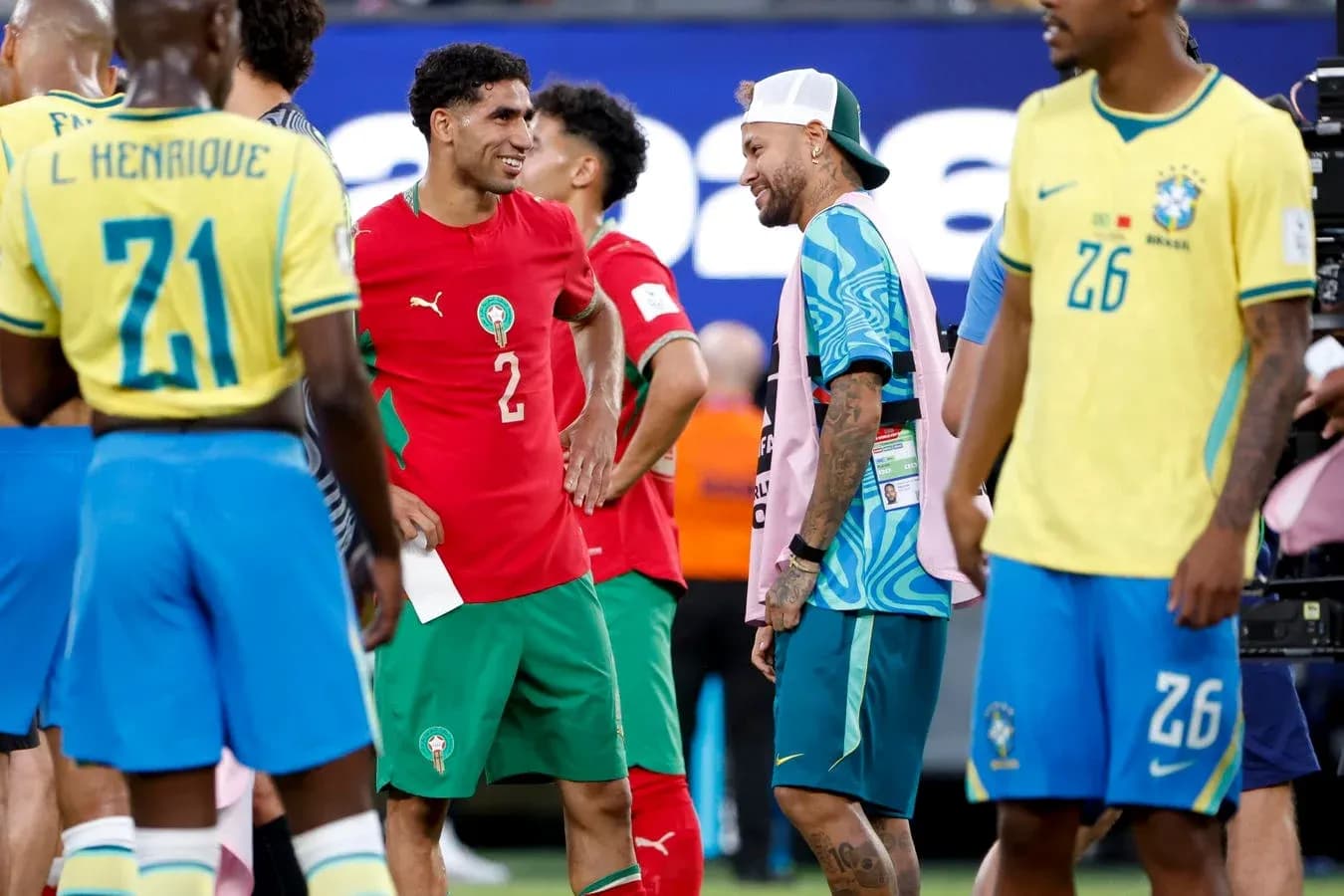
Neymar and Pulisic Face Calf Injuries Ahead of 2026 World Cup
Brazil and the United States walked into this World Cup expecting their star forwards to define tournaments, not medical bulletins. Instead, both Neymar Jr. and Christian Pulisic are fighting the same enemy: a damaged calf muscle at the worst possible time.
Neymar’s World Cup on Hold
For Neymar, this has become a familiar and brutal storyline.
The 34-year-old injured his right calf on May 17 while playing for Santos and has been out for a month. He has inched his way back, training alone on the sideline on Tuesday and joining teammates briefly on Wednesday. The comeback, though, remains stuck in neutral.
He has yet to play a single minute at this 2026 FIFA World Cup and has already been ruled out of Brazil’s next Group C match against Haiti.
Inside the Brazil camp, the calculation is clear: risk him now, or preserve him for when the stakes spike. There is a real possibility Brazil keep him out for the entire group stage in an effort to have him ready for the knockout rounds — assuming they get there.
That assumption no longer feels automatic. Brazil opened with a 1-1 draw against Morocco on Saturday, a result that tightened the group and the mood. Haiti await on Friday, Scotland on June 24. Dropped points in either and the five-time world champions could find themselves staring at an early exit, with their greatest active star watching from the bench.
Neymar has not played for Brazil’s senior national team since October 17, 2023, when he tore the anterior cruciate ligament and meniscus in his left knee during a South American World Cup qualifier against Uruguay. Now, just as that long road back seemed to reach its destination, a fresh muscle problem has stalled him again.
Medical reports indicate Neymar is dealing with a second-degree calf strain — a moderate tear that stops short of a complete rupture. These injuries typically sideline a player for roughly three to six weeks. For a World Cup squeezed into a few intense weeks, that margin is razor-thin.
Pulisic’s Tournament Takes an Early Hit
Across the Atlantic, the U.S. face a different kind of uncertainty.
Christian Pulisic, 27 and very much the heartbeat of the USMNT attack, injured his left calf in training last week. He aggravated it in the World Cup opener, a 4-1 statement win over Paraguay that turned sour for him personally by halftime. The knock forced him off at the interval.
Since then, one question has hovered over the American camp: will he make it for Friday’s Group D clash with Australia?
So far, there is no definitive answer. The severity of Pulisic’s strain has not been publicly classified as mild or moderate, leaving his status in the gray area that coaches and fans dread. He is not ruled out, but he is nowhere near certain.
For a U.S. side that finally looked ruthless in front of goal against Paraguay, the prospect of losing their primary creator and finisher — even briefly — is a jarring twist.
Inside the Injury: Calf Strains and Timelines
Strip away the star names and both players are dealing with a familiar problem in elite football: a calf strain, commonly known as a pulled calf muscle.
The injury occurs when one or more of the calf muscles, or the tendons that anchor them to bone, are overstretched or torn. It is a classic sprinter’s injury, born out of explosive acceleration — the very movement that defines both Neymar and Pulisic at their best.
Calf strains are typically graded in three levels:
- First-degree (mild): Less than five percent of the muscle mass is affected. Players often return in one to three weeks, sometimes even faster in tournament conditions if risk is accepted.
- Second-degree (moderate): A more substantial tear, but not a full rupture. This is what Neymar reportedly has. Recovery usually takes about three to six weeks, roughly two to three times longer than a mild strain.
- Third-degree (severe): A complete tear of the muscle or the muscle-tendon unit. That is a season-shifting, sometimes career-defining injury, often keeping players out for months and occasionally requiring surgery.
Neither Neymar nor Pulisic is believed to have reached that third, catastrophic level. Surgery is not on the table. The treatment, instead, follows a familiar protocol: rest, ice, compression and elevation.
Rest means stopping the very movements that define their games — no sudden sprints, no sharp changes of direction, no explosive take-offs. Ice is applied in short, regular bursts to limit swelling. Compression bandages help control fluid build-up, while elevation keeps the injured area above heart level to reduce inflammation.
None of it sounds dramatic. All of it is essential. Rush this process, and a World Cup strain can quickly turn into a season-long problem.
Fine Margins, Heavy Consequences
The context around the injuries sharpens the stakes.
Brazil, carrying the weight of history and expectation, must decide how much to gamble on Neymar’s timeline. Keep him in reserve for the knockouts and they risk not getting there. Push him early and they risk losing him when it matters most.
The U.S., still building their identity on the global stage, have just delivered a 4-1 win that suggested a new level of maturity. Now they must prove they can sustain that level if their star attacker is reduced to a cameo role — or ruled out entirely — against Australia.
In both camps, the medical staff hold more power than usual. One misjudged sprint in training, one premature return, and the tournament plans of two nations could change in a single stride.
For now, Brazil wait on a calf that refuses to cooperate with the clock, and the U.S. wait on a scan and a decision. Two World Cup campaigns, two fragile muscles, and no guarantees that either Neymar or Pulisic will be fully themselves when the pressure peaks.