.svg&w=384&q=75 "Pitchgist logo")
Messi’s Hamstring Scare Clouds Argentina’s World Cup Bid
Lionel Messi has spent a career making crowds gasp. On Sunday night in Philadelphia, he did it again — this time by walking off.
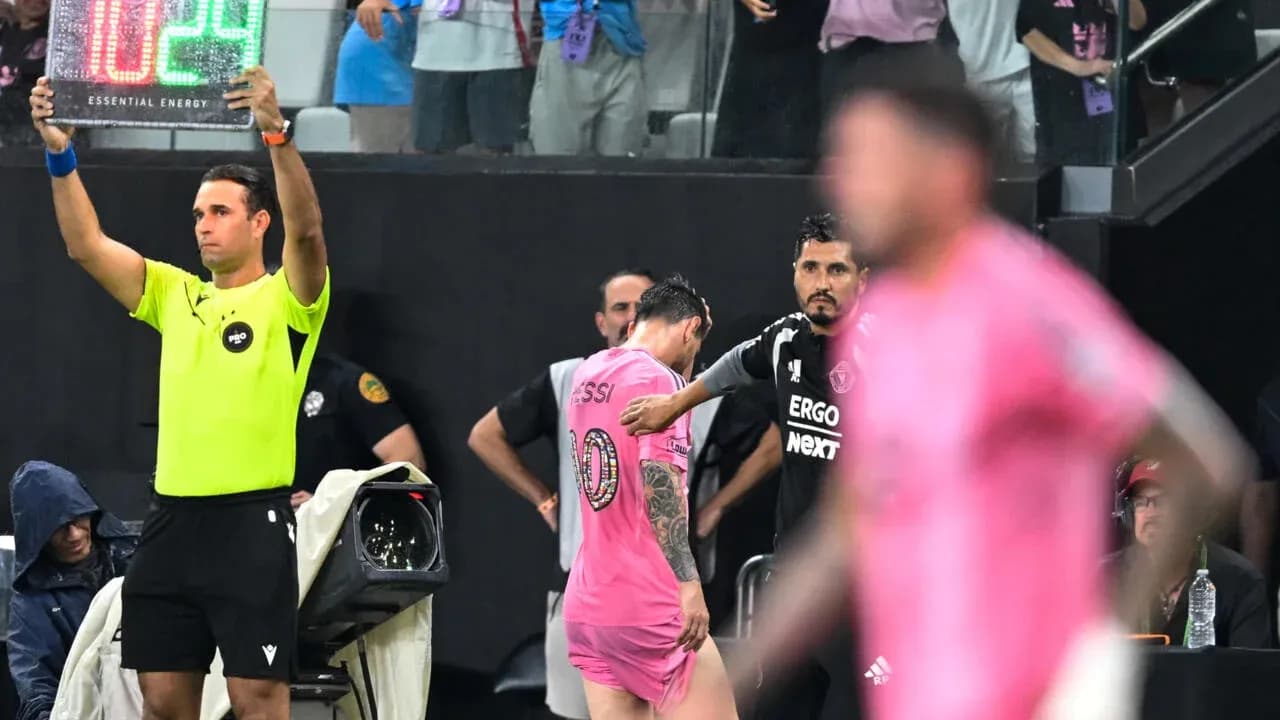
In the 73rd minute of Inter Miami’s wild 6-4 win over Philadelphia, the 38-year-old signalled to the bench and headed straight for the touchline, his night over without any obvious crunching tackle or dramatic fall. Within 24 hours, the club confirmed what everyone feared but half-expected: muscle fatigue in his left hamstring.
For Inter Miami, it is a warning. For Argentina, it is a jolt.
Scaloni cautious, but quietly relieved
National team coach Lionel Scaloni watched the drama unfold from the Argentine federation’s headquarters, eyes fixed on the television, World Cup plans already sketched out in his head.
“Obviously we would have preferred that nothing had happened,” he told DSports on Tuesday. The sentence carried the weight of a nation. Argentina are not just defending champions; they are defending a legacy built around one man who refuses to fade.
Scaloni’s next words revealed as much pragmatism as concern. Messi, he noted, had asked to come off. No bravado. No forcing it. For a coach staring at a June 16 opener against Algeria in Kansas City, that decision mattered as much as any diagnosis.
“Now one has to wait and see how it evolves and above all the new tests they are going to conduct in order to see if it confirms their original diagnosis,” Scaloni added. Translation: no panic, but no guarantees either.
Inter Miami play it safe
Inter Miami, who have learned quickly that their season rises and falls with Messi’s fitness, moved to calm the noise without offering much clarity. In a statement on Monday, the club said: “The timeline for his return to physical activity will depend on his clinical and functional progress.”
In other words, there is no fixed date. No circle on the calendar. Just a day-by-day watch on the most scrutinised hamstring in world football.
Manager Guillermo Hoyos tried to strip away some of the drama after the match. Messi, he explained, was tired. The pitch was heavy. Nobody wanted to take a risk. It sounded simple, almost routine. But nothing about Messi, three months out from a World Cup, is ever routine.
Since arriving in MLS in 2023, he has managed his workload with almost veteran precision. Inter Miami’s staff have regularly excused him from matches in congested stretches, accepting that less can mean more when the real prizes arrive.
Now MLS has paused for the World Cup, co-hosted by the United States, Mexico and Canada. The league’s break should, in theory, hand Messi precious recovery time. Yet the clock ticking in the background is not MLS’s. It is FIFA’s.
A sixth World Cup in the balance
Even at 38, Messi remains Argentina’s undisputed reference point. The man who lifted the trophy in Qatar is now chasing history of a different kind: a record-matching sixth World Cup finals appearance.
He has not formally confirmed he will play. He hardly needs to. Inside the Argentina camp, and across much of the football world, the expectation is that he will return for one last tilt at the tournament that has defined his international story.
He would not be alone on that historic line. Cristiano Ronaldo, his great Portuguese rival, is also on course for a sixth World Cup. Mexican goalkeeper Guillermo Ochoa could join them. Three careers that have spanned eras, converging on the same milestone.
The calendar leaves little margin for error. Argentina open against Algeria on June 16 in Kansas City. Six days later, they face Austria on June 22. They close their Group J campaign against Jordan on June 28. Before that, two warm-up matches in the United States: Honduras on June 6 and Iceland on June 9.
Every date now doubles as a medical checkpoint.
Argentina’s dependence laid bare
Strip away the romance and the numbers are stark. Argentina are world champions, but their football still orbits around Messi’s left foot. He dictates tempo, unlocks tight defences, calms nerves when matches fray. His presence alone bends opponents’ game plans.
So when Inter Miami describe “muscle fatigue” in the left hamstring, it lands like a coded message in Buenos Aires. Fatigue can be managed. Fatigue can also be the line just before something more serious.
Scaloni’s staff will pore over every scan, every report, every sprint in training. The friendlies against Honduras and Iceland were always going to be tune-ups. They may now become a delicate balancing act between rhythm and risk.
Messi has spent the past year pacing himself for moments like this, choosing rest over routine when needed, trusting experience over impulse. On Sunday, he listened to his body and walked off.
Argentina will hope that decision, made in the 73rd minute of an MLS goal-fest, is the one that allows him to walk out in Kansas City on June 16 — and to lead a world champion’s defence with one last, unbroken run.