.svg&w=384&q=75 "Pitchgist logo")
Marcus Rashford's Potential Comeback to Manchester United
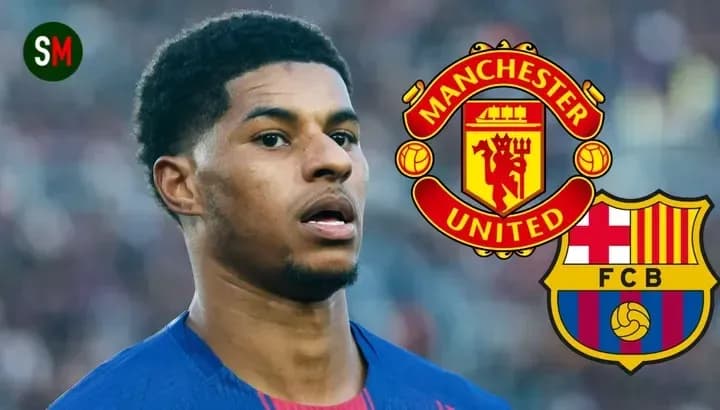
Michael Carrick has quietly cracked the door open for one of the most dramatic comebacks Old Trafford could stage: Marcus Rashford, back in Manchester United red for the 2026-27 season.
It is only a possibility for now, but it is no longer fantasy.
Barcelona step back, window opens
The chain reaction began in Catalonia. Barcelona’s decision to push through a big-money move for Anthony Gordon has shifted the landscape around Rashford’s future. The Spanish club held a £26m clause giving them the option to sign the England international permanently, but that provision expires on June 15. As things stand, there is no sign they will activate it.
So the path to a long-term stay at Camp Nou is narrowing. Rapidly.
Rashford’s loan in Spain has been productive enough – 14 goals and 14 assists in 49 appearances last season – but the Gordon deal has changed priorities. The message is clear: if Barcelona are committing serious money to a new wide forward, they are unlikely to do the same for Rashford this summer.
That hesitation has alerted others. Bayern Munich and Paris Saint-Germain are both credited with interest, heavyweight options for a player who will turn 29 during the 2026-27 campaign. Yet the most intriguing possibility lies back where it all began.
Carrick calls, Rashford listens
According to reports, Carrick has been “in regular contact” with Rashford in recent weeks. This is not a casual check-in. It is a head coach sounding out a player he knows could transform his attack.
Carrick, now in charge at Old Trafford, is understood to have made his stance clear: if Rashford wants to come back, he would be welcomed.
The conversation has not stopped with the manager. Members of United’s leadership group in the dressing room have also been approached. The feeling inside the camp, by all accounts, is positive. They would have him back.
It would be some reunion. Rashford has not played for United since December 2024, his time at the club derailed by a high-profile fallout with former head coach Ruben Amorim. That rift sent him on the road, first to Aston Villa, then to Barcelona, and raised serious doubts over whether he would ever pull on a United shirt again.
A fractured past, a complicated present
The scars from that breakdown have not fully healed. Inside the club’s hierarchy, there is resistance.
Director of football Jason Wilcox and CEO Omar Berrada are both believed to have backed Amorim’s hardline stance at the time, siding with the principle that no player is bigger than the club, regardless of talent or history. Rashford’s behaviour around Old Trafford during that turbulent spell did not go unnoticed, and those in power have long memories.
Any attempt to bring him back into the fold would pit Carrick’s footballing judgment against the institutional position that grew out of that clash. The manager may want him. The board may not.
That tension is what makes this potential return so compelling. It would not be a simple homecoming. It would be a test of authority.
The numbers don’t lie
Strip away the emotion and one thing remains: Rashford delivers.
Across his United career, he has scored 138 goals and provided 79 assists in 426 matches. Those are not the numbers of a fringe figure. They are the numbers of a forward who has carried the team in stretches, who has defined seasons.
His year at Barcelona underlined that there is plenty left in the tank. Fourteen goals, fourteen assists, in a new league, in a new system, under a different kind of pressure. Not world-beating, but more than respectable. More importantly, it showed he can still influence games at the highest level.
United, for their part, are actively looking for a left-sided winger this summer. The profile they seek is no secret: pace, direct running, end product, someone who can stretch the pitch and decide tight games. Rashford, at his best, is almost a tailor-made solution.
He is already under contract at Old Trafford until June 2028. The asset is theirs. The question is whether they are prepared to reinvest trust as well as minutes.
Regrets, redemption, and a decision to make
Those close to the situation suggest Rashford does harbour regrets over how he handled his struggles under Amorim. The form dip, the off-field noise, the confrontation with a manager who demanded absolute discipline – it all fed into a narrative that he had lost his way at his boyhood club.
Yet football is full of second acts. Players fall out with coaches, leave on loan, return to different managers and different dynamics. What once felt impossible suddenly looks plausible when the dugout changes and the tone softens.
Carrick’s presence changes everything. He knows the club, knows the player, and clearly believes there is still a version of Rashford who can make a “real difference” to United’s future. For a manager trying to reshape an attack and re-energise a fanbase, the idea of a rehabilitated local hero is powerful.
There will be resistance in the boardroom. There will be debate over standards, culture, and precedent. But there will also be a cold, footballing question at the heart of it all:
Can Manchester United really afford to turn their back on a proven, homegrown match-winner, just as the door to Barcelona is closing and the clock on his prime is ticking?