.svg&w=384&q=75 "Pitchgist logo")
Marcelo Bielsa: The Coach Who Refuses the Spotlight
Marcelo Bielsa has never cared much for the theatre that surrounds football. He cares about the work. The rest, in his mind, is background noise.
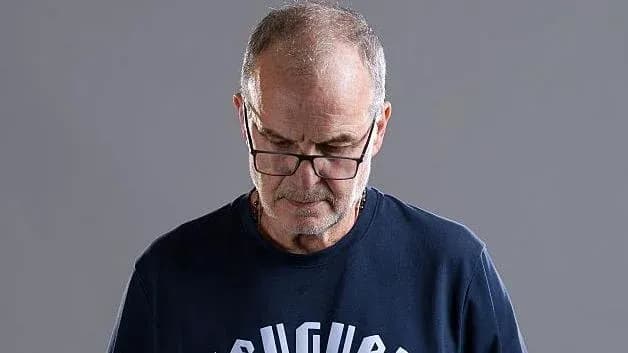
So when Fifa’s official World Cup portraits dropped and Uruguay’s head coach appeared staring downwards, expression fixed, refusing to meet the camera’s gaze, it felt entirely on brand. No smile. No pose. No performance. Just Bielsa, looking like a man dragged away from a tactics screen.
In an age where players and coaches lean into the spotlight, rehearsing their angles and curating their image, the 70-year-old Argentine cut a strikingly different figure. Most embraced their few seconds in front of the lens. Bielsa looked as if he’d rather be dissecting Saudi Arabia’s press or rewinding another training-ground drill.
That image, unsurprisingly, took on a life of its own. Social media debated it. Was it a message? A protest? A deliberate snub of the World Cup circus?
Bielsa wanted no part of that conversation.
Speaking after Uruguay’s 1-1 draw with Saudi Arabia in Miami on Monday, he bristled when asked to explain the photograph and the suggestion that it carried some deeper meaning.
"I don't have to give any explanation, the picture was taken the way it was taken," he said. "I'm not a model."
That was that, as far as he was concerned. Question asked, question dismissed.
Fifa’s official photo shoots have become part of the visual language of their tournaments over the last decade – a staple of previews, graphics and television montages. Coaches usually play along. Some grin, some smirk, some attempt a steely look straight down the barrel of the camera.
Bielsa chose to look away.
One of the most respected coaches of his generation, a man now in charge of his third national team at a World Cup after spells with Argentina and Chile, he has always been more interested in ideas than optics. The man nicknamed 'El Loco' for his intensity and eccentricity has built a career on obsessive preparation, not presentation.
So when the press conference moved on to a different topic, Bielsa did something very Bielsa: he circled back to the one he felt needed closing on his own terms.
"There is a limit in terms of what we need to explain," he said. "If I'm wearing glasses, why am I wearing glasses?
"You look somebody in the eye, why do you do that?
"There is nothing wrong about wearing glasses or looking into somebody's eyes or looking down."
It was a small monologue, but a revealing one. In Bielsa’s world, not everything requires a narrative. Sometimes a photograph is just a photograph. Sometimes a downward glance is simply the way a man chose to stand.
Uruguay move on now to their second group match, a late Sunday kick-off against surprise package Cape Verde (23:00 BST). The focus will shift back to the pitch, to systems and selections, to how quickly this Uruguay side can absorb the demands of a coach who once turned a training ground into a video library and inspired fans at Leeds to join him in litter picking as a lesson in work ethic.
The portrait will linger in the tournament’s visual archive, a still frame of a coach refusing to play the game off the pitch. The real question, as ever with Bielsa, is what his team will look like when the whistle blows.