.svg&w=384&q=75 "Pitchgist logo")
Luka Modric: The Unfinished Legend of Football
Luka Modric looked finished with international football that night in Leipzig. Not because his legs had gone, or his touch had deserted him, but because football can be cruel even to those who have given it everything.
He had dragged Croatia to the brink of the Euro 2024 last 16, scored in the defining game against Italy, and still walked away with nothing but a haunted stare and a trophy he never wanted.
The night that was supposed to be goodbye
At the Red Bull Arena, in what was effectively a knockout tie disguised as a group game, Modric did what Modric always does: he took responsibility.
He stepped up to take the penalty that could tilt Croatia’s tournament back on course. He missed. Then, in the very next breath, he followed in, reacted quickest, and buried the rebound. At 38, in the 55th minute of a high‑stakes game, he still had the speed of thought and the nerve to put his country in front.
Croatia were seconds away from going through. Then came Mattia Zaccagni in the 98th minute, curling Italy into the last 16 and Croatia out of the Euros with almost the final kick. When Modric later posed with the Player of the Match award, the image jarred: a man being honoured for his excellence at the exact moment his dream was collapsing.
This was not how an international career of that magnitude was supposed to end. Everyone knew it. Everyone felt it.
In the press room afterwards, Italian journalist Francesco Repice gave voice to what millions were thinking. He thanked Modric “for everything you have shown, not just tonight but in your career” and asked him, almost pleading, to “never retire”.
Modric smiled, but his answer was laced with realism. He said he’d like to play forever, then admitted there would come a time to hang up his boots. He would carry on, he said, but he didn’t know for how long.
That was then. He is 40 now. And still, somehow, the question remains unanswered.
The boyhood dream that became Milan’s crutch
When Modric left Real Madrid last summer after 13 years of medals, finals and masterpieces, many expected a soft landing. A farewell tour. A slower league. A gentle fade.
Instead, he chose AC Milan, the club he had adored as a child because of Zvonimir Boban. He was clear from the start: this was not nostalgia. He believed he could still shape games at the very top, still influence a giant of European football. He was right.
Italy greeted his arrival with a mix of awe and doubt. A legend, yes, but a late one. How much could he really give? Milan had already signed Samuele Ricci, a 24‑year‑old Italian midfielder seen as part of the club’s future. On paper, they did not need a 39‑going‑on‑40-year-old in the same area of the pitch.
On grass, the hierarchy became obvious. Massimiliano Allegri kept picking Modric. Ricci understood why.
“He’s the strongest player I’ve ever played with,” Ricci said, stunned not just by the Croat’s quality but by the way he trained, the way he spoke, the way he never eased off.
The Italian media watched the same story unfold. Week after week, Modric dictated games with the same economy of touch and clarity of thought that had defined him in Madrid. Journalist Alberto Polverosi joked that if Modric really was 40, science should get involved and clone him.
It didn’t feel like a joke to those facing him.
Kaka, who knows both Milan and Real Madrid at the highest level, called him a “force of nature”. The Brazilian described a mentality that simply refuses to accept the usual arc of a footballer’s career. Modric, he said, still wants to teach, still rallies his team‑mates, still fights for every ball. Energy. Personality. Technique. The full package, just in a body that should, by all logic, be slowing down.
His impact went beyond matchdays. Training standards rose. Younger players watched and learned. Italian football, Kaka argued, benefitted from his presence as much as Milan did.
Allegri, unsurprisingly, fell under his spell. Their bond grew so strong that talk emerged of Modric joining his staff as an assistant once he retired. It sounded plausible. It still might happen one day.
But there was a downside. Milan leaned on him too heavily.
When one fracture broke a season
The moment Modric cracked his cheekbone in a 0-0 draw with Juventus on April 26, Milan’s season shifted. He could not start any of the final four league games. Without their metronome, their reference point, they unravelled.
Three defeats from those four matches dragged the Rossoneri from third to fifth. A Champions League place slipped through their fingers. For a club of Milan’s stature, that kind of fall has consequences.
Allegri paid with his job. Missing out on the top four proved fatal for a coach who had built so much of his game plan around a 40‑year‑old midfielder. Modric watched on, masked, patched up, unable to influence the run‑in in the way he wanted.
Now, his future at San Siro hangs in the balance. A new coach will arrive with new ideas. Milan must decide whether to build another season around a player who has defied time, or whether to move on before they are forced to.
Madrid wait in the background. The Bernabeu, where he became one of the defining players of his generation, is ready to welcome him back in some capacity if he does finally call time on his playing days this summer. The role is unclear, the affection is not.
Modric, as always, keeps his cards close. He talks warmly about Milan, about the city, about the challenge. He refuses to commit publicly to anything beyond the next game.
One last dance in a mask
What does seem certain is that this will be his last major tournament with Croatia. That alone gives this World Cup a different weight. It is the final act of a player who carried a nation to a World Cup final and a World Cup semi-final, who turned a small country into a permanent fixture on the biggest stage.
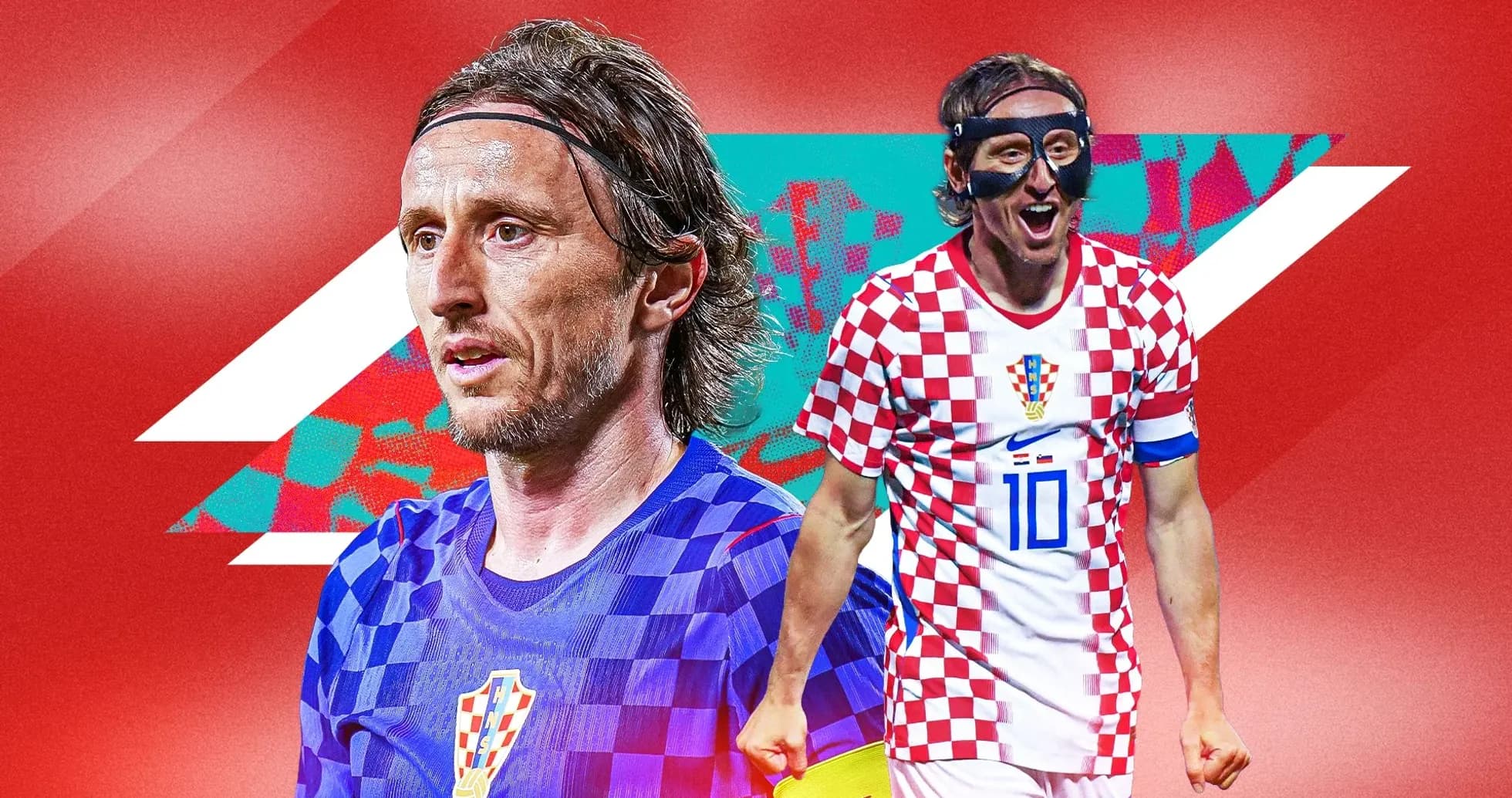
He will do it this time with a protective mask strapped to his face, a constant reminder of that fractured cheekbone and of a body that has taken more than its share of punishment. The conditions are expected to be demanding. The schedule will not be kind to a 40‑year‑old.
Then again, Modric has built a career on ignoring what is supposed to be possible.
“I never really cared what anyone else said,” he remarked recently. “It only further motivated me.”
That line sums up the man. Told he was too small. Told he was too slight. Told he was too old. He turned every doubt into fuel.
So who dares write him off now, masked and 40, still threading passes into impossible spaces and dictating the tempo of games that should have outgrown him years ago?
Not in England. They have seen this film before, from Kiev to Moscow to countless Champions League nights. They know how it ends when you underestimate Luka Modric.