.svg&w=384&q=75 "Pitchgist logo")
Jürgen Klopp Addresses Nagelsmann Controversy as Germany's New Head Coach
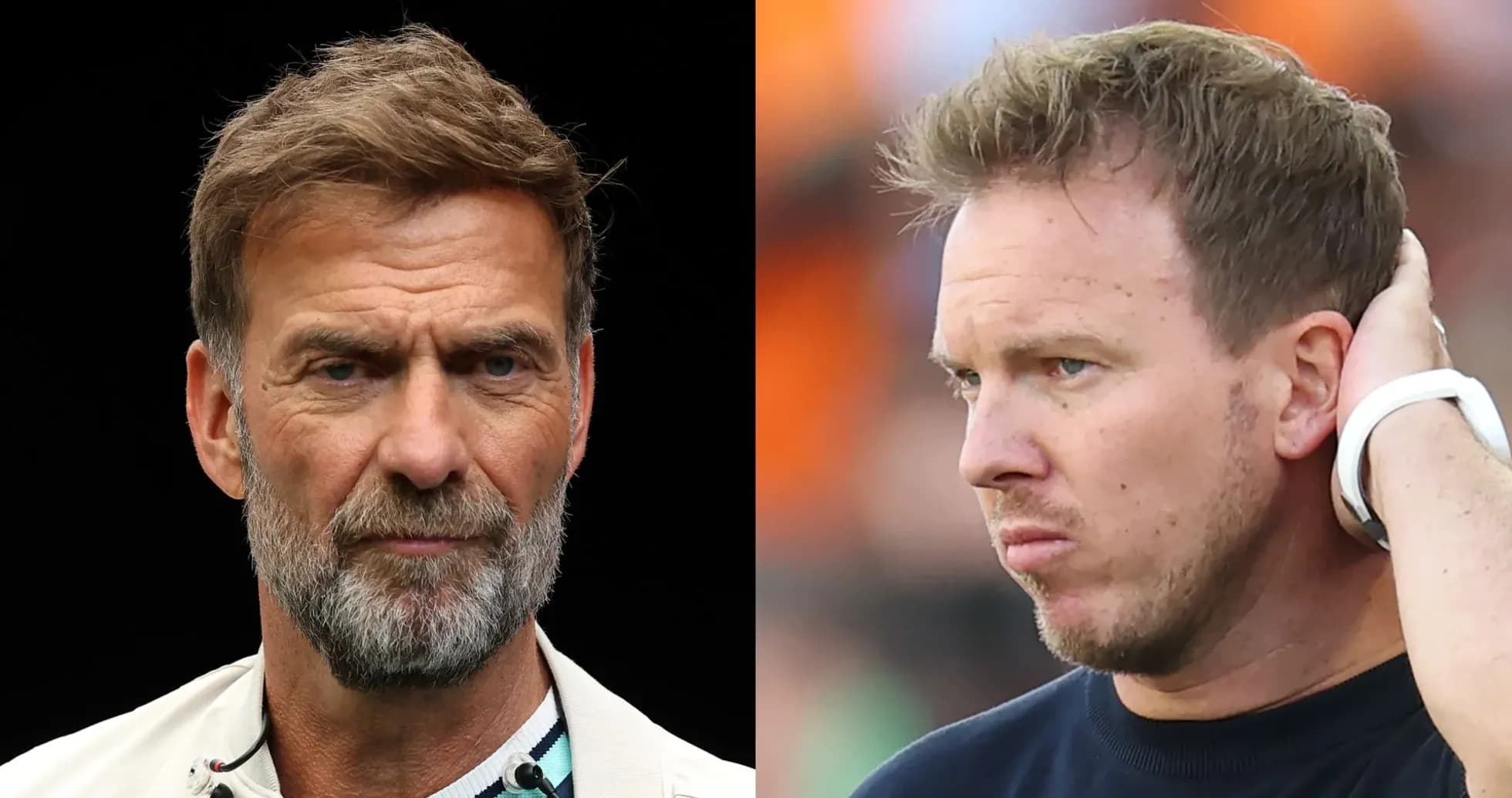
Jürgen Klopp did not try to dodge the subject. Before a ball has even been kicked in his reign as Germany head coach, he moved to clear the air over Julian Nagelsmann and the infamous “still” remark that dogged him through the World Cup.
“There has been no contact since the World Cup,” Klopp said at his introductory press conference, as quoted by Sky Sport. “I respect Julian Nagelsmann enormously. The day with the ‘still’ comment was one of the worst days of my life. I could have done without it, but it happened now. I wish Julian nothing but the best.”
The word that wouldn’t go away
The storm began during Germany’s opening game against Curacao, when Klopp, working as a TV pundit, let a single word turn into a national talking point. Live on German television, he remarked: “Luckily, Julian Nagelsmann is still picking the team.”
That “still” detonated. Back home, it was seized upon as a loaded hint about Nagelsmann’s job security at a time when the national team’s direction was already under scrutiny.
Klopp knew instantly he had walked into trouble.
“I’ve already found the most hated word of the year: ‘Still’,” he admitted later. “I could have punched myself in the face for that, but it was already too late and I was on TV. It just slipped out so casually and has absolutely no relevance.”
He did not leave it there. Klopp apologised directly to Nagelsmann on air, turning the studio into an impromptu confessional.
“There’s one more thing I have to say… we still need to make time for this,” he told him. “We’re also informally part of the team, we’re absolutely on your side. What I’ve realized is: I’ll be 59 the day after tomorrow and I’m still an idiot. We are completely on your side, whatever you do. Nothing was intended to come of it to disrupt the process here.”
It was raw, unfiltered Klopp: self-deprecating, emotional, but also acutely aware of the weight his words carry in German football.
From pundit’s chair to national dugout
Now the conversation has shifted. The man who once sat in a studio critiquing Germany must rebuild it.
Klopp’s first task is not tactical innovation or sweeping structural reform. It is human. He wants relationships before revolutions.
“I don’t know what my daily routine will be like yet; I’m almost glad it doesn’t start tomorrow,” he admitted. He will base himself in Wiesbaden and work out of Frankfurt, the logistical heart of the national setup. That is the geography. The real map, in his mind, is where his players are.
“I’ll watch games in every country our players are in,” he said. “I think it’s more important to have more contact with the players than just watching them play. I’ll try to get in touch with the players quickly.”
The message is clear: this will be a hands-on national coach, not a distant selector who appears only in international breaks.
Rebuilding after a fall
Germany’s exit in the round of 32 at the 2026 World Cup still hangs over the national team like a fog. For a country that measures itself in trophies and semi-finals, that early departure was not just a disappointment; it was a jolt to the system.
Klopp steps into that void with a simple brief and a complex reality. His mandate is to drag Germany back among the world’s elite, to restore a sense of inevitability about their presence at the sharp end of major tournaments.
The apology to Nagelsmann, the reflection on one careless word, might feel like a sideshow. It is not. It underlines how every gesture, every sentence, every nuance around the national team matters when expectations are this high and wounds are still fresh.
Klopp has already found his “most hated word of the year.” Germany now waits to see which words – and which results – will define his era.