.svg&w=384&q=75 "Pitchgist logo")
Iran's World Cup Journey Amidst Tension and Protest
On Monday night in Los Angeles, Iran will walk into a World Cup like no other – a football match framed by a ceasefire, a divided diaspora and a sense that the sport is fighting for space amid geopolitics.
Until this week, the host nation, the United States, was at war with Iran. An agreement announced on Sunday to halt hostilities and reopen the Strait of Hormuz has cooled immediate fears, but it has not cleared the air. The tension still hangs, thick and unavoidable.
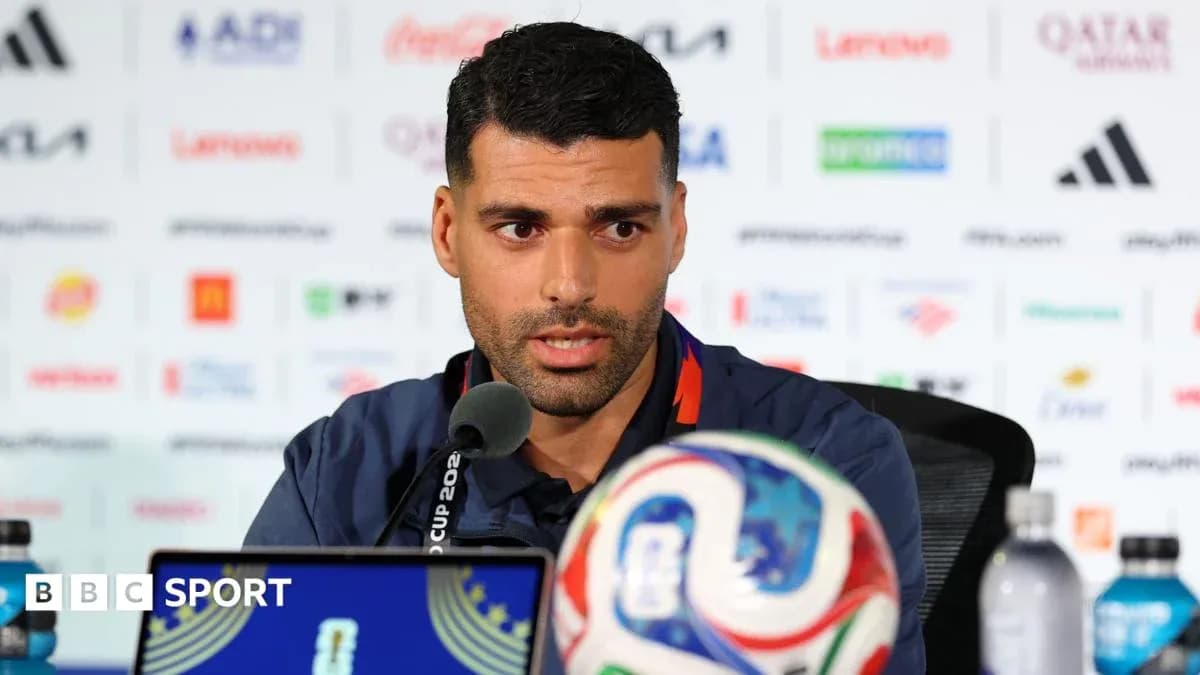
Mehdi Taremi feels it.
“This kind of tension undermines the joy of the World Cup,” the striker said. “I felt the tension from the first moment we arrived. The tension started even before we got here.”
He is not exaggerating. Iran’s World Cup has been shaped before a ball is struck.
A camp on the move
For months, Iran did not know where it would prepare. The team originally based itself in Tucson, Arizona, only to uproot and shift south to Tijuana, on the Mexican border.
Visas. Security. A worsening political climate around their presence on US soil. Each issue pushed them further from a normal tournament rhythm.
Head coach Amir Ghalenoei did not hide his frustration when he spoke to the BBC.
“Without any doubt, this kind of behaviour has impacted the spirit of football,” he said. “Football is supposed to bring nations and cultures together. It is about bringing joy. These conditions have affected our focus, but I have tried to make sure the players concentrate on strategy and performance.”
They arrived late. They have had little time to adjust. Training plans were rewritten on the fly.
“But I know how committed these players are to performing,” Ghalenoei added.
Commitment will be tested at SoFi Stadium, where Iran open their campaign against New Zealand in the early hours of Tuesday morning UK time. The football itself risks feeling like a subplot.
‘Tehrangeles’ prepares to roar – and protest
Los Angeles is home to one of the largest Iranian communities in the world. “Tehrangeles” is the nickname – a line that drew smiles from both Taremi and Ghalenoei when it came up in the pre-match news conference.
Those smiles will meet a complex reality.
Many Iranian-Americans will head to SoFi not to support the team in a conventional sense, but to demonstrate. For them, this World Cup is a stage – not just for goals, but for grievance.
Central to their anger is a decision by Fifa: the ban on the pre-revolutionary Lion and Sun flag, a potent emblem for many Iranians abroad. It is a symbol of resistance for some, of identity for others. Its absence will be loudly noted.
“You don’t come to Los Angeles and tell us we can’t fly the Lion and Sun flag,” said activist Arezo Rashidian, who is helping organise protests outside the stadium. “This is the largest Iranian community outside Iran. Many of us came here after the revolution. We’re opposing Fifa’s ban and standing in solidarity with the people of Iran.”
For large parts of the diaspora, the national team does not stand apart from the state. It stands in its shadow.
“Some see the squad as an extension of the Islamic Republic,” Rashidian said. “It’s unfortunate that the regime turns athletes into mouthpieces. We want athletes to remain athletes.”
Yet even in that criticism, there is nuance. She will still go to the match. So will many others who share her views.
“We understand the pressure they’re under,” she said. “We’ll carry our colours. We’ll cheer for Iran – the country – held captive by the Islamic Republic.”
So the stands will be full of Iranian flags, old and new, of chants and counter-chants, of support and dissent. A fan base split, but still in the same arena.
A team caught in the crossfire
Inside that arena, Iran’s players insist they are trying to narrow their focus back to the game.
“As players of the national team, we play for every single Iranian, whether in the diaspora or in Iran,” Taremi said. “In every country people have different opinions. We are here to unite people and bring joy. Everyone is entitled to their opinion. We don’t get involved in politics.”
That is the ideal. It is also, in this context, almost impossible.
Investigative football journalist Samindra Kunti captured the bind.
“There is no winning for Iran’s team,” he said. “Given the circumstances, the political pressure, the location of the matches and the diaspora in Los Angeles, they’re under enormous pressure. It’s impossible to avoid the politics. Everything becomes a reminder of their situation.”
Pressure from home, where the regime watches. Pressure from the host nation, where the relationship is defined by decades of hostility. Pressure from a diaspora that wants to be heard and refuses to be quiet.
All of it converges on a squad that, in theory, is here to think about New Zealand’s back line and set-piece routines.
On Monday in Los Angeles, Iran will walk out to a World Cup anthem. They will hear boos, cheers, and slogans that have nothing to do with football. The question is no longer whether politics will enter the stadium.
It is how this team will play with the weight of a nation – and a fractured global community – on their shoulders.