.svg&w=384&q=75 "Pitchgist logo")
Henrik Larsson: The Celtic Legend Who Redefined a Club
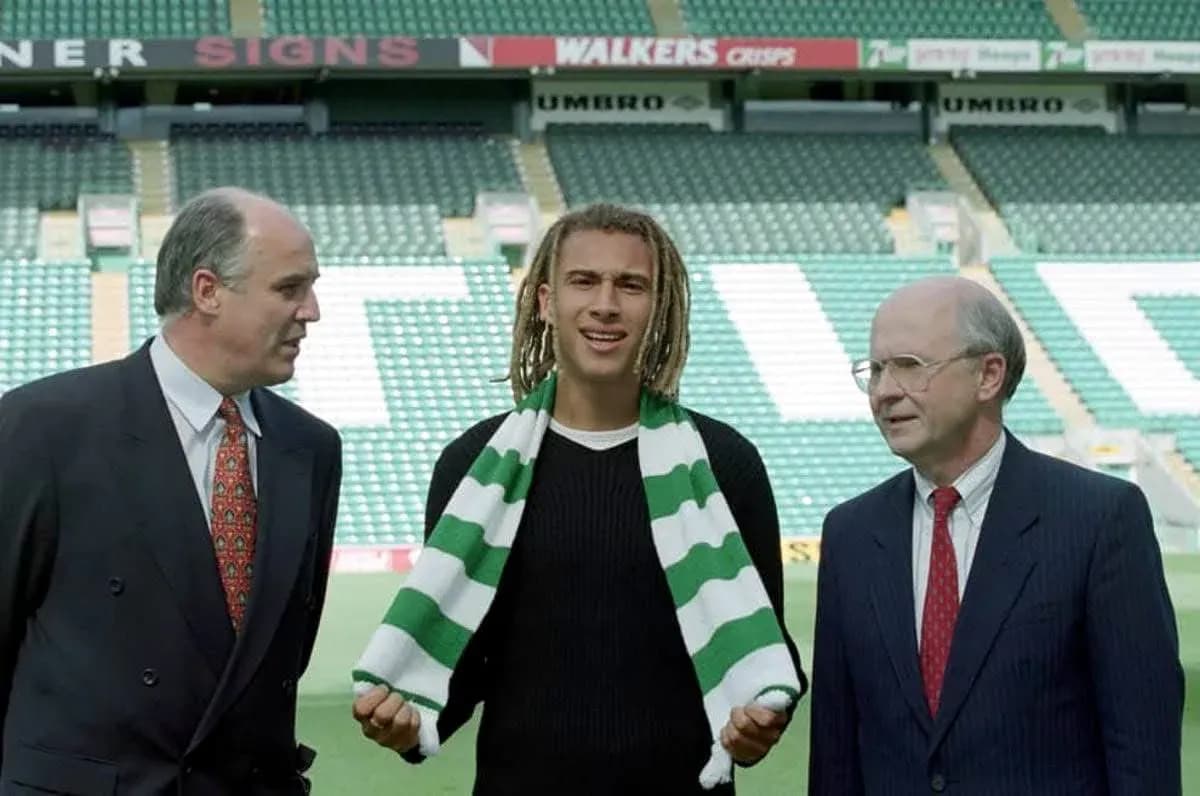
On a grey July day in 1997, a slight, dreadlocked Swede in a Hoops top and denim walked out onto the Celtic Park turf. No fan inside that old bowl could have known it, but Celtic were welcoming a man who would redraw the club’s modern history.
Henrik Larsson had arrived.
A bargain that changed everything
Celtic paid just £650,000 to Feyenoord for him, a fee that looks almost comical now. Wim Jansen, freshly installed as Celtic manager and the man who had previously taken Larsson to Rotterdam, knew there was a contractual opportunity and moved quickly. It was shrewd, bordering on visionary.
The start was anything but. Larsson’s Celtic debut is often remembered for the wrong reason: his misplaced pass at Easter Road that contributed to an opening-day defeat to Hibernian. It was a stuttering introduction, the kind that can swallow lesser players whole in Glasgow’s unforgiving glare.
He didn’t flinch. Week by week, game by game, the new No.7 began to stitch himself into the fabric of the club. The dreadlocks, the movement, the cold precision in front of goal – the Celtic support didn’t so much warm to him as fall, collectively, head over heels.
Stopping “the ten” and becoming the complete striker
By the end of that first season, Larsson was no longer just a promising signing. He was central to a revolution. Celtic lifted the League Cup and, more importantly, won their first league title in a decade, halting Rangers’ charge towards ten in a row. Larsson’s influence on that campaign was unmistakable; he had become the heartbeat of a team rediscovering itself.
He kicked on again. Under Dr Jozef Vengloš, Larsson’s game reached a new level. He scored 38 goals in his second season, the numbers of a striker operating at full command of his craft. He pressed, linked play, finished with either foot and his head. Celtic didn’t just have a goalscorer. They had the complete centre-forward.
Breaking, then rebuilding
Then came Lyon. A horrific leg break threatened everything. The images from that night in France still jar – a season derailed, a star shattered on the turf. For John Barnes, the fallout from losing his talisman would play a major role in a short, turbulent spell in charge.
Larsson’s response defined him. He did not simply return; he came back better. Stronger. Sharper. Mentally, he seemed reinforced by the ordeal. The injury that might have blunted another career instead hardened his resolve and deepened his bond with the Celtic crowd, who saw in him a resilience that matched their own sense of defiance.
O’Neill, Sutton and a domestic clean sweep
When Martin O’Neill walked through the door, Larsson was ready to ascend again. Paired with Chris Sutton, he found a perfect foil. The partnership bullied defences, at home and abroad, with Larsson the ruthless finisher and roaming genius at its core.
In O’Neill’s first season, Celtic swept the domestic board, claiming a historic treble – the club’s first in 32 years. Larsson scored an astonishing 53 goals in that campaign alone, a figure that belongs to the realm of fantasy for most forwards. These weren’t padded numbers either. They were title-shaping, trophy-winning goals, the work of a player operating at a level Scottish football had rarely seen.
Europe takes notice
The years that followed proved he was no flat-track bully confined to domestic dominance. Celtic’s resurgence in Europe carried Larsson’s fingerprints everywhere. His goals drove the club all the way to the UEFA Cup final, where he rose again on the biggest stage.
Against Porto in Seville, with the world watching, Larsson delivered two world-class finishes in a breathless extra-time defeat. The result stung, but his performance confirmed what Celtic fans already knew: this was a forward who belonged among the elite.
A legacy written in goals
By the time he left Celtic in 2004, Larsson’s numbers told one story, his aura another. The statistics are stark enough: 242 goals in 313 appearances, the third-highest scorer in the club’s unbroken history. Those figures alone would secure his place in the pantheon.
Yet it was the manner of those goals, the moments they framed, that turned him from hero to legend. Title deciders. Cup finals. Derby days when the noise at Celtic Park felt like it might rip the roof clean off. Larsson was there, again and again, calm in the chaos.
Supporters of an older generation will always, and rightly, invoke Jimmy Johnstone and the Lisbon Lions. Others will point to Kenny Dalglish, another king who went on to be crowned Liverpool’s greatest. Those names are sacred in the east end of Glasgow.
But for most Celtic fans who grew up in the 1990s and beyond, one figure stands alone. Henrik Larsson is their standard. Their benchmark. Their King of Kings.
Twenty-nine years on from that unassuming walk across the Celtic Park pitch, the image of the young Swede in Hoops and denims feels almost surreal. Celtic thought they were unveiling a clever signing.
They were, in truth, unveiling an era.