.svg&w=384&q=75 "Pitchgist logo")
Harry Kane: Bayern Munich's Best Transfer Ever
Uli Hoeness has never been shy with a superlative, so when he walked out of the DFB-Pokal final and declared Harry Kane “the best transfer Bayern have ever made”, it sounded like another flourish from a man who speaks in exclamation marks. A month on, with the confetti swept away and the emotion cooled, the line has hardened into something else inside the club.
“He absolutely is the best we’ve had,” says one Bayern figure, matter-of-factly.
Kane has not so much silenced doubt as rendered it irrelevant. The striker who left Euro 2024 still ringless, his legs supposedly heavy, his reputation abroad tinged with suspicion, has become the game’s most emphatic rebuttal to the idea of a fading force. For years his Golden Boot at Russia 2018 was picked apart in certain corners – “top goalscorer despite not having scored from the quarter-finals on,” sniffed Le Journal du Dimanche – as if the most prolific English forward of his generation were somehow a flat-track phenomenon.
That caricature has disintegrated in Bavaria.
From €100m risk to Bayern’s beating heart
When Bayern crossed the €100m line to sign Kane, they entered territory they had always warned others about. This was supposed to be the sort of “crazy risk” they left to the Premier League and the Spanish giants. Hoeness admitted as much. Yet the return has been brutal in its clarity.
Kane has paid it back. All of it. In goals, in standards, in the way he has walked into one of football’s most political dressing rooms and quietly taken ownership of it.
The hat-trick in the 3-0 DFB-Pokal final win merely gave the story a neat headline. The real shift lies in the everyday detail. Hoeness delights in recounting how Kane drifts towards younger players, checks on them, puts an arm around those struggling with form or expectation. The language barrier has never really bitten. Kane is still taking German lessons – it is written into his contract – but Bayern’s core speak English and Vincent Kompany runs the dressing room in it.
What cuts through, though, is not vocabulary but example. Hoeness, a World Cup winner in 1974 and no stranger to hard defending, marvels at the punishment Kane absorbs in the Bundesliga and the absence of theatrics in response. “I think you’d have to cut off his head or his arm to stop him playing,” he says, half-joking, half-admiring.
Inside the club, staff talk about his presence in the same breath as Manuel Neuer and Thomas Müller in their pomp. Those two are Bayern lifers, the embodiment of “Mia san Mia”. Kane arrived as an outsider and has bent the room in his direction.
The Englishman who actually stayed
When the Kane family initially delayed moving fully to Munich, the old stereotype stirred: the British star abroad who never really leaves home. Ian Rush never actually uttered the line about Juventus being “like living in a foreign country”, but the myth stuck for a reason.
Kane has shredded that, too. He and his wife, Kate, have settled in a rural property once owned by Lucas Hernández, near the affluent suburb of Grünwald. Speak to Kane about his life there and the picture is not of a reluctant exile but of a family leaning into Bavaria. Ivy, Vivienne, Louis and Henry have taken to skiing in the winter. Kane, contractually barred from hurtling down a mountain, still joins the Alpine trips to Garmisch, content to watch rather than carve.
His appearance at a fan day in Kirchweidach, a village of barely 2,000 near the Austrian border, underlined the point. Here was one of the world’s most recognisable footballers seasoning soup at a local festival, as Bavarian wedding couples traditionally do, symbolically binding himself to the region. He played a rustic form of skittles using litre beer steins instead of bowling balls. Kane later called it “a bit crazy” with typical English understatement, but he threw himself into it. Bayern noticed.
A scorer reborn – and then some
On the pitch, even Bayern’s optimists have been surprised by the breadth of Kane’s dominance. They expected a world-class No 9. They have ended up with something closer to the Messi-Ronaldo era’s statistical echo, but with the work ethic of a deep-lying playmaker grafted on.
Since breaking his personal trophy drought with the Bundesliga title in 2025, Kane has only accelerated. Another league crown followed, then the DFB-Pokal. At 32, he looks leaner, sharper, more explosive in short spaces than at any stage of his Tottenham years.
The catalogue of goals is already long enough to fuel arguments in bars from Munich to London. The strike against Atalanta in the Champions League stands out: a drag-back and swivel that erased two defenders in a breath, followed by a clean, ruthless finish. Yet it was his second goal in the DFB-Pokal final that captured his evolution best. A fearsome curling effort from outside the box crashed off the bar. When the rebound dropped, Kane didn’t snatch. He killed it, executed another drag-back and turn to carve out space, then finished as if he had never been denied in the first place.
That blend of audacity and composure has become his signature.
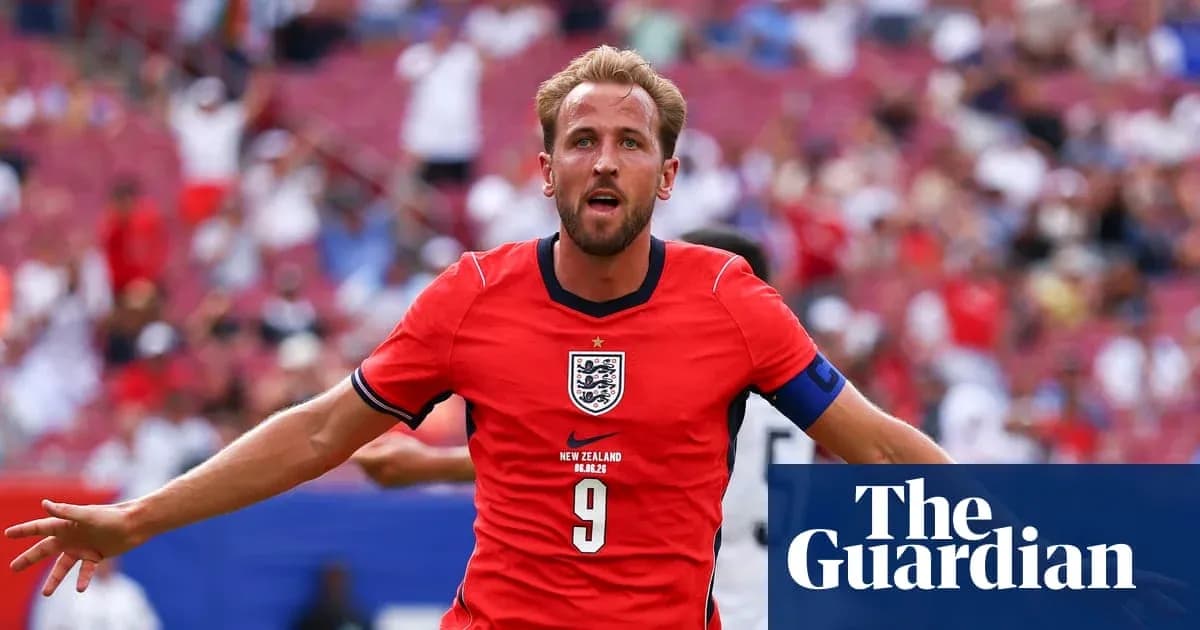
The numbers are absurd. With 61 goals for Bayern, he is the only player in Europe’s major leagues matching the monstrous scoring output of Messi and Ronaldo in their prime years, with only Erling Haaland even in the same postcode. Ronaldo once hit 66 in a season without a summer tournament. Messi went to 73. After the game against New Zealand in Tampa, Kane stands on 67.
And he does not simply wait for service. At Bayern he often drops into what is effectively a No 6 position when the team are out of possession, collecting the ball, dictating tempo, spraying passes that would not shame a deep-lying playmaker. His assist for Luis Díaz in the Champions League semi-final first leg against Paris Saint-Germain – a raking, precise delivery – showcased a passing range that rivals his finishing. Thomas Tuchel’s blueprint, now being adapted for the World Cup, leans heavily on that dual threat.
From Spurs doubts to Ballon d’Or talk
Kane was never truly in the Ballon d’Or conversation at Tottenham. Too few trophies, too many early exits, too much of a sense that he was dragging a team that could not quite follow. Now, with regular deep runs in the Champions League and silverware finally on the shelf, his name sits naturally among the contenders. How high he climbs will hinge on what happens at this World Cup.
If you zoom out, his career reads like a slow-burning epic. The tortoise in a sport that worships hares.
Spurs youth coaches remember an unremarkable teenager by elite standards: a touch heavy, not quick, technically tidy rather than dazzling. “You would never have thought that he would be what he is now,” one recalls. The turning point came at 14, when a growth spurt coincided with a marked jump in technique. His ball striking, in particular, began to separate him. Instructions did not need repeating. Tell him once – about gym work, finishing drills, positional tweaks – and it stuck.
The early senior years were far from glamorous. A miserable loan at Norwich brought an awful, high-profile miss on debut against West Ham and a half-time substitution in an FA Cup defeat to non-league Luton. Between those low points he was dropped to the under-21s, where he was not even allowed to take penalties. He was not considered good enough.
At Leicester, on another loan, he started on the bench alongside Jamie Vardy for both legs of their 2013 Championship playoff semi-final against Watford. The future England captain and the future Premier League record-breaker, watching from the sidelines.
Even at Spurs, the belief was not instant. Mauricio Pochettino did not initially rate Kane after an underwhelming pre-season in 2014. The body-fat tests were brutal. Kane came out highest in the squad, around 18%. He went to see his manager. Pochettino did not sugarcoat it. He told Kane he was not working hard enough, that his conditioning was not where it needed to be. Then he added a line that, at the time, sounded like motivational exaggeration: “You can be the best striker in the world.”
Back then, like Hoeness’s recent claim, it felt like hyperbole designed to light a fire. A manager’s trick. A president’s flourish.
Now, watching Kane stride through Munich, trophies finally in his wake and a World Cup looming as the last great test, those words no longer sound inflated. They sound like a prediction that the rest of football is only just catching up with.