.svg&w=384&q=75 "Pitchgist logo")
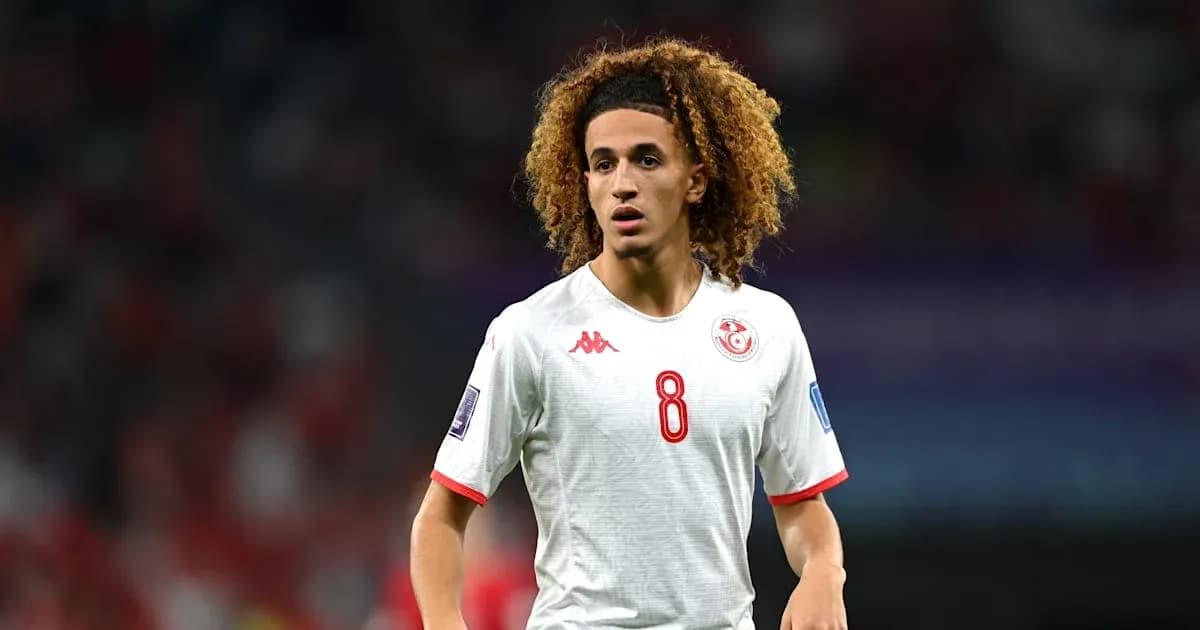
Hannibal Mejbri: From La Banane to the World Cup
The Eagles of Carthage have carried many gifted players, but few arrive with a name as heavy as Hannibal Mejbri’s.
His nickname, his story, his very first name all point back to an ancient commander who once marched war elephants over the Alps and stared down Rome from just beyond its walls. Two thousand years on, another Hannibal is trying to lead Tunisia over their own mountain – the group stage of the 2026 FIFA World Cup – and into territory the country has never reached.
He is only 23. He already looks like the heartbeat of a side desperate to rewrite its history.
From La Banane to the world
To understand Mejbri, you start in Paris’ 20th arrondissement. Not the postcard city, but the crowded, working-class streets where North and West Africa meet in concrete courtyards and tight stairwells. Tunisians, Algerians, Moroccans, Senegalese, Malians – a neighbourhood where accents mix and the game is the common tongue.
At the centre of it sits a curved block of flats the locals call La Banane. It is unglamorous, unfiltered, and for a skinny kid with a wild mane of blonde curls, it was home.
"Instead of going straight up to my house, I used to stay out and play football until night fell," Mejbri recalls in the series World at Their Feet, which tracks emerging talent on the road to the 2026 World Cup. No academies, no personal trainers, no carefully plotted path. Just a boy, a ball, and friends who saw him every day.
"I was a normal boy, there was no master plan," he says. "I had my friends, I was focused on my life as a kid."
Normal, but impossible to miss. Childhood friend Hubert Mbuyi remembers the first impression.
"He had a unique style, with big hair, big blonde hair. So everyone knew him and had a lot of expectations for him," Mbuyi says. On those crowded pitches, one detail never changed: "Where you could find a pitch and a ball, you will find Hannibal."
That was La Banane’s secret. Between the tower blocks and the late sunsets, a future international midfielder was being sharpened, one small-sided game at a time.
Paris, Monaco, Manchester: a fast climb
The talent didn’t stay hidden for long. At six, Mejbri joined Paris FC’s academy, the first formal step for a kid who still preferred the street game. He stayed almost seven years, learning structure and discipline, then moved briefly to Boulogne-Billancourt.
By 2018, the wider world had noticed. Monaco, fresh from a period of producing and polishing elite young talent, paid €1 million to bring the 15-year-old into their academy. For a boy from La Banane, the change was striking.
"I could feel the richness of Monaco," he remembers. The yachts, the spotless training pitches, the sense of having walked into someone else’s dream. "So yeah, it was a little bit of a shift, a little dream, and I learned a lot there."
Not everything fit. The experience was far from perfect, but the raw ability was obvious. Scouts from Europe’s biggest clubs circled: Bayern Munich, Paris Saint-Germain, Barcelona. All made their interest known.
Mejbri chose a different path. In August 2019, at just 16, he signed for Manchester United, a club that still sells itself to young players on the promise of Old Trafford lights and a tradition of trusting youth.
The rise was sharp. By 2021, he had made his Premier League debut. By September 2023, he had his first top-flight goal for United, a fierce strike in a 3–1 home defeat to Brighton. The scoreline made the celebration unusual, but the emotion was real.
"I still get chills," he says. "I don't know why I started to celebrate when we were losing 3–0, and you can see in my celebration that I had a certain rage in me and that I let go of everything when I scored."
It was a moment that summed him up: intensity, defiance, a refusal to let the occasion pass quietly, even when the night was going against him.
A national choice made with the heart
On the international stage, Mejbri had options. He represented France at under-16 and under-17 level, a natural step for a boy born and raised in Paris. Yet the pull of his parents’ homeland never loosened.
In 2021, Tunisia called. He didn’t hesitate.
"I joined Tunisia because I chose with my heart," he explains. "Even though I lived in France, it doesn't take away the love I have for France. But I find that the love I have for Tunisia is greater."
That decision has already defined his career. He has accumulated 44 caps, become a central figure in the Eagles of Carthage midfield, and twice been named African Revelation of the Year at the Africa d'Or awards. Each time he pulls on the red shirt, another image flashes in his mind.
"When I represent my country, I also represent my neighbourhood," he says. "Because I know that I will represent them, and so all of that, it's a bit related to pride."
For the people back at La Banane, that bond is everything. They see their own story in his. Mbuyi feels it every time Tunisia play.
"All Tunisians are proud of him," he says, "because in the end, he's a kid from the neighbourhood. When he plays matches, everyone focuses on the match. We're all watching Hannibal's hair on the pitch. We try to spot him every time."
The famous curls have become a beacon. In living rooms, cafés and crowded courtyards, eyes scan the screen, searching for that shock of blonde in a sea of red and white.
Giving back to La Banane
Success has not pulled Mejbri away from his roots. Every summer, he goes back to La Banane and turns the courtyard pitches into a festival. He organises a football tournament, brings the community together, and arms the next generation with something he never had: a role model from their own staircase.
Last year, he handed out around 100 shirts. Not symbolic gestures, but real, wearable proof that someone from their block made it. Mbuyi only has to look around to see the impact.
"You can just walk around here and find two or three people wearing his shirt," he says.
The cycle continues. Kids lace up their boots and dream a little bigger. Parents point at the television when Tunisia line up and say, "He grew up here." The gap between La Banane and the World Cup suddenly feels smaller.
"Hannibal is a great example of what the people look for in this area," Mbuyi adds. "Because of him, the young kids can dream."
Now the dreams have shifted again. The boy from the curved block in Paris is leading the Eagles of Carthage into a World Cup where Tunisia want more than brave exits and honourable draws. Hannibal Barca once came within sight of Rome and stalled. Hannibal Mejbri stands at his own mountain, eyes fixed on the other side.
The question is no longer whether he belongs on this stage. It is how far he can drag a nation – and a neighbourhood – with him.