.svg&w=384&q=75 "Pitchgist logo")
Graham Potter's Journey from Chelsea to Sweden's World Cup
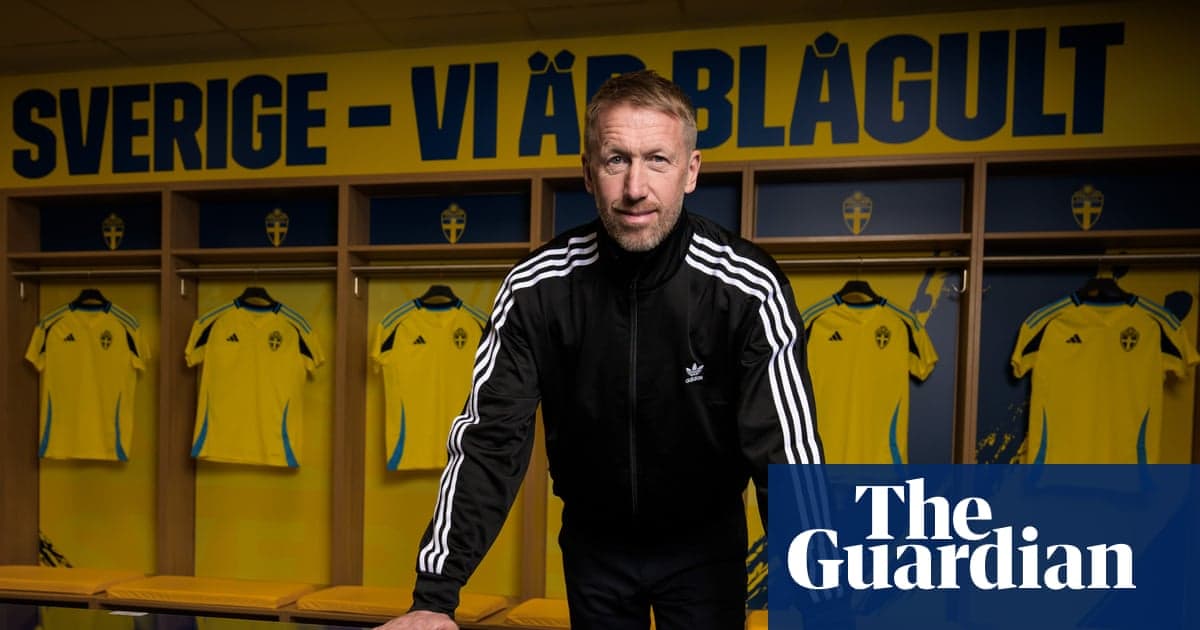
Graham Potter doesn’t flinch from the wreckage. He walks towards it.
“You’ve got to face the bad stuff,” he says, reflecting on the bruises left by Chelsea and West Ham. “The more you face it, the more chance your life is better. Then you get these beautiful moments.”
Right now, the beautiful moment is Sweden. A country he once helped lift from obscurity at club level has handed him its national team and a World Cup ticket. The journey there, though, has been anything but smooth.
From Chelsea and West Ham to the brink
Potter knows how quickly reputations can sour. At Brighton he was the thoughtful builder, the coach who made a mid‑table club look like it belonged in Europe. At Chelsea, he lasted seven months after swapping that stability for chaos in September 2022. At West Ham, the fit was even worse.
He never really found a rhythm in east London. Six wins from 25 games, a poor start to his first full season, and by last September he was out. Another dismissal, another inquest. A career that once seemed destined for the elite had drifted to a dangerous place: the margins.
“I have had enough life experience to be able to put all these things into perspective,” he says. “I’m grateful for all the experiences I have had, pluses and minuses. In the end, you have to deal with what life throws at you.
“After West Ham, I could have done two things. I could have sat around and done media. Or you can go and work.”
He chose work. Sweden called.
A second life with Sweden
When the Swedish federation approached, the national team were in trouble in their World Cup qualifying group and needed a replacement for Jon Dahl Tomasson. Before he could fix them, Potter had to fix himself.
“You have to deal with the failure,” he says. “But I think you become a better person for it. And then sometimes in football you just can’t rationalise it. You just go: ‘Maybe it wasn’t meant to be.’ Then you try to move on with your life.
“The learnings you take from these experiences, they’re painful. I won’t share my learnings with you because it’s hurt me to get them. I think it should because that’s how you improve.”
He tuned out the noise. “If I worry about what people think about me that’s a miserable life,” he says. Yet he knew the stakes. Sweden were already out of their qualifying group, clinging to a lifeline earned through Nations League results and a place in the playoffs. Another failure, another stain on the CV.
The pressure told in the right way. In March, Sweden were calm when it mattered most. Viktor Gyökeres hit a hat-trick in a 3-1 semi-final win over Ukraine, then delivered an 88th-minute winner in a wild 3-2 playoff victory against Poland in Stockholm.
Potter still replays it.
“You go on to YouTube and go into the Swedish commentary of the game; I looked at it a couple of months afterwards and it’s the emotion in the voice,” he says. “Viktor scores and it’s like an out-of-body experience. All our subs are just running on the pitch. There’s 15 players on the pitch and I’m thinking: ‘That’s yellow cards, that’s problems.’ But it’s a World Cup, so all the rules are out the door.”
That night changed everything. Sweden were going to the World Cup. Potter had his redemption arc.
He has since signed on until 2030. This is not a brief rescue mission; it is a commitment to a country he already knows intimately.
“I feel very Swedish when I’m working,” he says. “I look a bit Swedish. Two of my kids were born in Sweden.”
Those roots run back to Östersund, where he spent seven years dragging a small club from the fourth tier into the Europa League. The connection is emotional as much as professional.
“With the national team you’re doing something for more than you. It’s a bigger thing. You can feel the intensity. That’s what’s beautiful about it.”
The art of managing in fast-forward
Potter built his reputation on long-term projects, on detail and repetition. International football laughs at that.
“You haven’t got the time to develop ideas,” he says. “The mistake you could make is that you could form all these ideas from the camp in November ahead of the camp in March, forming tactical plans to beat Ukraine, and the reality is that you have two days to prepare for a game. You don’t want to make it too complex.”
The playoffs were followed by a different kind of difficulty: the phone calls and meetings with players who did not make his World Cup squad. The tactical board is the easy part; managing egos and disappointment is where tournaments are won and lost.
“Even if you play 11 v 11 in a training game, four players are standing on the outside,” he says. “That’s not easy. You want the group to be on the same path.”
Sweden are currently in camp in Stockholm before flying to their base in Texas. History looms over them: third place at USA 94, a golden summer that still shapes expectations. With Japan, the Netherlands and Tunisia in Group F, simply reaching the last 32 will be a serious test.
There is detail everywhere. Climate. Travel. Recovery. “Managing the heat” has become a theme. Monterrey, where they open against Tunisia on 14 June, will not be forgiving.
Potter expects slower games, more patience, and a premium on dead balls.
“You can see the way the game has gone,” he says of set pieces. “Tournament football, you know the knife is at your throat so it’s less easy to be expansive. Games become tight. It’s a way to create chances so I think teams will focus on it a lot.”
Gyökeres, Isak and a blunt edge sharpened
Sweden will go to the World Cup without Dejan Kulusevski, whose injury strips them of one of their most inventive players. Yet they still carry menace. Up front, a pairing of Alexander Isak and Gyökeres looks capable of troubling anyone.
Gyökeres has divided opinion during his first season at Arsenal, but not in Potter’s office.
“It’s a great example of the modern world,” he says. “From our perspective, he got us to the World Cup, so his impact is incredible. From Arsenal’s perspective he’s played his role in the team, scored his goals, the team have won the Premier League and got to the Champions League final. You look at how much work he does. He’s had a brilliant season.”
Isak’s year has gone the other way. Since leaving Newcastle for Liverpool last summer, he has been stuck in a stop-start cycle of disrupted pre-season, a broken leg and a struggle to find rhythm at Anfield.
“It hasn’t gone as well as he would have liked,” Potter says. “We sometimes make the assumption that when you sign a player it’s going to improve everything. I’ve lived that – it’s not always the case. Alex playing for Newcastle does this but how does he adapt to what Liverpool want him to do? The player doesn’t change. His quality doesn’t change. He’s still a top player. It’s just how they interact as a team together. It can take a bit of time. He’s a great lad.”
Potter has known Isak longer than most. He still remembers the teenager’s AIK debut against his Östersund side.
“We were quite happy before the game because the centre-forward wasn’t playing and some 16-year-old kid was playing,” he recalls. “Then he scored, we got beat 2-0 and I learned my lesson.”
This week brought another reminder of Isak’s talent: a stunning goal in a 3-1 defeat by Norway. For Potter, the idea of pairing him with Gyökeres is irresistible.
“They’re different in their styles, which is good for us. We haven’t played with them together yet so that’s exciting to develop.”
A tournament with soul
The anticipation is building. Potter has exchanged messages with Zlatan Ibrahimovic, the great totem of Swedish football, and has been sounding out coaches who have lived both the club and international grind.
“I’ve spoken to people who’ve done both and people have said the tournaments are the best feeling in football,” he says. “In the national team you feel like you’re doing something with more soul.”
That word – soul – matters to him. It explains why, after West Ham’s relegation and his own dismissal, he chose a path that carried more risk than a TV studio. West Ham sacked him but still went down. Potter moved on and is heading to the World Cup.
“My first football memories are ’86, 11 years old, watching Diego Maradona rip football up,” he says. “As a kid, that’s where I started. To get the chance to work in that environment, it’s just a dream.”
From the wreckage of Chelsea and West Ham to the heat of Monterrey and the roar of a World Cup, Potter has his beautiful moment. Now he has to make it last.