.svg&w=384&q=75 "Pitchgist logo")
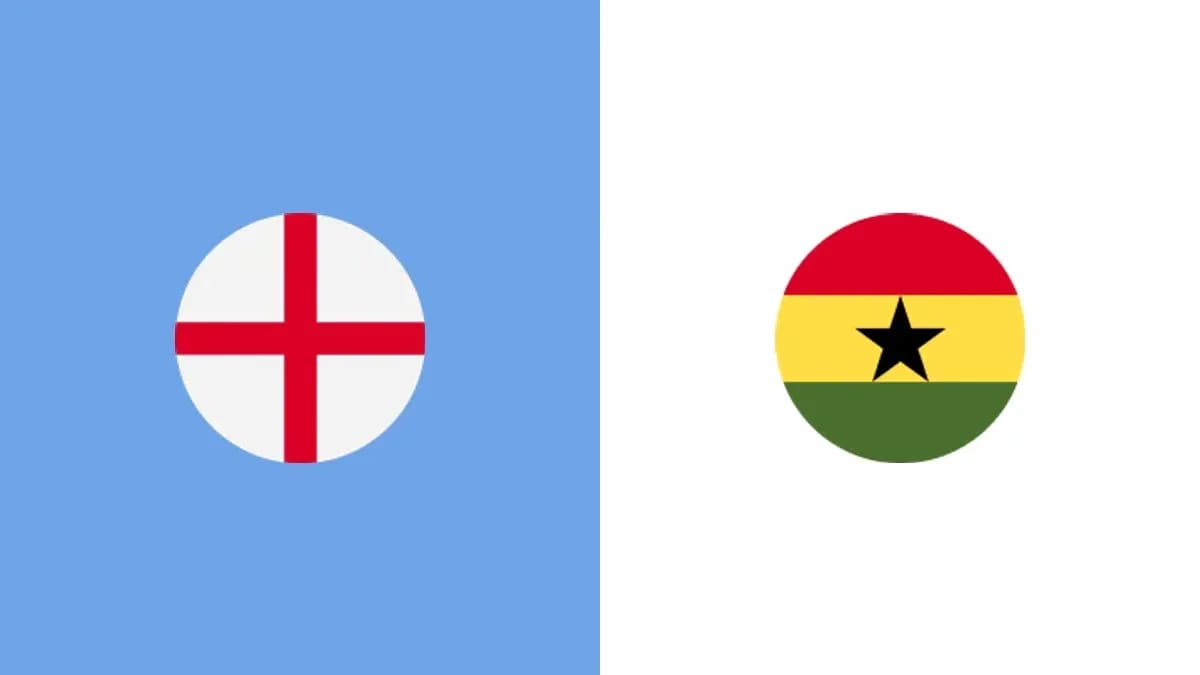
England vs Ghana: World Cup Clash in Foxborough
On a humid June evening in Foxborough, two very different footballing identities will walk out under the lights at Boston Stadium – and only one may leave with real control of Group L.
England arrive with their usual noise, a 4-2 statement win over Croatia still ringing in their ears. Ghana come in quietly, but with something more dangerous: belief forged in the 95th minute of a sodden, bruising win over Panama. Both have three points. Both know that one more victory almost drags them into the Round of 32. The margin for error is already razor-thin.
Kick-off is set for 23 June 2026 at 20:00 GMT, 16:00 EST. The stakes are far bigger than the calendar suggests. This already feels like a knockout game in disguise.
Tuchel’s England: Firepower With a Flaw
Thomas Tuchel’s first glimpse of World Cup England was exhilarating and alarming in equal measure.
His side ripped Croatia open in Dallas. Harry Kane scored twice – a penalty after 12 minutes, then another cold, clinical finish before the interval – and did all the things that have come to define him at this level. He dropped deep, linked play, dragged centre-backs into uncomfortable areas, then punished them ruthlessly when they switched off.
Jude Bellingham was the conductor. He ran the game between the lines, then restored England’s lead just seconds into the second half with the sort of sharp, decisive finish that has become his trademark. Marcus Rashford came off the bench to add the fourth in the 85th minute, a reminder that England’s attacking depth is as real as the hype.
Yet Croatia scored twice and could have had more. Direct running exposed gaps. England’s back line wobbled whenever the full-backs flew forward and the midfield lost its grip. The match turned into a shootout, and while Tuchel’s men had the heavier artillery, the defensive cracks were obvious.
Tuchel won’t rip up a 4-2-3-1 that produced four goals. He doesn’t need to. But he knows that leaving the same spaces against Ghana’s counter-attack would be asking for trouble.
Declan Rice becomes crucial now. The Arsenal midfielder must lock the central lanes, screen John Stones and Ezri Konsa, and stop England’s defence being dragged into one‑v‑one duels in wide-open grass. The rest-defence – the structure left behind when England attack – will decide whether this turns into another carnival or a cautionary tale.
The supporting cast around Kane and Bellingham is rich. Anthony Gordon and Noni Madueke are pencilled in to attack the flanks, with Bellingham as the No.10. Rashford and Bukayo Saka, so sharp off the bench in Dallas, are hammering on the door for starts. Jordan Pickford stays in goal, with Reece James and youngster Nico O’Reilly expected to push high from full-back.
England have no injuries, no suspensions, and no excuses. They have the tools to dominate. The question is whether they can control.
Queiroz’s Ghana: Discipline, Suffering, and a Late Punch
Carlos Queiroz has built a career on structure and suffering. Toronto was the latest chapter.
Ghana’s 1-0 win over Panama was not pretty. It was not meant to be. Under steady Canadian rain, the Black Stars dug in, absorbed pressure, and clung to their shape when the game threatened to drift away from them. Lawrence Ati Zigi made key saves early, the back four stayed narrow and disciplined, and the midfield tracked every run.
For long stretches, the match looked destined for a goalless grind. Then came the 95th minute. Caleb Yirenkyi, a tireless midfield presence all evening, surged into the box and forced home the winner. The goal detonated on the touchline and in the stands – a late, ugly, glorious strike that instantly changed the feel of Ghana’s campaign.
Queiroz will not abandon that defensive core. His 4-2-3-1 is drilled, compact, and stubborn. Yet he knows England present a different test. Sit too deep, move the ball too slowly, and Tuchel’s side will pen them in, wave after wave, until the dam breaks.
So the adjustment is clear: Ghana must be braver when they win the ball.
The first pass after a turnover cannot be safe and sideways. It must be forward, sharp, vertical. Ghana’s wide players – Kamaldeen Sulemana and Ernest Nuamah – will be told to explode into the spaces left by England’s marauding full-backs. The idea is simple: turn England’s greatest attacking weapon into their biggest defensive risk.
There is one major complication. The goalkeeping position is in flux. Ati Zigi went off at half-time against Panama, and his replacement, Benjamin Asare, took a knock late on. Both are being assessed, and Queiroz may have to make a late call on who stands behind Jerome Opoku and Jonas Adjetey at centre-back. Gideon Mensah and Marvin Senaya are set to continue at full-back.
In midfield, Elisha Owusu will sit alongside Yirenkyi, who has earned the right to keep his place after his stoppage-time heroics. Higher up, Antoine Semenyo, fresh from a Player of the Match display, is tasked with linking play and supporting veteran Jordan Ayew, while Brandon Thomas-Asante is pushing hard after supplying the crucial assist in Toronto.
Ghana’s recent form – four defeats in five before this tournament, including heavy losses to Austria and Germany – painted a grim picture. The late winner against Panama didn’t erase that record, but it did something else: it restored edge and belief. Against England, they will need both.
The Duels That Could Decide It
Some World Cup games hinge on systems. This one may come down to two individual battles.
Harry Kane vs Jerome Opoku
Kane is England’s reference point, the man everything flows around. Against Croatia, he was immaculate: clever in his movement, ruthless in his finishing, calm from the spot. He pins centre-backs, brings runners into play, and then appears in the area just when they’ve forgotten about him.
Opoku’s job is brutal and simple. He must stay attached to Kane without being dragged out of the defensive block Queiroz prizes so highly. Lose concentration for a second, and Kane will spin, receive, and feed Bellingham or a wide runner. Drop too deep, and England will suffocate Ghana around the box.
Opoku marshalled Panama well. This is a different level of problem.
Jude Bellingham vs Caleb Yirenkyi
Bellingham is the heartbeat. Against Croatia, he dictated the rhythm, broke lines with his running, and finished with authority. Give him time to turn in the middle third and he will pull Ghana’s shape apart, either by driving at the back four or by releasing the wide players early.
Yirenkyi’s task is to disrupt that rhythm. His late goal in Toronto grabbed the headlines, but his work without the ball will define his night in Foxborough. He must compress space around Bellingham, block passing lanes, and time his presses so that England’s No.22 never feels fully comfortable.
If Bellingham dominates that zone, Ghana will spend the evening retreating. If Yirenkyi can turn it into a scrap, Ghana’s transitions suddenly come alive.
Group L on a Knife-Edge
The maths is simple, the implications anything but.
England top Group L on goal difference after their 4-2 win over Croatia. Ghana sit just behind them after their 1-0 victory against Panama. Croatia and Panama are stranded on zero points.
This match is the pivot.
An England win puts Tuchel’s side on six points and all but into the Round of 32. Depending on the result of Croatia vs Panama, it could seal qualification with a game to spare and leave Ghana stuck on three, facing a tense final showdown with Croatia.
Flip it, and the picture changes entirely. If Ghana win, they move to six points and seize control of the group. England stay on three and walk into a must-perform finale against Panama, with the spectre of third-place calculations looming over them.
A draw keeps both on four points, still unbeaten, still in charge of their own fate. It would set up a final day decided by goal difference and nerve, with England likely needing a win against Panama to secure top spot and Ghana facing a similar equation against Croatia.
History, Form, and the Weight of the Moment
There is almost no history between these sides. Just one meeting, a 1-1 friendly draw at Wembley in 2011, sits in the books. No rivalry, no scars, no comfort. Only a blank page.
Recent form tilts heavily towards England. Across their last five games, they have four wins, one defeat, and seven goals scored with just two conceded. They eased past Costa Rica and New Zealand in their warm-ups, and even their lone loss – 1-0 to Japan – came in a tight contest.
Ghana’s build-up was far rougher: defeats to Mexico, Germany, Austria, and South Africa, with goals leaking at an alarming rate. The draw with Wales offered only a small reprieve. That is why the Panama win mattered so much. It didn’t just deliver three points; it broke a damaging pattern.
So here they are. England, armed with talent and expectation, trying to prove that Tuchel’s version can finally marry flair with control on the biggest stage. Ghana, organised, dangerous in transition, and carrying the quiet conviction that one more shock can flip the group on its head.
Under the New England lights, with qualification already looming into view, this is no ordinary group match. It is a test of nerve, structure, and star power – and a chance for one of these sides to seize the World Cup by the throat rather than simply cling to it.