.svg&w=384&q=75 "Pitchgist logo")
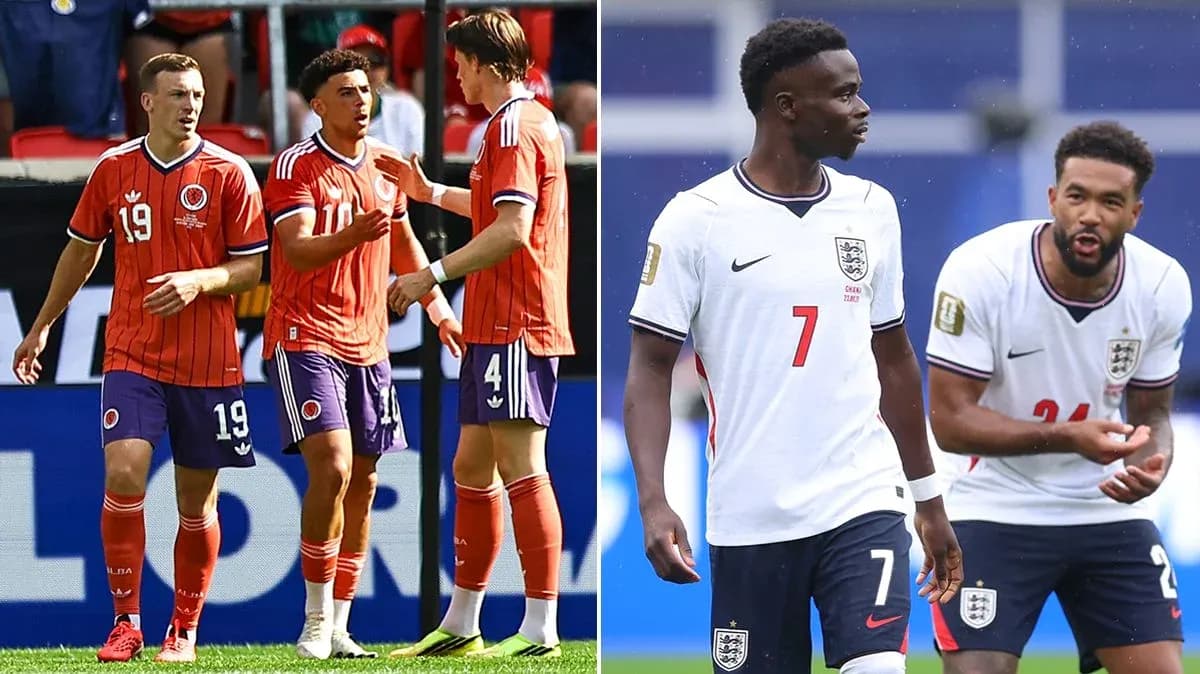
England Faces Pressure After Ghana Stalemate as Scotland Prepares for Brazil Showdown
The World Cup has hit the point where nerves start to fray. Legs get heavy, tempers shorten, and one bad touch can tilt an entire campaign. England felt all of that in Boston. Scotland are about to feel it in Miami.
Bellingham’s ‘second game fever’ and an England side stuck in neutral
England walked away from a 0-0 draw with Ghana with more questions than answers and no ticket yet punched for the last 32. The performance was flat, the finishing wasteful, and the mood – at least outside the camp – twitchy.
Inside it, Jude Bellingham refused to panic. Man of the match on a night that rarely sparked, he branded the stalemate “second game fever” – a familiar dose of lethargy that has now seen England draw their second fixture at four straight major tournaments, stretching back to Euro 2020.
His message? Roll with it. Learn from it. Move on.
England’s route is still clear enough. Beat Panama on Saturday and they will almost certainly top Group L, especially if they better Ghana’s result against Croatia. Eberechi Eze, one of the brighter influences in Boston, insisted the draw hadn’t altered the internal mood or the plan.
“We set out to win anyway, so it changes nothing for us,” he said. “You can't be too high, you can’t be too low… we’re trying to enjoy it as much as we can, and being confident of what's to come.”
That confidence will be tested. Declan Rice left the Boston Stadium with his leg strapped and will have his fitness assessed, as will Reece James, who completed the full 90 minutes but continues to manage his body after a stop-start spell at Chelsea. The BBC has indicated there is no long-term concern over Rice, though both could be rested against Panama.
Rice’s situation is complicated by a yellow card picked up for a foul on Jerome Opoku just before half-time. It was England’s first booking of the tournament, but a second against Panama would trigger a one-match suspension for the last 32 under FIFA rules. Single yellows are wiped after the group phase, yet one more mis-timed challenge from the Arsenal midfielder could leave Thomas Tuchel without his midfield anchor for the knockouts.
Tuchel, though, does not have a monopoly on England’s nerves.
Kane shrugs off miss as witch doctor claims credit
Harry Kane’s late miss in Boston – lashed over from seven yards when he normally passes those moments into the corner – has already acquired a life of its own.
The Bayern Munich striker is not buying into the drama. “It’s part of a striker’s life,” the 32-year-old said. “Nine times out of 10 I score but in football there is a feeling that it just doesn’t go your way.” His response is simple: back himself to bury the next one.
Eze rejected the idea that England lean too heavily on their captain, even if his two goals against Croatia in the opener inevitably shape the narrative. “It makes it look like that, because he scores so many goals,” Eze argued, pointing instead to the depth of attacking options around him.
Kane himself has thrown his weight behind Tuchel, who has dismissed talk of over-reliance on his No 9. “I don’t think there is an over-reliance,” Kane insisted. “Any No 9 at a big team, people expect them to score goals and it’s no different for me.”
The story has taken a surreal twist in Ghana. Self-styled “witch doctor” Nana Kwaku Bonsam claimed he had placed a spell on Kane to stop him scoring against the Black Stars, then promptly announced he had “released” the England captain so he can find the net again versus Panama. Bonsam, whose name translates as “Devil of Wednesday”, now says he wants Kane to flourish for the rest of the tournament.
On the pitch, Ghana boss Carlos Queiroz was unimpressed with Bellingham. Off it, the match has triggered an entirely different row.
Bellingham at centre of FIFA storm as Paraguay protest
A still image of Bellingham covering his mouth while talking to Jordan Ayew has ignited a World Cup controversy that cuts to the heart of FIFA’s new disciplinary stance.
For this tournament, world football’s governing body introduced a rule allowing referees to show a red card to any player who hides their mouth during a confrontation with an opponent. The law was pushed by FIFA president Gianni Infantino after Benfica’s Gianluca Prestianni received a six-match UEFA ban for homophobic abuse aimed at Vinicius Jr.
Paraguay’s Miguel Almiron became the first player dismissed under the new rule during a fiery clash with Turkey, sent off following a VAR review for shielding his mouth in a heated exchange. In Boston, Bellingham did the same physical action – hand over mouth – but was not sanctioned, with officials judging his chat with Ayew as friendly rather than confrontational.
Paraguay are furious. Reports from Spain say their federation has lodged a formal complaint with FIFA, arguing that the law is being applied inconsistently after Almiron’s red card left him banned for their decisive final group game against Australia.
FIFA now face pressure to explain why one player walks and another walks away.
England fans praised as off-field mood stays calm
On the streets and in the stands, England’s support has been under a different spotlight – and passed with distinction.
Around 30,000 fans travelled to the Boston Stadium, where the goalless draw with Ghana passed without a single arrest of a British national. Chief Constable Mark Roberts, the National Police Chiefs’ Council lead for football policing, hailed their behaviour as “excellent” and said local officers had been “very complimentary”, with Foxborough’s Chief Grace calling the conduct “exemplary”.
The atmosphere in Boston mirrored that in Dallas earlier in the tournament, with US authorities and bar owners also praising the Scotland fans who have followed their team across the country.
As it stands, the brackets whisper of a possible last-16 showdown between England, top of Group L, and Scotland, third in Group C. Both still have work to do to make that fixture a reality – and that brings us to Miami.
Scotland’s date with Brazil and history
Scotland’s World Cup campaign has been a tightrope walk from the opening whistle. A laboured 1-0 win over Haiti, followed by a 1-0 defeat to Morocco in which Ismael Saibari scored after just 70 seconds, has left Steve Clarke’s side on a knife-edge heading into their final Group C clash with Brazil.
The equation is brutally simple. Beat Brazil and Scotland are through, with a chance of topping the group if Morocco slip against Haiti. A draw would almost certainly be enough, taking them to four points – usually the magic number for third-placed sides hoping to sneak into the last 32.
Even a narrow defeat might not be fatal. Lose by a single goal, as they did against Morocco, and Scotland would finish on three points with a goal difference of -1. History suggests that could still be enough to progress as one of the best third-placed teams, though it would leave the Tartan Army glued to later results and nervously doing the maths.
The bookmakers are not convinced. Scotland sit around 17/2 to beat Brazil, with the South Americans odds-on favourites. Yet the mood among the travelling support tells a different story.
Miami Beach has been turned tartan. Kilts, bagpipes and beer have flooded the shoreline as fans swap Boston baseball games for South Beach sunshine. Local police have spoken of an “unforgettable atmosphere” after the Scottish invasion, and the Tartan Army have already won over American hearts – and traded good-natured taunts with Brazilian fans ahead of kick-off.
The stakes, though, are deadly serious. Scotland have never reached the knockout stages of a World Cup. They have faced Brazil at the 1974, 1982, 1990 and 1998 finals and never beaten them. Now they meet again in the heat of Miami, with everything on the line.
Neymar back, Raphinha out – and Ancelotti wary of “fighters”
Brazil will welcome back Neymar for the first time at this World Cup. The forward has been nursing a calf problem but has trained fully this week and is, in the words of coach Carlo Ancelotti, “fit and able and ready to play”.
“He can play half the time or the whole 90 minutes,” Ancelotti said. “He is very well, he worked very hard so he is ready. His attitude is very good… he brings experience and knowledge.”
One attacking option they will lack is Raphinha, the Barcelona winger sidelined by a hamstring injury picked up in the 3-0 win over Haiti.
Ancelotti, though, is not treating Scotland as a soft landing for his returning superstar. “It will be a difficult game,” he warned. “Scotland has quality, they are fighters, they are well organised. They have good players, (Scott) McTominay, (John) McGinn… Easy games at the World Cup were finished a long time ago.”
The Italian knows his side are already through. Scotland do not have that luxury.
Ronaldo roars back as Portugal flex
While England stalled and Scotland fretted, Cristiano Ronaldo chose Tuesday to announce his return to centre stage.
The Portugal captain, heavily criticised after a poor showing in the opening win over DR Congo, hit a brace in a 5-0 demolition of Uzbekistan. Afterward, he declared to the world that he was “back”, a statement that inevitably invited comparisons with Wayne Rooney’s ill-fated “big man is back in town” proclamation at the 2006 World Cup.
This time, the numbers backed the noise. Bruno Fernandes, who created Ronaldo’s second, admitted he felt a sense of relief.
“It was important for our captain to score,” the Manchester United midfielder said. “He's our go-to player in attack. We're very happy for him. We managed to score a lot of goals, and we're happy about that. I'm here to set up my teammates up front. It's part of my game, regardless of whether I score or not.”
Portugal now finish their group against Colombia in Miami on Saturday with top spot in Group K on the line and their talisman purring again.
World Cup under the microscope: weather, tickets and scheduling
Off the pitch, FIFA face scrutiny on multiple fronts.
Severe storms have already forced France’s clash with Iraq to finish almost four hours after kick-off. With the final round of group games traditionally played simultaneously to avoid any repeat of the infamous 1982 “Disgrace of Gijón” – when West Germany and Austria were accused of colluding to eliminate Algeria – there are growing fears that extreme weather could hand an advantage to teams playing later, fully aware of what they need.
Article 12.4 of the tournament regulations states that final group matches “shall have simultaneous kick-off times… unless stipulated otherwise by FIFA (e.g. in cases of force majeure).” The Times has reported that there is no special provision for summer storms, leaving the door open to staggered kick-offs if lightning and heavy rain intervene.
Ticket prices have also sparked anger. Former UK prime minister Gordon Brown, who attended Scotland’s opener against Haiti, has branded the cost of seats “extortionate” and called for an inquiry into what he sees as ordinary families being “priced out” of the game. He pointed to the World Cup final ticket cost being “30 or 40 times” higher than the Euro final in Germany and demanded change after the tournament.
For now, fans continue to travel in vast numbers. A magnitude 5.6 earthquake in Mendocino County shook California on Wednesday morning, with tremors felt as far as Sacramento, just hours before the state prepares to host USA v Turkey at Los Angeles Stadium. The National Tsunami Warning Center has confirmed there is no tsunami risk, and the match is set to go ahead as planned.
Germany ruthless, Argentina relentless
Elsewhere among the heavyweights, Germany and Argentina are treating their dead rubbers like cup finals.
Germany, already safely into the knockouts, face Ecuador next. Midfielder Nadiem Amiri insists there will be no easing off. “We need to keep this momentum going. Winning breeds confidence,” he told the German FA’s official channels, adding that they “owe it to the other sides” to approach the game as if their own tournament depended on it.
Argentina, who have already wrapped up Group J, will not be resting on their laurels either. Coach Lionel Scaloni plans to rotate against Jordan in Dallas but has no intention of wrapping Lionel Messi in cotton wool. Messi, with five goals in his first two matches and leading the Golden Boot race, is understood to want at least 45 minutes.
Tottenham defender Cristian Romero is expected to miss the group finale with a muscle problem and may not return until the last 16. Even so, Argentina will stride into the knockouts with their captain in full flow and their ambitions undimmed.
Sweden’s Potter backs his captain amid Dutch rout fallout
Not every coach is dealing with the luxury of form and fitness. Sweden boss Graham Potter has been forced to defend his captain Isak Hien after a 5-1 hammering by the Netherlands turned the centre-back into a lightning rod for criticism.
Hien was at fault for three of the goals in Houston, yet Potter has refused to budge. “I love Isak Hien, and I don't care what anybody says,” he said. “If I'm manager, then he's playing. It's a blame game. It's the world we live in.”
Sweden had started their campaign with a five-goal thrashing of Tunisia, only to be handed one back by the Dutch. Now they face Japan in Dallas on Friday with their World Cup balance sheet reset and their manager doubling down on his leader. “We win and we lose together as a team,” Potter insisted.
USA wait on Pulisic as group-stage drama builds
The USA, already through to the knockouts under Mauricio Pochettino, received a succinct boost from Christian Pulisic. Asked if he would be fit to face Turkey after missing the win over Australia with a knock picked up against Paraguay, the AC Milan forward needed just one word: “Yes.”
Turkey, already eliminated, will be playing for pride. The USA will be playing for rhythm.
And that, in the end, is the story everywhere you look at this World Cup now: rhythm, risk, and the thin margins between progress and regret.
England must shake off their “second game fever” against Panama. Scotland must stare down Brazil and their own history on a humid Miami night. One nation trying to remember how to win when it matters. Another daring to discover what it feels like in the first place.