.svg&w=384&q=75 "Pitchgist logo")
Champions League 2026/27: The New Format and Key Dates
The pain of Budapest still lingers. A penalty shootout defeat to Paris Saint-Germain in last season’s Champions League final is the kind of scar that doesn’t fade quickly. But it sits now alongside something else: the glow of a first Premier League title since 2004 and a fourth straight ticket back to Europe’s elite.
The 2026/27 Champions League is already taking shape. Twenty-nine of the 36 places are locked in, the calendar is set, and the new-look format – still fresh, still divisive in some corners – is here to stay. The league phase kicks off on September 8. The climb back towards another final begins long before that.
The New Normal: A League, Not a Group
The competition no longer opens with the familiar four-team groups. The 2025/26 season was the second year of UEFA’s revamped “league phase” format, and the 2026/27 edition will follow the same script: 36 teams, one big table, eight matches per club.
Each side faces eight different opponents, four at home, four away. No return fixtures, no mini-leagues. Just a rolling, high-stakes schedule where every result feeds into a single standings table.
Finish in the top eight and the reward is clear: straight into the last 16. Slip into ninth to 24th and there’s no safety net, only a two-legged play-off to fight for a place in the knockouts. Below that, the journey ends before the real cut-and-thrust of spring.
Last season, the bar was set brutally high. They finished top of the entire league phase, winning all eight matches – a first in the short history of this format. Perfection across autumn and winter, only to see the dream torn away from 12 yards in Budapest.
The structure around them is shifting too. Two of the extra league-phase berths go each year to the associations whose clubs performed best the previous season. In 2024/25, that honour fell to England and Spain, so both the Premier League and La Liga send five teams this time.
Who’s In? The European Cast
England’s contingent underlines the depth at the top of the Premier League. Five clubs step into the Champions League next season: Liverpool, Manchester City, Manchester United and Aston Villa join the reigning champions of England in the league phase.
Spain matches that firepower. Real Madrid, Barcelona, Atletico Madrid, Villarreal and Real Betis all return, a blend of royalty and ambitious chasers determined to keep La Liga’s grip on the latter stages.
Italy and Germany send four sides each. From Serie A come Napoli, Inter Milan, AS Roma and Como, the latter a striking new name on this stage. The Bundesliga’s quartet is more familiar: Bayern Munich, Borussia Dortmund, RB Leipzig and Stuttgart.
France’s representation is slimmer but potent. Paris Saint-Germain defend their European crown, with Lens and Lille alongside them. The Netherlands supplies two: Eredivisie champions PSV and runners-up Feyenoord.
Porto and Sporting Lisbon carry Portuguese hopes. Galatasaray arrive from Turkiye, Slavia Prague from Czechia, Shakhtar from Ukraine, and Club Brugge from Belgium, all domestic champions who secured their spots months ago.
Seven more clubs will emerge from the qualifying rounds, whose first and second draws took place on June 16 and 17. Five of those final entrants will come through the ‘champions path’, reserved for title winners from 42 different nations. The remaining two will be drawn from clubs finishing second, third or fourth in their leagues.
The qualifiers conclude on August 26. One day later, on August 27, the full 36-team league phase draw will be made, and the last pieces of the puzzle will finally lock into place.
Pots, Politics and Possible Opponents
The draw itself is a tactical minefield long before a ball is kicked. UEFA’s rules shape who can face whom, and for the Premier League winners that already narrows the field.
They cannot face fellow English clubs in the league phase, so Liverpool, Manchester City, Manchester United and Aston Villa are off the table at this stage. Domestic rivalries will have to wait for the knockouts.
The four seeding pots are based on UEFA club coefficients. Pot 1 is a who’s who of modern European power: Paris Saint-Germain, Bayern Munich, Real Madrid, Liverpool, Inter Milan, Manchester City, Barcelona and Atletico Madrid sit alongside the English champions. These sides cannot be drawn against each other in the league phase.
Pot 2 is stacked with danger of its own: Borussia Dortmund, AS Roma, Sporting CP, Porto, Club Brugge, Real Betis, PSV Eindhoven, plus Aston Villa and Manchester United. Pot 3 offers Feyenoord, Lille, Napoli, RB Leipzig, Villarreal, Shakhtar Donetsk and Galatasaray.
Pot 4, for now, is headlined by Como and Lens. Slavia Prague, Stuttgart and the seven qualifiers are still to be assigned between pots 3 and 4, depending on how the coefficients fall once the final line-up is confirmed.
The rules add a further twist: they will play two teams from each pot, one at home, one away, and cannot be drawn against more than two sides from the same country. Eight matches, eight different opponents, and a schedule that offers little room for missteps.
All four pots will be confirmed on August 26, when the last qualifying ties are settled and the final seven clubs step through the door.
Dates That Will Shape a Season
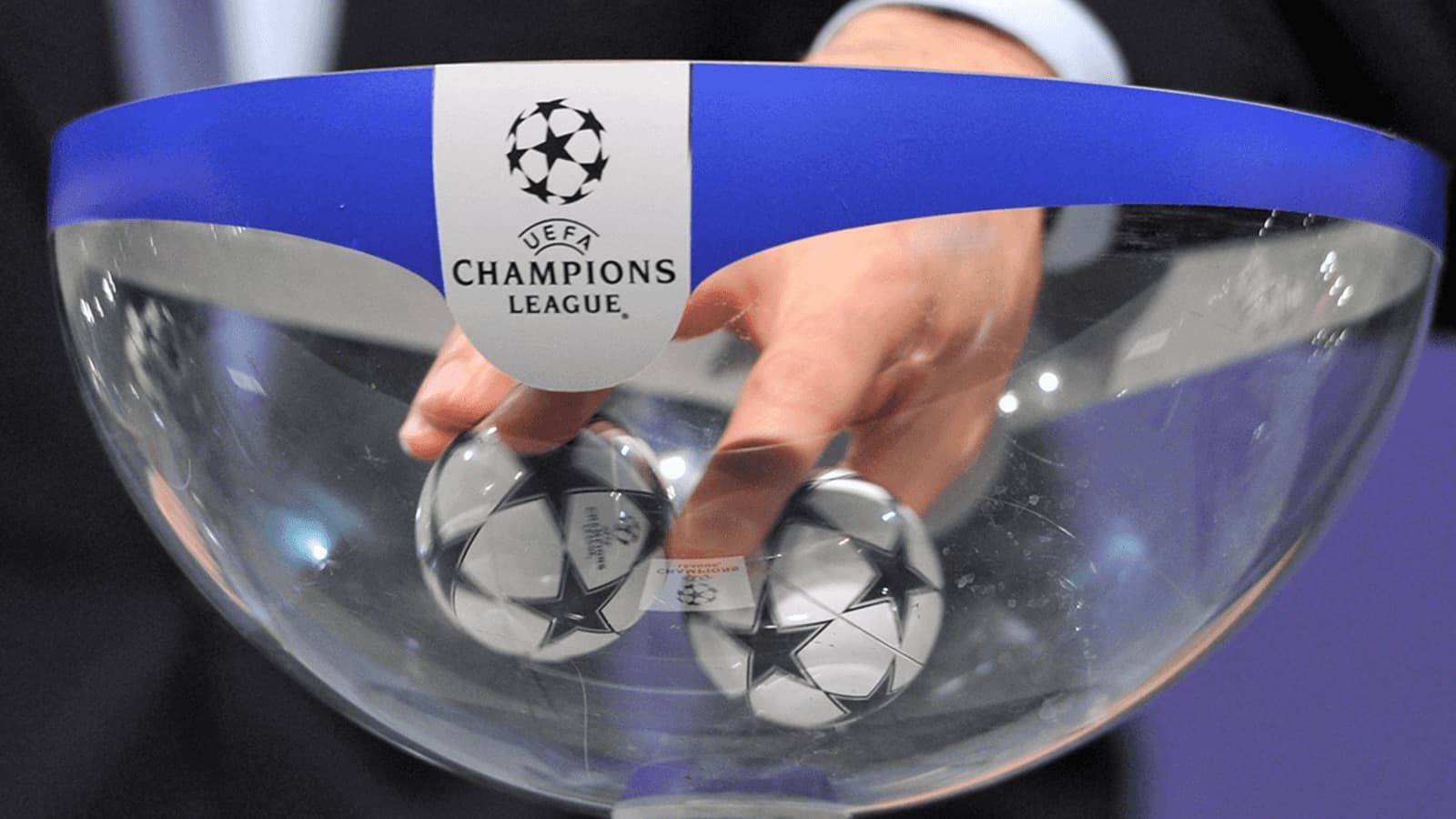
The Champions League draw arrives on Thursday, August 27, 2026. That’s the day the path becomes real, when the eight league-phase opponents are revealed and the autumn calendar hardens into something you can plan a season around.
The league phase itself stretches across months, threading through the heart of the domestic campaign. Matchdays fall on:
- September 8–10
- October 13–14
- October 20–21
- November 3–4
- November 24–25
- December 8–9
- January 19–20
- January 27
Once the league table settles, the knockout machinery whirs into life. The draw for the play-off round – where those finishing ninth to 24th scrap for a last-16 place – takes place on January 29, 2027. The ties themselves are played over two legs on February 16–17 and February 23–24.
Then comes the decisive reveal. On February 26, 2026, UEFA will conduct the draw for the round of 16, quarter-finals, semi-finals and the final, mapping out every possible route to the trophy.
The round of 16 will be played on March 9–10 and March 16–17. The quarter-finals follow on April 6–7 and April 13–14, then the semi-finals on April 27–28 and May 4–5.
Everything builds towards one night: Saturday, June 5, 2027, at the Wanda Metropolitano in Madrid. A stadium that has already staged Champions League glory once will host the final again.
They came agonisingly close in Budapest. Now the road bends towards Madrid. The question is simple, and brutal: can a team that has conquered England turn that domestic dominance into the one prize that still eludes them?