.svg&w=384&q=75 "Pitchgist logo")
Canada's Historic 6-0 Victory: A New Era in Soccer
Canada did not just win a World Cup match on Thursday night. It tore up a chapter of its sporting identity and started writing a new one.
A modest 1-0, a scruffy 2-1 – that would have been enough for most supporters heading into Vancouver’s opener against Qatar. Instead, they walked out of a heaving stadium having watched a 6-0 demolition, the country’s first-ever men’s World Cup victory, and a scoreline that shouted something many Canadians have long whispered: this is now a soccer nation, too.
A city wrapped in red
The signs were there long before kick-off.
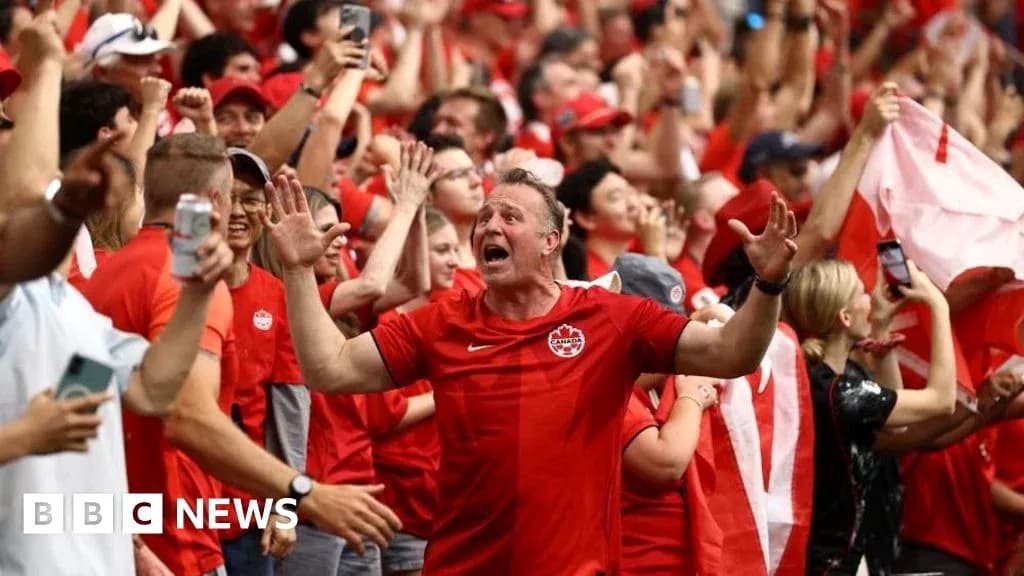
Hours before the game, thousands of fans surged along the “last mile” to the stadium, swallowed by a haze of red smoke. The crowd of 52,000 was officially sold out, but the real story was in the colours: a sea of red and white, shirts and flags and scarves blending into a single, pulsing backdrop.
Across the country, the scene repeated itself in miniature. Granville Street in downtown Vancouver turned into a rolling watch party. In Toronto, small neighbourhood bars crammed with fans who, not long ago, might have been there for hockey preseason instead. They were there for Les Rouges.
One of them was Dave Di Cola, a longtime believer in Canadian football who watched the match with dozens of others. He went in with what he called “reserved optimism,” fully aware that in this sport, belief can turn to heartbreak in a heartbeat.
This time, it didn’t.
Goals, red cards, and a statement
Canada flew out of the blocks. The tension that usually grips a team chasing its first World Cup win never really took hold. Three goals before half-time told their own story: quicker to every ball, sharper in the final third, ruthless in transition.
By the time Qatar had two players sent off, the contest had become a procession. The red cards tilted the field even further, but the tone had already been set. Canada did not ease off. It piled on.
Jonathan David, the striker so often touted as the future of Canadian football, stepped fully into the present. He scored three of the six, a hat-trick that felt like a coronation. One image raced around social media: a fan in a Connor McDavid hockey jersey with the “Mc” taped over and replaced by a hand-drawn “J,” turning one national superstar into another. A hockey country, rebranding itself on the fly.
For fans like Di Cola, the result went far beyond the scoreline.
“Canada soccer has always been kind of a joke. It’s always secondary,” he said. Watching the support swell in Vancouver and across the country, he admitted it “nearly brought a tear” to his eye. Validation. At last.
A night stained by heartbreak
Yet even on a night when the scoreboard screamed joy, there was a jarring silence.
Midfielder Ismaël Koné, the Ottawa native who has grown into the heartbeat of Jesse Marsch’s midfield, left the pitch with a leg break that ended his tournament on the spot. The stadium, so loud all evening, fell into a stunned hush as medics rushed on. His teammates formed a protective ring, then bristled with anger and emotion, stepping in to defend him in the aftermath.
Marsch has called Koné “a big part of the heart of our team.” On Thursday, that heart was suddenly ripped out.
Nathan Saliba came on in his place and did what football so often demands: he played on. Not just played, but scored Canada’s fourth goal, then lifted Koné’s jersey aloft in tribute. A simple gesture, but one that cut through the noise of the rout and landed with real weight.
Koné underwent surgery and, by Friday morning, had sent his own message back to the squad. “What you guys did yesterday will stay with me forever,” he wrote on Instagram. The win would go down in the record books. His absence would linger in the dressing room.
For Di Cola, the injury changed the mood instantly. “If that didn’t happen, I would have been running up and down the avenue yesterday,” he said. The party went on, but with a limp.
A prime minister’s dressing-room verdict
In the aftermath, the celebrations moved from the pitch to the dressing room. There, Prime Minister Mark Carney addressed a team that had just delivered a landmark result under the harshest spotlight.
He did not talk tactics. He talked character.
Carney praised the squad for showing “a level of character that some people never achieve” in how they responded to Koné’s injury and the shock of seeing a teammate suffer on such a stage. “You showed it when the entire country and a good part of the world is watching,” he told them. “And if they didn’t watch they would have watched the highlights tomorrow.”
The message was clear: this was not just about six goals or a clean sheet. It was about how a team, and by extension a country, handled its first taste of real World Cup drama.
Placing the moment in Canadian lore
Canada’s sporting history is not short on iconic snapshots. Sidney Crosby’s golden goal in Vancouver in 2010. The Toronto Raptors toppling the Golden State Warriors in 2019. The women’s football team climbing to the top of the podium at the Tokyo Olympics.
Thursday’s 6-0 over Qatar does not sit on that same shelf. Not yet.
Even Di Cola, basking in the glow of a night he had waited years to see, was quick to point out that this achievement is smaller in scale. Canada’s men’s team, he said, still has “a long way to go.”
He is right. One emphatic win, even a historic one, does not rewrite decades overnight. But momentum is a powerful thing in sport, and Canada suddenly has plenty of it.
The country that once shrugged at men’s football now marches to stadiums through clouds of red smoke. It tapes over hockey jerseys to honour a hat-trick hero. It packs bars to watch Les Rouges take apart a World Cup opponent.
Next up is Switzerland. A different test, a higher bar, a chance to prove that Qatar was not an outlier but a starting point.
Canada has its first World Cup win. The real question now is how far this “soccer nation” intends to go.