.svg&w=384&q=75 "Pitchgist logo")
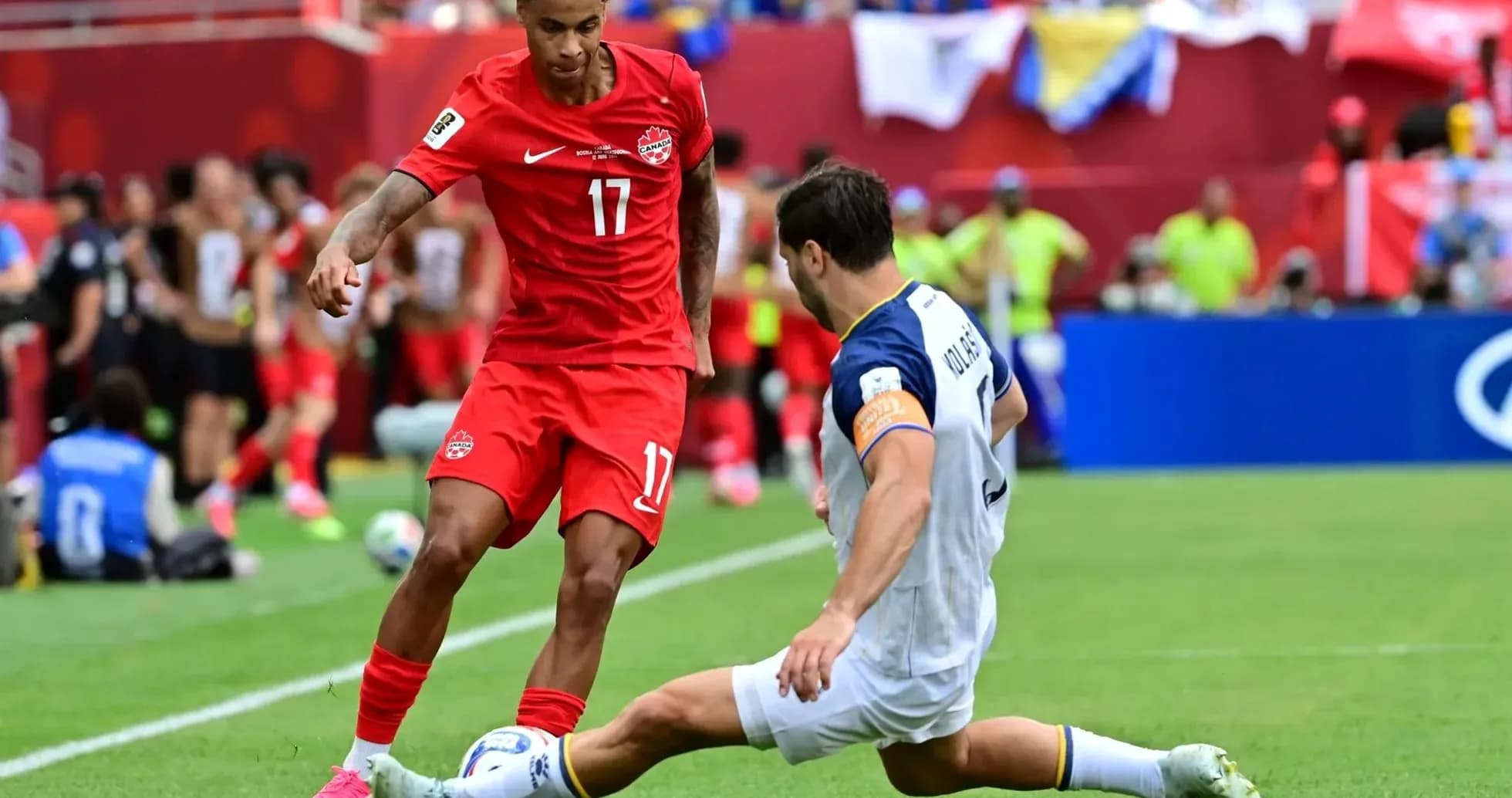
Canada's Draw with Bosnia & Herzegovina: Tactical Analysis
Canada’s 1-1 draw with Bosnia & Herzegovina at BMO Field was a structurally coherent World Cup group-stage performance from Jesse Marsch’s side, built on territorial control and a clear 4-4-2 identity, but undermined by slow first-phase circulation and limited incision before the hour mark. Bosnia & Herzegovina, also in a 4-4-2, leaned into compactness, direct play and set-piece threat, and nearly stole full points by maximizing a smaller volume of attacks.
Canada’s 4-4-2 was orthodox on paper but asymmetrical in function. Maxime Crépeau anchored a high defensive line that allowed full-backs Alistair Johnston and Richie Laryea to push aggressively, turning many Canadian possessions into a 2-4-4. Stephen Eustaquio and Ismael Koné formed the central pivot, with Tajon Buchanan and Liam Millar providing width. Jonathan David and Tani Oluwaseyi started as a front pair, but David often dropped into the right half-space, creating a 4-2-3-1 in possession.
The statistical profile matches that picture: 61% possession, 415 passes and 75% accuracy show Canada as the clear ball-dominant side. However, the tempo of their first-half build-up was too safe. Bosnia & Herzegovina’s front two, Ermedin Demirović and Jovo Lukić, screened passes into Eustaquio and Koné, forcing Canada wide. Canada’s 13 total shots and 10 efforts inside the box indicate they eventually found territory, but the first 45 minutes saw many of these touches in crowded zones, with Bosnia & Herzegovina’s back four defending the width of the box compactly.
Bosnia & Herzegovina’s Defensive Structure
Bosnia & Herzegovina’s 4-4-2 was defensively disciplined and physically assertive. With only 39% possession and 270 passes at 64% accuracy, they accepted long spells without the ball. Sead Kolašinac and Nikola Katić were aggressive stepping into duels, supported by narrow wide midfielders Esmir Bajraktarević and Amar Memić who tucked in to deny central combinations. The foul count (20 for Bosnia & Herzegovina, 10 for Canada) underlines a strategy of breaking rhythm and contesting every vertical pass into Canadian forwards.
Transition was Bosnia & Herzegovina’s main offensive weapon. Their 8 total shots, 5 inside the box and 3 on target, show a low-volume, relatively high-quality shot profile. Lukić’s first-half goal, assisted by Kolašinac, fits the pattern of quick, direct exploitation of Canada’s advanced full-backs: once the first line was broken, Bosnia & Herzegovina attacked space early rather than recycling. With only 4 corner kicks, they did not rely heavily on set-pieces but used them to reinforce the territorial swings created by transitions.
Goalkeeping Performance
The goalkeeping duels underline how each team’s tactical choices shaped risk. Maxime Crépeau (Canada) faced 3 shots on goal and made 2 saves. That volume is modest given Canada’s high line and attacking posture, which suggests that the rest defence—Cornelius and De Fougerolles protecting transitions, plus counter-press from Eustaquio and Koné—was generally well-organized, limiting Bosnia & Herzegovina to sporadic but dangerous looks. On the other side, Nikola Vasilj (Bosnia & Herzegovina) made only 1 save despite Canada registering 4 shots on goal, which implies that Canada’s finishing or final contacts lacked precision, or that some efforts were blocked or missed the frame under heavy pressure.
The xG values reinforce the story of a relatively balanced game in chance quality despite Canada’s territorial dominance: 1.25 xG for Canada versus 0.98 for Bosnia & Herzegovina. Canada’s 4 blocked shots show Bosnia & Herzegovina’s back line and midfield getting tight to shooters at the edge of the box, while Bosnia & Herzegovina’s single blocked effort reflects their preference to shoot quickly once in range rather than over-elaborate.
Substitutions and Tactical Adjustments
Jesse Marsch’s in-game management significantly altered the attacking dynamics. The triple substitution at 61'—Promise David (IN) came on for Jonathan David (OUT), Ali Ahmed (IN) came on for Tajon Buchanan (OUT), and Jacob Shaffelburg (IN) came on for Liam Millar (OUT)—re-energized the flanks and central channels. Promise David’s vertical running and Shaffelburg’s directness gave Canada more penetration against a tiring Bosnia & Herzegovina block. Later, Cyle Larin’s introduction, with Tani Oluwaseyi (OUT) and Larin (IN) at 76', shifted Canada towards a classic target-forward model, prioritizing crosses and second balls. The equaliser at 78', scored by Larin and assisted by Promise David, was a direct payoff of that reconfiguration: fresh legs attacking the box and a clearer reference point for wide service.
Sergej Barbarez’s substitutions were largely reactive and aimed at preserving structure. At 62', Samed Baždar (IN) came on for Jovo Lukić (OUT) and Armin Gigović (IN) came on for Ivan Bašić (OUT), adding fresher legs to the press and central cover. The double change at 74'—Kerim Alajbegović (IN) for Amar Memić (OUT) and Ivan Šunjić (IN) for Esmir Bajraktarević (OUT)—tilted the side towards more defensive solidity in midfield, with Šunjić in particular offering ball-winning in front of the back four. At 84', Dženis Burnić (IN) replaced Sead Kolašinac (OUT), a move that slightly reduced aerial and physical presence on the left but added another midfielder to help defend deeper phases as Canada pushed.
Discipline and Tactical Levers
Discipline was a key tactical lever. Canada’s two yellow cards—Alistair Johnston for “Foul” at 11' and Luc De Fougerolles for “Foul” at 53'—reflect individual defensive interventions rather than systemic breakdowns. Bosnia & Herzegovina’s three yellows—Demirović for “Foul” at 44', Lukić for “Foul” at 45+1', and Katić for “Foul” at 90+3'—are consistent with a game plan of aggressive engagement, especially as they sought to disrupt Canada’s late waves of pressure.
From a macro perspective, Canada’s 9 corner kicks to Bosnia & Herzegovina’s 4 underline sustained territorial pressure, especially after the hour. Yet the negative goals prevented values for both sides (Canada -0.26, Bosnia & Herzegovina -0.26) suggest that each goalkeeper conceded slightly more than the modelled expectation, pointing to finishing quality or small defensive lapses around both goals.
In summary, Canada produced a tactically coherent, possession-heavy performance that lacked early verticality but was intelligently adjusted through substitutions, culminating in a deserved equaliser. Bosnia & Herzegovina executed a compact, transition-oriented 4-4-2 with high physical commitment, and their ability to turn limited possession into near-parity in xG shows a well-drilled, pragmatic approach that will be competitive in tight World Cup group matches.