.svg&w=384&q=75 "Pitchgist logo")
Barcelona's Tactical Mastery in 2-0 Victory Over Real Madrid
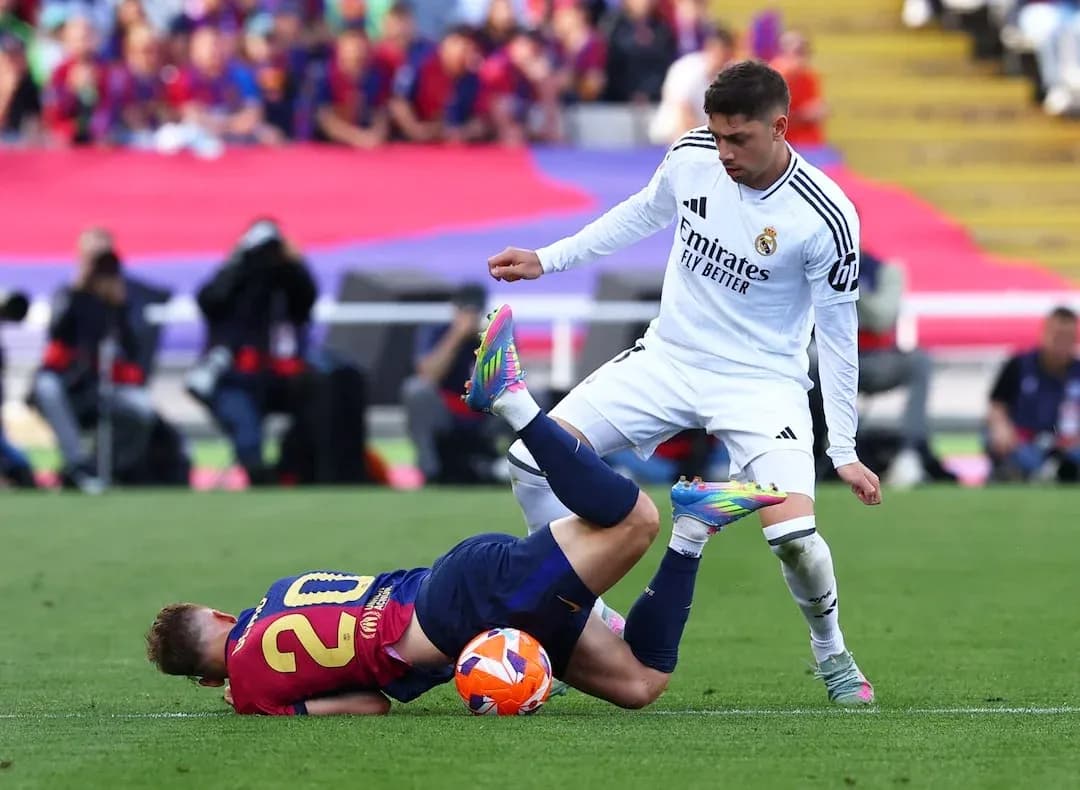
Barcelona’s 2-0 home win over Real Madrid at Camp Nou in La Liga’s Regular Season - 35 was defined early and then managed with control. Two strikes inside 18 minutes from Marcus Rashford and Ferran Torres established a platform that Hansi Flick’s side never relinquished. With 57% possession and a 10–8 shot edge, Barcelona combined territorial dominance with compact rest-defense, limiting Madrid to just one shot on target. Alvaro Arbeloa’s Real Madrid grew into the game territorially via set-pieces and wide overloads, but they struggled to convert their 8 corners and right-sided combinations into clear chances, finishing with a slightly lower xG (0.79 to Barcelona’s 0.99) and chasing the structure of the game rather than dictating it.
I. Executive Summary
Barcelona set up in a 4-2-3-1 with Joan García behind a back four of João Cancelo, Gerard Martín, Pau Cubarsí and Eric García. Pablo Gavi and Pedri formed the double pivot, with Fermín López, Dani Olmo and Marcus Rashford supporting Ferran Torres as the nominal 9. Their early verticality, especially through Rashford attacking the left half-space and Torres pinning the center-backs, destabilized Madrid’s back line.
Real Madrid mirrored the 4-2-3-1, with Thibaut Courtois in goal, a back four of Trent Alexander-Arnold, Raúl Asencio, Antonio Rüdiger and Fran García, Eduardo Camavinga and Aurélien Tchouaméni as the double pivot, and an attacking band of Brahim Díaz, Jude Bellingham and Vinicius Júnior behind Gonzalo García. On paper this offered central security, but the pivots were repeatedly stretched by Barcelona’s rotations between lines.
II. Scoring Sequence & Disciplinary Log
The scoring opened at 9' when M. Rashford (Barcelona) struck a Normal Goal, capitalizing on Barcelona’s aggressive left-sided occupation and early circulation that pulled Madrid’s block apart. At 18', F. Torres (Barcelona) added a second Normal Goal, assisted by D. Olmo. This sequence reflected Barcelona’s plan: quick progression into the final third and direct occupation of the box from wide and half-space runs.
From there, the match tilted into a control-versus-chase dynamic. Real Madrid’s first major disciplinary moment came at 40':
- 40' Eduardo Camavinga (Real Madrid) — Foul
His booking underlined Madrid’s difficulty in containing Barcelona’s midfield rotations without stepping into reactive challenges.
Barcelona’s first card arrived just after the break:
- 52' Dani Olmo (Barcelona) — Argument
- 52' Raúl Asencio (Real Madrid) — Foul
- 55' Jude Bellingham (Real Madrid) — Unallowed field entering
- 81' Raphinha (Barcelona) — Argument
- 81' Trent Alexander-Arnold (Real Madrid) — Argument
Card verification step: Barcelona: 2, Real Madrid: 4, Total: 6.
The cluster of “Argument” bookings at 52' and 81' reflected rising emotional temperature as Madrid pushed to get back into the game and Barcelona sought to disrupt rhythm and protect their lead.
Substitution vector (chronological, reflecting tactical adjustments):
- 64' Frenkie de Jong (IN) came on for Dani Olmo (OUT) — Barcelona sought more control and press resistance in the pivot.
- 64' Raphinha (IN) came on for M. Rashford (OUT) — fresh wide running and defensive work on the flank.
- 70' Thiago Pitarch (IN) came on for E. Camavinga (OUT) — Arbeloa adjusted his midfield profile, likely seeking more progressive passing.
- 77' Robert Lewandowski (IN) came on for F. Torres (OUT) — Barcelona added a reference point to secure long balls and relieve pressure.
- 77' Marc Bernal (IN) came on for Gavi (OUT) — fresh legs to sustain central coverage.
- 79' Franco Mastantuono (IN) came on for B. Díaz (OUT) — a more direct, dynamic option between the lines.
- 79' César Palacios (IN) came on for G. Garcia (OUT) — structural tweak to add midfield presence.
- 88' Alejandro Balde (IN) came on for Fermín (OUT) — extra defensive stability and pace on the flank to close out the game.
III. Tactical Breakdown & Personnel
Barcelona’s 4-2-3-1 behaved like a 2-3-5 in settled possession. Cancelo often inverted, joining Gavi and Pedri to form a three-man base, allowing Gerard Martín and Pau Cubarsí to hold a high line. Fermín López and Dani Olmo drifted into the half-spaces, with Rashford starting from the left but constantly attacking inside channels. This created repeated 5v4 or 5v5 situations against Madrid’s back line, which was key to both early goals.
Defensively, Barcelona’s rest-defense was compact and aggressive. With 18 fouls to Madrid’s 9, they accepted tactical fouling high up the pitch to prevent transitions, especially against Vinicius Júnior. The double pivot screened passes into Bellingham, forcing Madrid to play wide and cross rather than combine centrally. Joan García faced only 1 shot on goal, making 1 save; his main task was sweeping and distribution rather than high-volume shot-stopping.
Real Madrid’s 4-2-3-1 lacked vertical staggering in the first half. Camavinga and Tchouaméni were often on the same line, giving Barcelona’s press clear cues. When Madrid did progress, it was typically via Alexander-Arnold’s diagonals or Vinicius receiving to feet wide left. However, with Gonzalo García relatively isolated and Bellingham closely tracked, Madrid’s 8 total shots produced only 0.79 xG, reflecting half-chances rather than clear openings.
Courtois, despite conceding twice, registered 5 saves, underlining Barcelona’s ability to keep creating after going 2-0 up. His workload contrasted with Joan García’s, emphasizing the directional nature of the game: Barcelona attacked in waves, Madrid tried to counter-punch.
The substitutions sharpened these trends. De Jong’s introduction stabilized Barcelona’s circulation under pressure, allowing them to lower the game’s tempo. Lewandowski’s presence provided an outlet for direct balls and improved first-contact retention, which helped Barcelona survive Madrid’s late territorial push. Arbeloa’s changes — Pitarch, Mastantuono and Palacios — aimed to add ball progression and central occupation, but Barcelona’s compact 4-4-2 off the ball after the changes blunted Madrid’s attempts to overload the half-spaces.
IV. The Statistical Verdict
The statistical profile supports the tactical reading. Barcelona posted 57% possession and 527 passes, 484 accurate (92%), reflecting a high Overall Form in ball circulation and control. Real Madrid, with 43% possession and 394 passes, 342 accurate (87%), were competitive in passing efficiency but operated more reactively and over longer distances.
In chance quality, Barcelona’s xG of 0.99 versus Madrid’s 0.79 shows a narrow margin, but the game state matters: Barcelona created their best chances early, then shifted into game management. Madrid’s 8 corners to Barcelona’s 4 signal territorial phases for the visitors, yet the low shot-on-target count (1) indicates that Barcelona’s Defensive Index was strong — they allowed entries but protected the box.
Discipline tilted heavily towards Madrid: 4 yellow cards to Barcelona’s 2, Total: 6, reflecting their need to disrupt transitions and their growing frustration. Both goalkeepers showed similar xG-related metrics with “goals prevented” at -0.53 for each side, suggesting neither keeper overperformed shot-stopping expectations; instead, structure and shot quality defined the result.
In sum, Barcelona’s early attacking precision, superior structural control and disciplined box protection delivered a deserved 2-0, while Real Madrid’s adjustments came too late to meaningfully alter the tactical balance.