.svg&w=384&q=75 "Pitchgist logo")
Barcelona Signs Adeyemi: Dortmund's Transfer Streak Ends
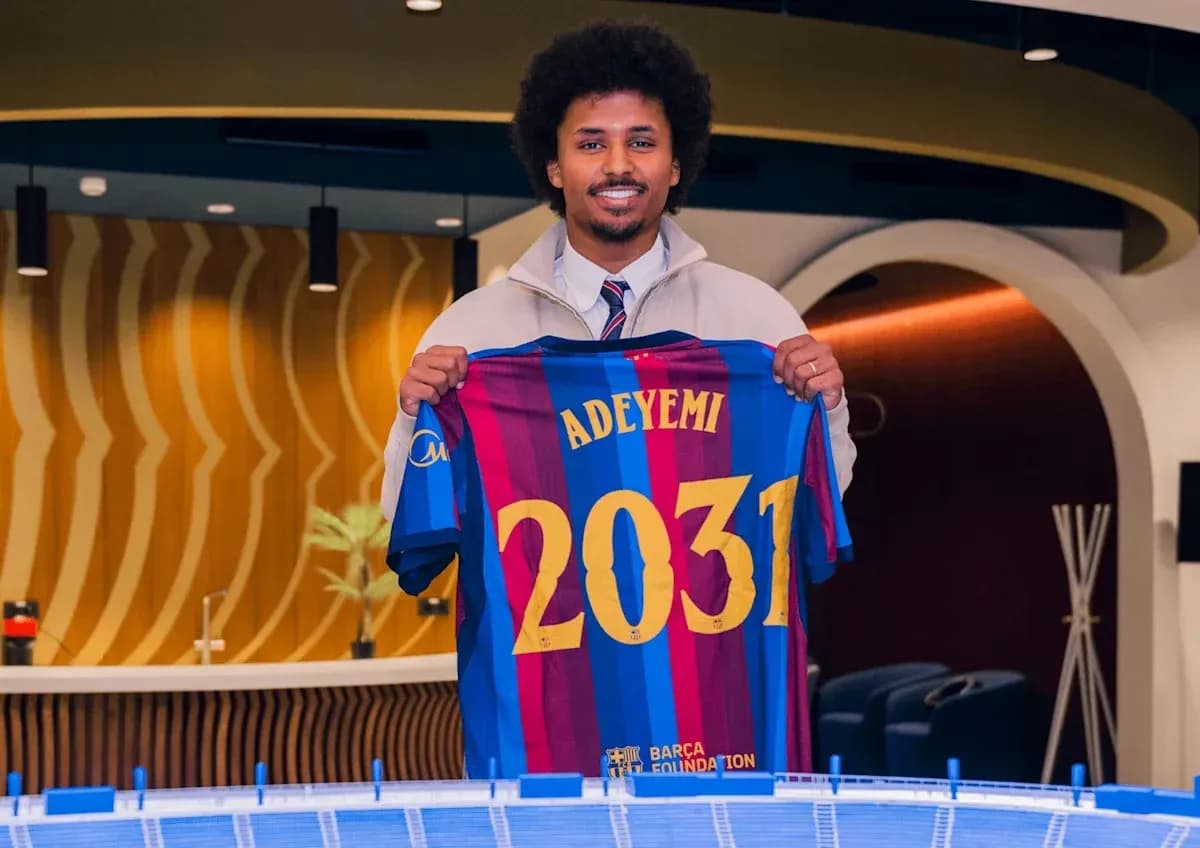
Karim Adeyemi’s arrival at Barcelona gives Hansi Flick a new weapon in attack. It also snaps one of modern football’s most reliable patterns: Borussia Dortmund buying low, polishing a rough diamond, and selling for a fortune.
This time, the numbers tell a different story.
The German winger joins Barça for a fixed €22 million, with a further €7m tied to performance-related add-ons. Sensible money for a player entering the final year of his contract. But for Dortmund, a club that has turned the transfer market into an art form, it is a deal that lands with an unusually modest thud.
A rare miss in a well-oiled machine
Dortmund brought Adeyemi in from RB Salzburg in 2022 for €30m, betting on him as the next big thing: young, explosive, and with the profile to become a world-class forward.
Fast forward four seasons and Barcelona have secured him for a package that, at best, reaches €29m. Even if every bonus is triggered, Dortmund will not recoup more than their original outlay. No margin. No classic Dortmund uplift. Just a straight line where there is usually a steep curve upwards.
For a club that has built its identity on talent trading, that is striking.
Dortmund’s model has been clear for over a decade: identify early, develop smartly, sell at the peak. It has funded title challenges, stadium growth, and constant squad renewal. Adeyemi’s transfer, judged purely on the balance sheet, breaks that rhythm.
When Spain came calling before
The contrast with previous blockbusters is stark, especially when Spain’s giants are involved.
In 2017, Barcelona came for Ousmane Dembélé. Dortmund had plucked him from Rennes for €15m. One electric season later, Barça paid €135m including bonuses. Roughly €120m in profit, a deal that reshaped both clubs’ trajectories and became a reference point for the inflation of the market.
Real Madrid followed a similar path with Jude Bellingham. Dortmund paid €29m to Birmingham City in 2020, nurtured him into one of Europe’s most complete midfielders, and sold him in 2023 for €127m. Another masterclass in timing and development.
Those are just the headline acts. Around them, Dortmund have consistently cashed in smartly:
- Jadon Sancho, turned from Manchester City prospect into a marquee sale.
- Christian Pulisic, developed in-house and moved on at a premium.
- Erling Haaland, signed for a fraction of his true value and sold with the inevitability of a force of nature.
- Pierre-Emerick Aubameyang, Henrikh Mkhitaryan, Mario Götze, Jamie Bynoe-Gittens – different eras, same pattern. Buy potential, sell proof.
Each deal reinforced the idea that Dortmund rarely lose on a major outgoing.
Adeyemi as the exception
Set against that backdrop, Adeyemi stands out. Not as a failure, but as a break in tradition.
The logic behind the sale is sound. A player in the final year of his contract. A market that no longer throws around Dembélé-level fees for promise alone. A squad that needs constant adjustment. From a sporting and strategic perspective, Dortmund avoid the risk of losing him for nothing and free up room for the next project.
Yet the numbers are unmissable. A €30m signing leaving for a package capped at €29m is not how Dortmund usually write their transfer stories.
For Barcelona, the deal looks like an opportunity: a 22-year-old German international, already experienced in European competition, arriving at a price that would once have barely covered the first bid for a Dortmund star. For Dortmund, it is a reminder that even the sharpest operators can’t bend the market to their will every summer.
One move will not redefine a model that has delivered so consistently. But it does pose a question: in a changing market, with rising wages, shorter contracts, and more player power, how often will a club like Dortmund be able to hit those spectacular highs again?