.svg&w=384&q=75 "Pitchgist logo")
Arsenal's Title Charge: Lewis-Skelly's Remarkable Journey
The roar inside the London Stadium never had a chance to settle. One moment, West Ham thought they had their lifeline. The next, Chris Kavanagh’s voice sliced through the chaos.
“Final decision, direct free-kick.”
Callum Wilson’s 95th‑minute equaliser was gone, chalked off for a foul by Pablo on David Raya. Arsenal’s 1-0 win was back on. So was their title charge.
On Sky Sports, Ian Wright was asked if those were the sweetest words he had ever heard. He didn’t hold back. “The sweetest words since Martin Luther King’s ‘I have a dream’,” he said, leaning fully into the drama of a season that refuses to breathe.
Inside the Arsenal dressing room, Myles Lewis-Skelly felt it as something else entirely.
“It was just God on our side,” he said. “We are so grateful.”
A season on pause, then fast-forward
Lewis-Skelly spoke about the moment like a believer describing a late miracle. Relief first. Then everything else.
“It is just a huge sense of relief,” he began, before the floodgates opened. “Joy, excitement, fulfilment – everything you can describe. We are buzzing, but we know that the job is not done. We have got two more finals left.”
Two more finals. Burnley at home. Crystal Palace away. Arsenal sit five points clear of Manchester City, who still have a game in hand and three fixtures to come – Palace at home, Bournemouth away, Aston Villa back at the Etihad. The margins are thin. The emotions are not.
For Lewis-Skelly, that VAR delay felt like a lifetime. It also mirrored his year.
An “extraordinarily worrying situation followed by everything coming good in the end,” is how his journey could be framed. Faith and belief as the thread. Because until the Saturday before last, his season had been stuck in neutral.
From prodigy to test case
Not long ago, Lewis-Skelly looked like he was writing his own fairy tales. Fifteen Premier League starts in his breakthrough campaign. His first Arsenal goal in a 5-1 demolition of Manchester City, capped by a cheeky nod to Erling Haaland’s “Zen” celebration. A teenager with swagger, not shyness.
He scored on his England debut against Albania inside 20 minutes. He went to the Bernabéu in a Champions League quarter-final and ran the game to the point where Real Madrid legends in the executive seats were asking the same question: “Who is this kid?”
This season, the answer felt less clear. The league minutes dried up. His England place disappeared. On 11 April, when Mikel Arteta named him in the starting XI against Bournemouth, it was only his second league start of the campaign. Arsenal lost, badly. The spotlight shifted. So did the narrative.
Arteta later admitted he had been “tough” on the 19-year-old. This was the acid test: how does a young player handle being pushed to the fringes after touching the heights?
Lewis-Skelly chose to go quiet on the outside and loud on the training pitch.
“I spoke with my family and friends,” he said. “I just told them: ‘I don’t want to hear all the noise that is coming from social media. Let me stay in this moment, let me continue to face this adversity and let me come out the other side of it.’”
He refused to prepare like a squad player.
“It is always being prepared, always feeling like I prepare as a starter because you never know when your time will come. Luckily enough, it came against Fulham. I took my opportunity and helped the team out as much as I can.”
The gut call that changed everything
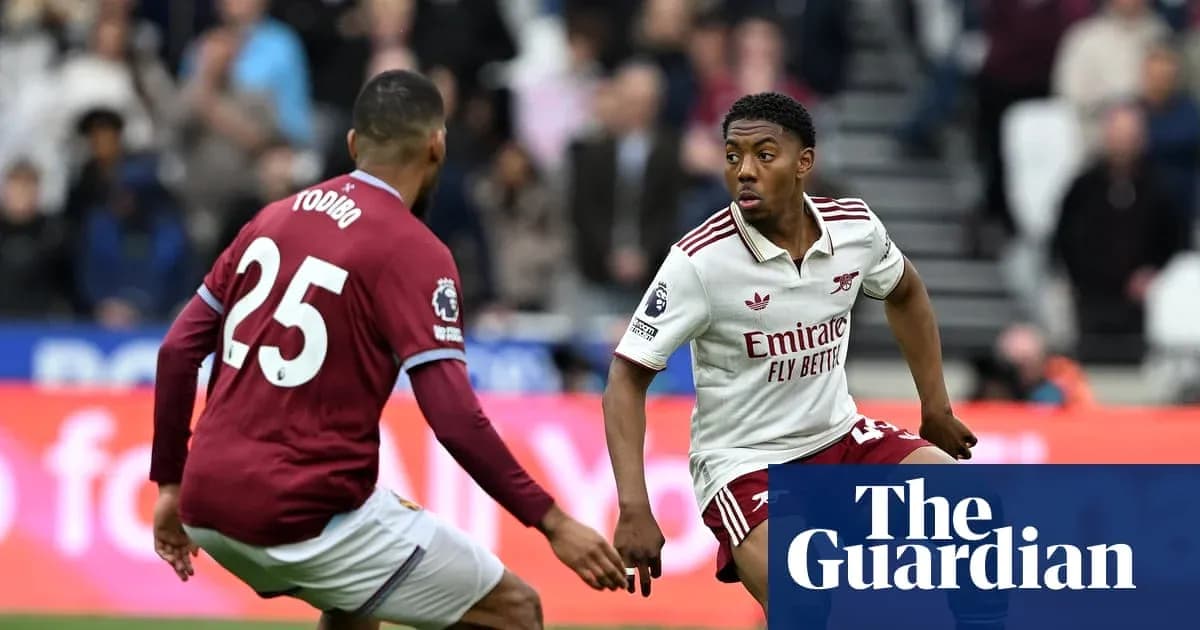
That “time” arrived nine days ago. Arteta went with a gut feeling and dropped Lewis-Skelly into midfield against Fulham, the position he had owned as a kid in the academy before breaking into the first team as a left-back.
It clicked instantly.
His driving display in the 3-0 win did more than energise the side. It reset his season. Suddenly he wasn’t the forgotten prospect. He was the midfielder Arsenal didn’t know they still had.
“It feels so natural for me to be there,” he said. “I have been training there a lot so [against Fulham] I felt comfortable. The boss told me: ‘You are going to play midfield, so go for it.’ That is what I did. I had to be bold and play with courage because that is what this league demands.”
Arteta kept faith. Lewis-Skelly started the 1-0 Champions League semi-final second leg against Atlético Madrid, a tight, nervy win that booked a showdown with Paris Saint-Germain. Then he stayed in the XI at West Ham.
Just like that, he had climbed above Martín Zubimendi in the midfield pecking order. The competition is fierce. Martin Ødegaard, the captain and creative axis, came on after 67 minutes at the London Stadium and changed the rhythm of a performance that had started to sag. Lewis-Skelly shuffled back to left-back to accommodate him, another reminder of his versatility and of the standards around him.
Noise, numbers and a title race
As his minutes shrank earlier in the season, the speculation grew. The dreaded words “pure” and “profit” hovered around his name, shorthand for a homegrown player who could be sold to balance the books.
For now, that talk is pushed to the background. Lewis-Skelly has more immediate concerns.
“It was tough for me initially,” he said. “But I pride myself on having mental strength. Sport is not one pathway because there are ups and downs. It’s how you bounce back from that, how you are in those moments when you face adversity. That is what defines you.”
He knows his form and his future will be judged again once the dust settles on this title race and the Champions League campaign. He knows this run in midfield may yet shape the next phase of his career.
But he is choosing the short view, the sharp edge of the present.
“I am focused on the games we have got coming up,” he said. “And bringing this club back to glory.”
The VAR call at West Ham felt like a twist of fate. For Arsenal, and for Lewis-Skelly, the real judgement arrives over the next two league games and a looming night against PSG.