.svg&w=384&q=75 "Pitchgist logo")
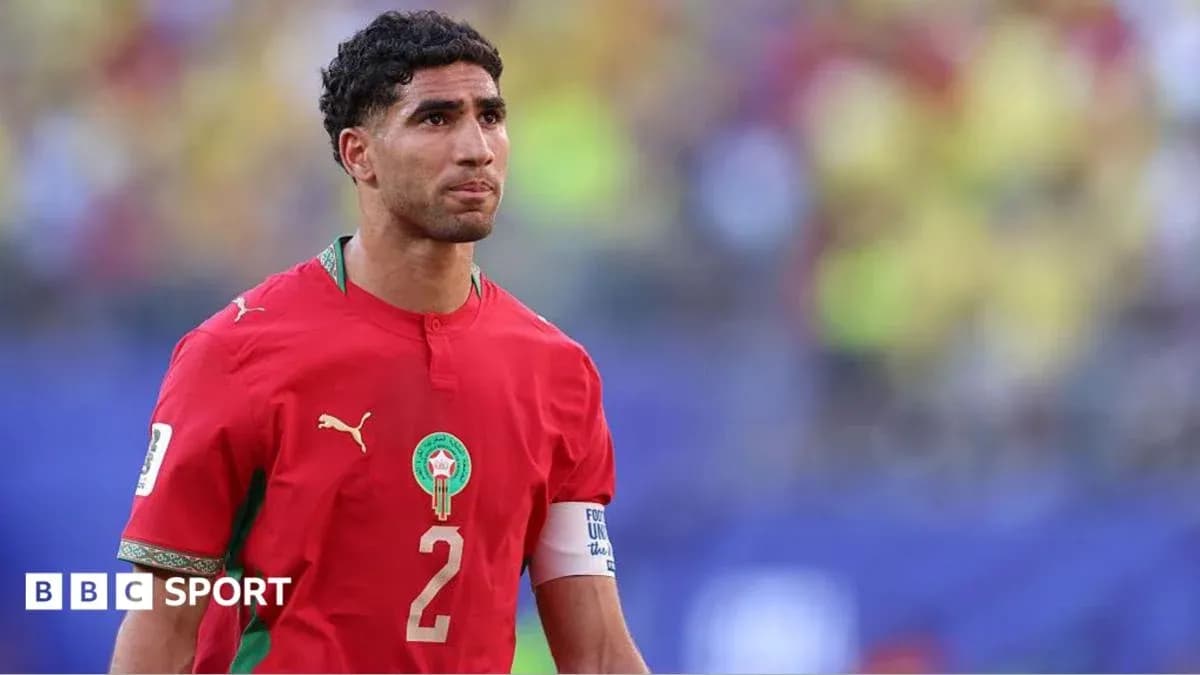
Achraf Hakimi to Stand Trial for Rape in France
Achraf Hakimi, captain of Morocco and one of the most recognisable full-backs in world football, will stand trial for rape in France after prosecutors confirmed the case will go before a criminal court.
The decision follows a preliminary investigation opened in March 2023 by the public prosecutor's office in Nanterre, a western suburb of Paris. A 24-year-old woman accused the Paris St-Germain defender of raping her at his home in the French capital that same year.
An investigating judge ordered a trial in February 2026. French media report that Hakimi, now 27, recently failed in an appeal to have the case thrown out.
He has consistently and firmly denied the allegations.
Hakimi speaks out
On Friday, with Morocco preparing for their second World Cup group match against Scotland in the United States, Hakimi broke a long public silence with a stark message on social media.
"The justice system looked me in the eye and said, 'If you weren't famous, there would never have been a case,'" he wrote.
"I chose to remain silent for years. I believed that maintaining my dignity, being patient, and trusting in the justice system would allow the right decisions to be made.
"Today, a story that isn't mine is being told at the expense of my family, my life, and above all, the truth. I sometimes feel like I've become an easy target.
"I've been waiting for this trial since day one. And now I'm eagerly awaiting it. Finally, I'll be able to speak."
No date has yet been set for the start of the trial, but the decision to proceed ensures the legal battle will run in parallel with the peak years of his career.
Plaintiff’s camp hails “relief and hope”
From the other side of the case, the reaction carried a very different tone.
Rachel-Flore Pardo, lawyer for the plaintiff, welcomed the ruling in a written statement.
"After more than three years of legal proceedings, and after my client was, in her view, defamed and dragged through the mud by Achraf Hakimi's defence, this decision brings her relief and hope.
"Relief that she has been heard by the justice system and will have the right to a trial.
"Hope that this trial will help other women and further weaken the wall of denial and impunity surrounding sexual violence, including in the world of men's football."
The comments underline how this case has already moved beyond the confines of a single allegation, touching on the broader debate around power, celebrity and accountability in elite sport.
World Cup on the horizon, uncertainty off the pitch
On the field, Hakimi remains central to Morocco’s ambitions. He is set to lead his country out against Scotland on Friday (23:00 BST), their second group fixture at a World Cup staged across the United States, Canada and Mexico.
All three of Morocco’s group games are being played in the US, where the team is currently based. For now, his participation is straightforward.
The complications may come later.
Should Morocco advance to the knockout stages and be scheduled to play in Canada or Mexico, Hakimi could face serious difficulties entering those countries. Canadian immigration rules state that authorities can deny entry to any person who has "committed or been convicted of a crime". While he has not been convicted of any offence, the existence of a rape trial order adds a layer of uncertainty that football alone cannot resolve.
The issue is not hypothetical. Last week, Ghana midfielder Thomas Partey missed his nation’s World Cup opener against Panama after being denied entry to co-hosts Canada.
Partey, 32, has pleaded not guilty to seven charges of rape and one count of sexual assault relating to allegations made by four women between 2020 and 2022. He is due to stand trial next year.
The World Cup will be played across all three co-hosts up to the quarter-final stage, before the tournament moves exclusively to the United States. For Morocco, every step beyond the group could bring a fresh layer of logistical and legal tension around their captain.
A stellar career under a harsh spotlight
Hakimi’s footballing rise has been relentless. He made his Morocco debut in 2016 at just 17 and has since earned 97 caps. His surging runs from right-back and set-piece threat were vital as Morocco became the first African nation to reach a World Cup semi-final in 2022, a landmark run that reshaped expectations for the continent’s leading sides.
At club level, Hakimi joined Paris St-Germain from Inter Milan in 2021. In Paris he has collected 13 trophies, including back-to-back Champions League titles over the past two seasons, and established himself as one of the most influential wide defenders in the modern game.
That glittering CV now sits alongside a case that will follow him into 2026 and a trial that promises intense scrutiny from far beyond football.
For Morocco, for PSG, and for Hakimi himself, the next few years will be lived on two stages: one on the pitch, chasing more history; the other in a courtroom in Nanterre, where the stakes could not be higher.