.svg&w=384&q=75 "Pitchgist logo")
The World Cup as a Marketplace for England Players
The World Cup is supposed to strip life back to its basics: flag, anthem, shirt, ball. For England this summer, it comes with group chats pinging, agents calling and sporting directors hovering on the other end of a weak hotel Wi-Fi connection.
This is not a clean break from club football. It is a five‑week shop window.
Thomas Tuchel has taken 26 players to chase history, yet a sizeable chunk of his squad are also chasing clarity over where they will actually be working next season. Transfers will not politely pause for the World Cup; they will run straight through it.
Tuchel knows it.
“If I said to the players not to deal with it now, their telephone will still blow up,” he said. “Of course it is a distraction. It’s a reality, though.”
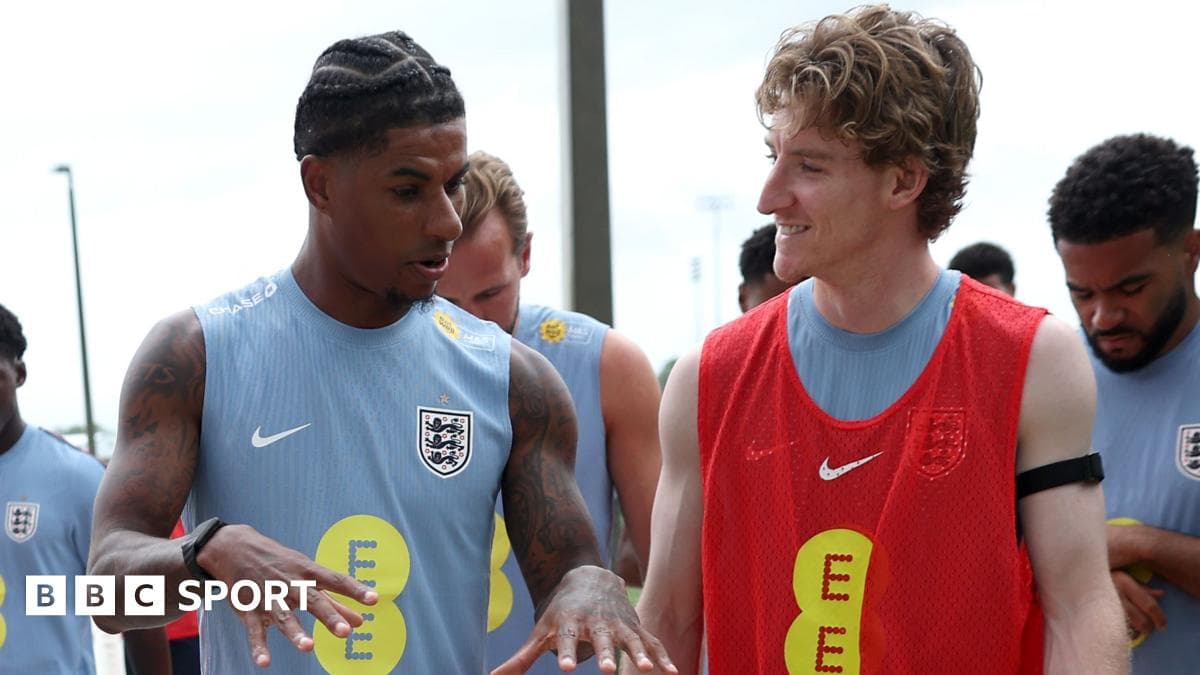
The reality is that England’s camp in West Palm Beach, Florida, is as much about managing noise as managing minutes. The players are learning to handle the heat, the travel and the tactical demands of a Tuchel tournament side. Some are also learning how to live with the knowledge that every training session and every match might nudge a transfer fee up or down by a few million pounds.
The World Cup as marketplace
A World Cup has always doubled as the game’s biggest trade fair. James Rodriguez turned 2014 into a personal highlight reel and walked into Real Madrid. Enzo Fernandez rode 2022 all the way to Chelsea. Harry Maguire’s 2018 performances helped push him through the doors at Manchester United.
The pattern is familiar. Shine on this stage and your value explodes. But the other side is just as real: constant speculation, the drip of rumours, the sense that a player’s mind is half in the next contract and half in the next group game.
Tuchel’s job is to keep the balance: let careers move, keep England moving with them.
“We will always recommend a player to take a decision before a tournament starts,” he said. “The best thing we can have is clarity… but it’s not always possible.”
Anderson on the brink of a record
Few England players arrive with more eyes on them than Elliot Anderson.
The midfielder forced his way into Tuchel’s squad off the back of a standout season at Nottingham Forest. Now both halves of Manchester are circling. Manchester City have already seen an opening bid knocked back; Manchester United are watching closely. Those close to the situation believe the 23-year-old favours a move to Etihad Stadium.
If Forest do sell, the numbers will be huge. The fee is being talked about in the bracket that would eclipse the £105m Arsenal paid West Ham for Declan Rice in 2023. That would make Anderson the most expensive British player in history.
So he trains in Florida, trying to impress Tuchel and block out the noise, while knowing that every sharp turn and crisp pass is being clipped, shared and dissected in recruitment rooms back home.
Rogers in demand
Anderson is not alone.
Morgan Rogers comes into the tournament off a heavy-duty campaign with Aston Villa: 55 appearances, 14 goals, 12 assists. Those are the sort of numbers that do not stay quiet for long.
Arsenal, the reigning Premier League champions, are interested. Manchester United are in the conversation. Chelsea and Manchester City are also linked. The list reads like a who’s who of English football’s power brokers.
The message from Villa is clear enough. According to BBC Sport’s senior football correspondent Sami Mokbel, any club wanting Rogers will need to cross the £80m line. That price tag travels with him into every England session, an invisible marker of expectation.
Rashford’s clock is ticking
Some situations are more urgent than others. Marcus Rashford’s is on a countdown.
The forward is on loan at Barcelona from Manchester United. Barca have until 15 June – two days before England open their World Cup campaign against Croatia – to trigger a £26m clause to make the deal permanent. The Spanish club are trying to renegotiate the terms.
If the deadline passes without agreement, Rashford’s future remains in limbo, and the negotiations roll on into the tournament itself. That means one of England’s most experienced attackers could be juggling knockout games with contract uncertainty.
Tuchel can set rules, but he cannot stop the clock.
“It’s about common sense. I would not like it [transfers] the day before a match, or on a matchday, that’s the policy,” he said. “But everything else if it’s done privately, efficiently and quietly then we are always happy to help.”
Stones closes a chapter
For John Stones, there is no countdown. There is a full stop.
After a decade at Manchester City, he has decided to move on. Six Premier League titles, a Champions League, two FA Cups, five League Cups and a cabinet full of other honours mark him out as one of England’s most decorated modern defenders.
Now he is heading into a World Cup without a club, at least in the long-term sense. It is a strange kind of freedom: no training ground to report back to, no manager to impress beyond Tuchel, yet a need to show potential suitors that he remains the same composed, ball-playing defender who anchored City’s dominance.
Clarity will come, but not yet.
Gordon done, others waiting
Anthony Gordon, by contrast, has already turned the page. He completed his move from Newcastle United to Barcelona before flying across the Atlantic. His future is inked in, his focus can narrow.
He is the exception in this England squad, not the rule.
Around him, conversations are happening in corridors and on quiet balconies. Agents are plotting, clubs are pushing, families are asking questions. Tuchel cannot seal his players off from all of it, so he is trying to manage the flow.
“If anyone has a chance to complete a change of club and a transfer we will not stand in their way,” he said. “But it has to align, of course, with our schedule and our goals which is to be focused and prepared for matches.”
History repeating itself
None of this is new to England. Ashley Cole spent the 2006 World Cup with his Arsenal exit saga rumbling on in the background, eventually sealing a deadline-day move to Chelsea in a swap deal involving William Gallas. His medical was squeezed in while he was on England duty in Manchester.
In 2010, Joe Cole arrived in South Africa without a club after leaving Chelsea. He insisted he had handed everything to his agent so he could concentrate on England. “My future will sort itself out. It won’t distract me,” he said at the time.
The names change. The pattern doesn’t.
This summer, Tuchel must walk the same tightrope: embrace the reality that the World Cup is part theatre, part marketplace, and still somehow create a bubble strong enough for his players to perform at their peak.
If he gets it right, England might ride this chaos all the way through the tournament. If he gets it wrong, the biggest distraction of their summer may not be the heat in Florida or the pressure of a World Cup – but the vibration of a phone on a bedside table.