.svg&w=384&q=75 "Pitchgist logo")
World Cup 2023: Italy Watches from the Sidelines
The lights come up at the Azteca tonight at 20:00, and with them the biggest World Cup in history. Forty‑eight national teams, three host countries, a month of football stretching to a final on 19 July. The whole world is there. Almost.
Italy, once a fixture on nights like this, will be watching from the touchline and the television studio, not from the pitch. The tricolore will be carried instead by three coaches: Carlo Ancelotti, Fabio Cannavaro and Vincenzo Montella. It is a strange, disorienting World Cup for a country so used to being at the centre of it.
Mexico v South Africa opens the tournament in the legendary bowl of the Estadio Azteca, where history hangs in the air as heavily as the altitude. It is the first act of a competition that promises excess in everything: three opening ceremonies, three hosts, and a cast of stars that stretches from Lionel Messi to Kylian Mbappé, from the precocious Lamine Yamal to Spain’s metronome Rodri.
Messi’s hunt for a repeat
Messi arrives as reigning champion, the man who finally lifted the curse with Argentina in Qatar and now goes hunting for something even rarer: a successful defence. He knows exactly what awaits.
“It will be tough to beat us,” he has warned. Not a boast, more a statement from someone who understands what a settled, battle‑hardened group looks like.
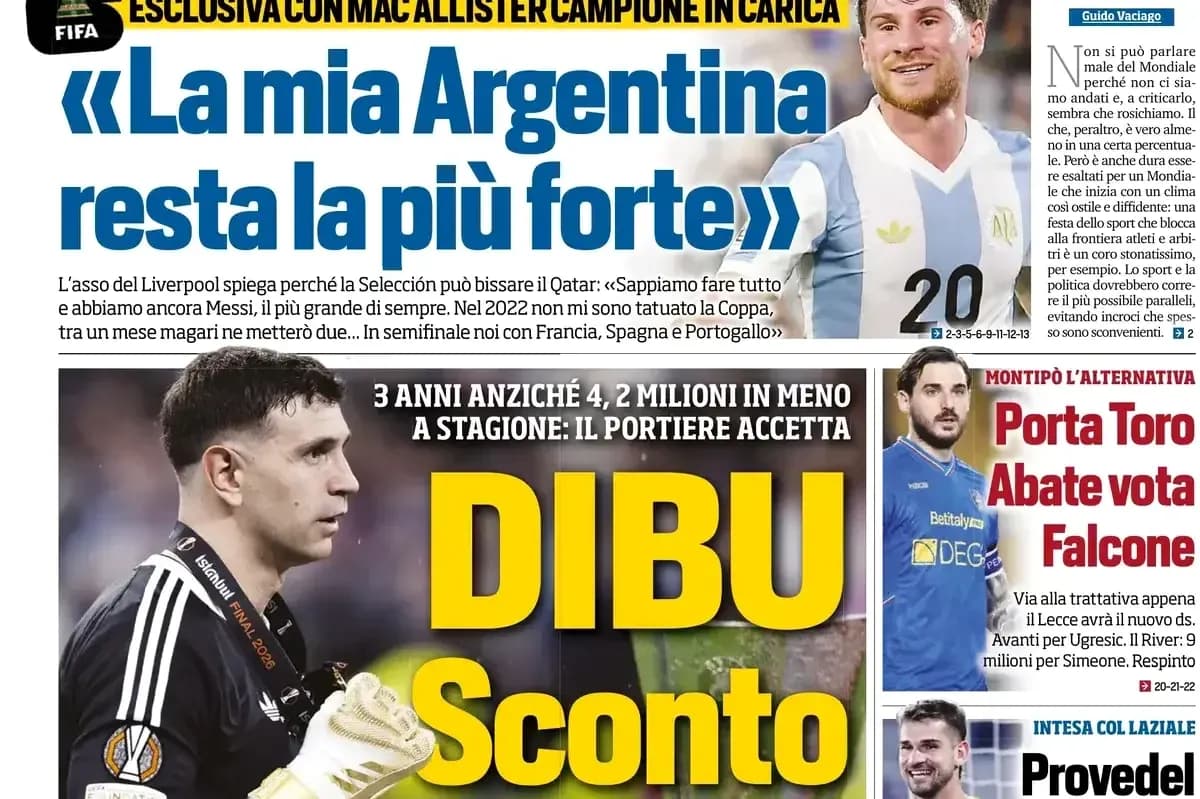
Inside that dressing room, belief runs deep. Alexis Mac Allister, now a key figure at Liverpool and still a pillar of the Selección, lays it out simply. Argentina, he insists, remain the benchmark.
“My Argentina remains the strongest,” he says. “We know how to do it and we still have Messi, the greatest of all time.”
Mac Allister did not mark the 2022 triumph with ink. No World Cup tattoo then. This time, he smiles, the story could be different: in a month he might have “two” on his skin. That is how confident the champions feel about their ability to navigate another marathon.
He even sketches his dream last four: Argentina, France, Spain and Portugal in the semi‑finals. A heavyweight bracket for a heavyweight tournament.
Spain, the algorithm and Rodri’s claim
On paper, the favourites’ podium looks familiar: France and Argentina at the top, the two finalists from Qatar again expected to dictate the pace. Yet the numbers tell a slightly different tale.
An algorithm tips Spain as the team to beat. Cold data, probability curves, simulations. It all points towards La Roja.
Rodri does not argue. He embraces it.
“The level has been raised, my Spain side are favourites,” the Manchester City midfielder declares. He knows the spine he leads is loaded with talent and depth, and he is not shying away from the expectation. Spain arrive with a blend of youth and control, and in a tournament where squad depth will be tested like never before, that matters.
France, stars everywhere
France land with a squad that looks like it has been assembled in a video game. Kylian Mbappé heads an attack that can frighten anyone, surrounded by an embarrassment of options in every line.
The question hangs over Didier Deschamps’ group: can there be too many stars? La Gazzetta dello Sport wonders the same. The firepower is obvious, the fear factor undeniable. Managing egos, minutes and roles over a month in three countries is another challenge entirely.
For now, the rest of the world simply sees the blue wave coming and braces.
Italy’s coaches on the world stage
If Italy’s players are absent, its football culture is not. Ancelotti, “our Carletto”, carries Italian know‑how into the dugout once more, a serial winner entrusted with guiding a powerhouse on the biggest stage. Cannavaro and Montella complete an unusual trident: three Italian coaches, three different paths, one shared responsibility to represent a nation that has fallen out of the World Cup’s inner circle.
Their presence softens the blow, but only slightly. Nights like this are supposed to belong to Italian captains, not just Italian tacticians.
The last dance for two icons
This 23rd edition of the World Cup also carries a sense of farewell. For two icons, this is the last dance. The tournament will not see their like again in the same way, with the same weight of history and expectation.
They step into a competition that has grown around them, expanded, commercialised, stretched across a continent. Yet for them, the essence remains the same: one month to define a career’s final chapter.
Juve eye Dibu, Inter move in goal
While the world turns its eyes to the Azteca, the transfer market quietly reshapes Italy’s giants.
At Juventus, the path to Emiliano “Dibu” Martinez is opening. The Aston Villa and Argentina goalkeeper has accepted a three‑year deal on reduced terms, worth 4.2 million euros less per season than his previous demands. A discount for Juve, a statement from a World Cup winner willing to bend for the chance to guard their goal.
Now comes the hard part: finding an agreement with Aston Villa. The English club want 15 million euros. Juventus, with director Giovanni Manna and the new structure at work, are starting from five. The gap is clear, the negotiation delicate.
In the background, Besiktas move for Michele Di Gregorio, while Nico is close to unlocking a deal for Alexander Sørloth. Ruggeri has admirers at Atletico. The Premier League chases Thuram, which could mean more money for Kolo. There is contact with Lucumí. Cagliari push for Gaetano. The dominoes line up, waiting for the first big fall.
Across the city, Inter are building from the back. After closing for Solet, they are close to a second defensive piece: an agreement is in place with Lazio goalkeeper Ivan Provedel. The meeting with his agent went smoothly, and the Nerazzurri see him as a key reinforcement between the posts.
Alessandro Bastoni, meanwhile, is going nowhere. His representative has been clear: “Ale is happy at Inter.” The message is simple, and it suits Simone Inzaghi just fine.
Milan and Modric, one more chapter?
On the other side of the San Siro divide, Milan keep a door open to a different kind of legend. Luka Modric has an offer from Real Madrid to move upstairs into a director’s role. A golden retirement inside the Bernabéu.
He is not ready to accept. Not yet.
Before deciding, the Croatian wants to speak with Oliver Glasner, the new coach. He wants to understand his place, his minutes, his role. Milan wait, attentive. If Modric decides there is still football left in his legs and not just in his memory, the Rossoneri could yet become the stage for his final European act.
A World Cup without Italy on the pitch, a market alive with Italian fingerprints, and a planet turning its gaze to Mexico v South Africa at 20:00. The ball is about to roll. The question, for Italy, is simple and brutal: how many more of these World Cups will pass before the Azzurri are back where they belong?