.svg&w=384&q=75 "Pitchgist logo")
U.S. Soccer's Offer to Pochettino for 2030 World Cup
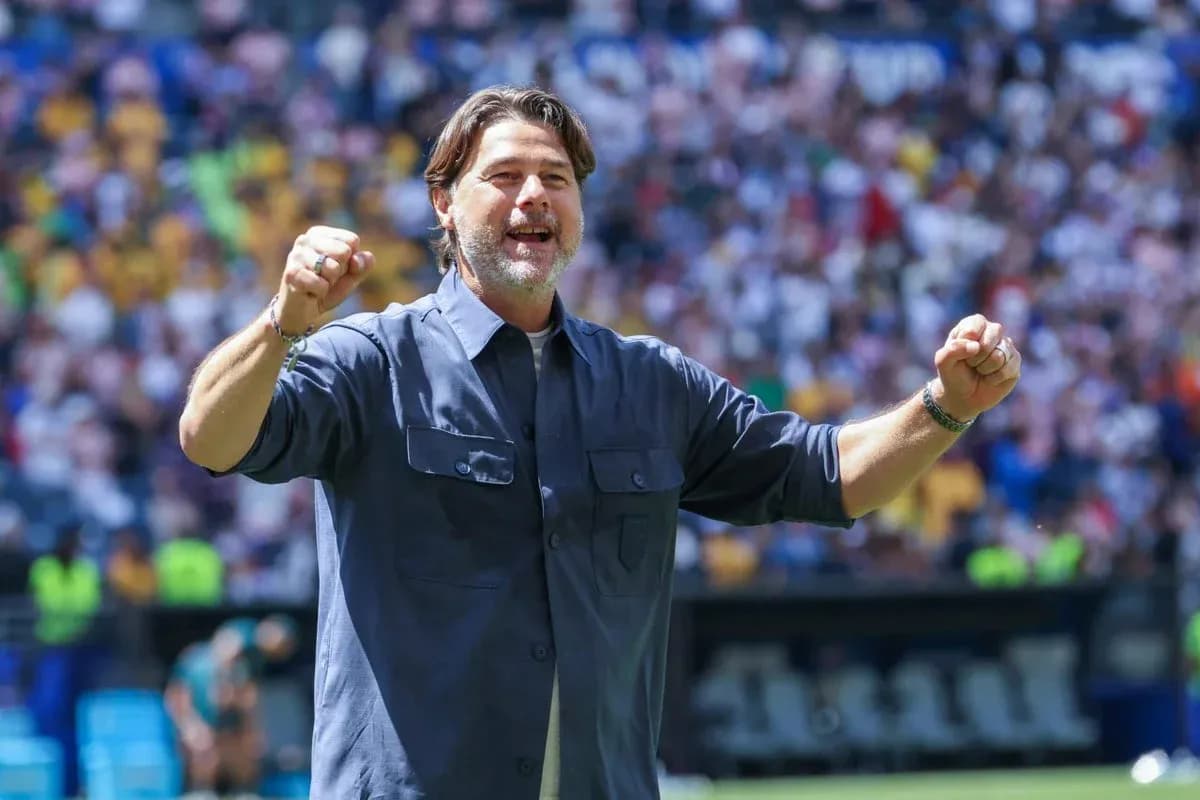
U.S. Soccer has put its cards on the table. Mauricio Pochettino now knows they want him not just for this World Cup on home soil, but for the next one as well.
The federation has formally presented the Argentine with an offer to stay on for a second World Cup cycle through 2030, sources briefed on the talks have told The Athletic. The proposal has been on the table since before the tournament kicked off, a clear signal that the relationship has worked for the federation and they want it to continue.
The decision, though, will not come now. Not while the World Cup is raging in the United States and his team is flying.
Pochettino’s current deal runs only to the end of this tournament. On paper, he could be a free agent within weeks. U.S. Soccer knows that, knows his stock is rising with every confident USMNT performance, and moved to stake its claim early. Conversations between the federation and Pochettino have been running for months, but all sides agreed: no final call until after the World Cup, when results, emotions and opportunities are clearer.
A dream start, a bigger question
On the field, Pochettino has delivered exactly what the federation hoped when it turned to him in September 2024. The USMNT have burst into this World Cup, beating Paraguay and Australia to secure a place in the round of 32 with a game to spare. That made Thursday night’s defeat to Turkey a dead rubber, a rarity for this program at a major tournament and a luxury that underlines their progress.
The draw beyond that looks inviting. A nation that arrived with cautious optimism is now daring to think about the latter stages. Every performance, every new layer of belief, only sharpens the question: how long will Pochettino stay to oversee this project?
There was an assumption in some corners of the game that, at 54, he would treat this World Cup as a high-profile interlude before jumping back into the churn of elite club football. Those whispers grew louder when Matt Crocker, the sporting director who had worked with him at Southampton and then brought him to U.S. Soccer, abruptly left for a job in Saudi Arabia in April.
If that departure was meant to destabilize the project, it has not shown on the pitch.
A four-year offer wrapped in a decade-defining cycle
What U.S. Soccer is putting in front of Pochettino is more than just another contract. It is a four-year runway through one of the most loaded cycles in American soccer history.
The next World Cup looms, of course, but the calendar is crowded with marquee milestones. The United States will host the Olympic Games in Los Angeles in 2028. Copa America that same year is also expected to land in the U.S., with the USMNT again in the thick of it. A new $250 million national training center in Atlanta is coming online, intended as both a physical home and a statement of intent.
For a coach who has long spoken about development and culture, the pitch is obvious. An extension would give Pochettino greater scope to shape the national team beyond the senior squad: influence over youth pathways, a say in the progression of prospects, a role in coach education, an area that has interested him throughout his career.
U.S. Soccer believes that combination – a global stage, a booming domestic market, and the chance to build something lasting – can keep him in international football when Europe’s biggest clubs come calling again.
Big-league money, big-league expectations
The federation has had to think and act like a heavyweight to even get into this conversation. Before hiring Pochettino, U.S. Soccer held talks with Jurgen Klopp, a move that underlined the level of ambition at the top of the organization. It then constructed a financial package robust enough to attract a coach whose résumé includes Chelsea, Tottenham Hotspur and Paris Saint-Germain.
A historical tax filing published in March, covering April 1, 2024 to March 31, 2025, projected Pochettino’s pro-rated base salary at around $4 million. With bonuses and incentives, his total compensation in a non-World Cup year could reach between $5 million and $6 million. An extension, with a home World Cup and more major tournaments built in, would keep him among the highest-paid international managers in the game and competitive with what he could command at the upper end of European club football – though still shy of the very richest club deals.
That financial muscle has relied heavily on private backing. U.S. Soccer has previously said that Pochettino’s original deal depended “in significant part” on a “philanthropic leadership gift” from Ken Griffin, the founder and CEO of hedge fund Citadel, with “additional support” from Scott Goodwin of Diameter Capital and several commercial partners. The federation has kept up a steady dialogue with wealthy donors and sponsors to ensure it can continue to shop in that market.
This is what “the big leagues” look like, U.S. Soccer chief executive JT Batson argued when it emerged that Pochettino had held talks with AC Milan in late May. An in-demand coach will attract interest. The federation expects more approaches if the USMNT’s World Cup surge continues.
Pochettino weighs legacy against the lure of club football
For now, Pochettino is careful not to let the future dominate the present. Speaking earlier this week, he made it clear he has not closed the door on staying, but also that his focus remains on the players in front of him.
“It’s difficult to describe or know your future,” he said. “But when you are here, I think it’s difficult now to see yourself living in another place, because for sure, we will miss it if one day we don’t stay here in this country.
“We told the federation we are open, but we don’t want to distract when all the energy needs to be with my players.”
In another interview, he pushed the conversation towards something broader than results or trophies.
“If the American people start to show passion in our sport too, why not be here being part of something that can create a legacy?” he said. “The legacy is not to win the World Cup. Of course, we want to win, but that [connection] is the legacy we need if one day we want to be very successful and be consistent. Why not be part of that?”
That is the crossroads in front of him. One path leads back to Europe, to the relentless rhythm of club football, to the weekly grind and the Champions League nights that still define managerial reputations. The other runs through Atlanta’s new training fields, a home Olympics, Copa America on American soil and a second World Cup cycle with a generation he has already begun to shape.
U.S. Soccer has made its choice clear. The rest will be decided not in a boardroom, but in the weeks that will define how this World Cup – and perhaps Pochettino’s American chapter – is remembered.