.svg&w=384&q=75 "Pitchgist logo")
Turki Al-Sheikh's Bid for Derby County: A Defining Moment for English Football's Regulator
English football’s new independent regulator has barely taken its seat at the table. Already, it faces a decision that cuts to the heart of what it claims to stand for.
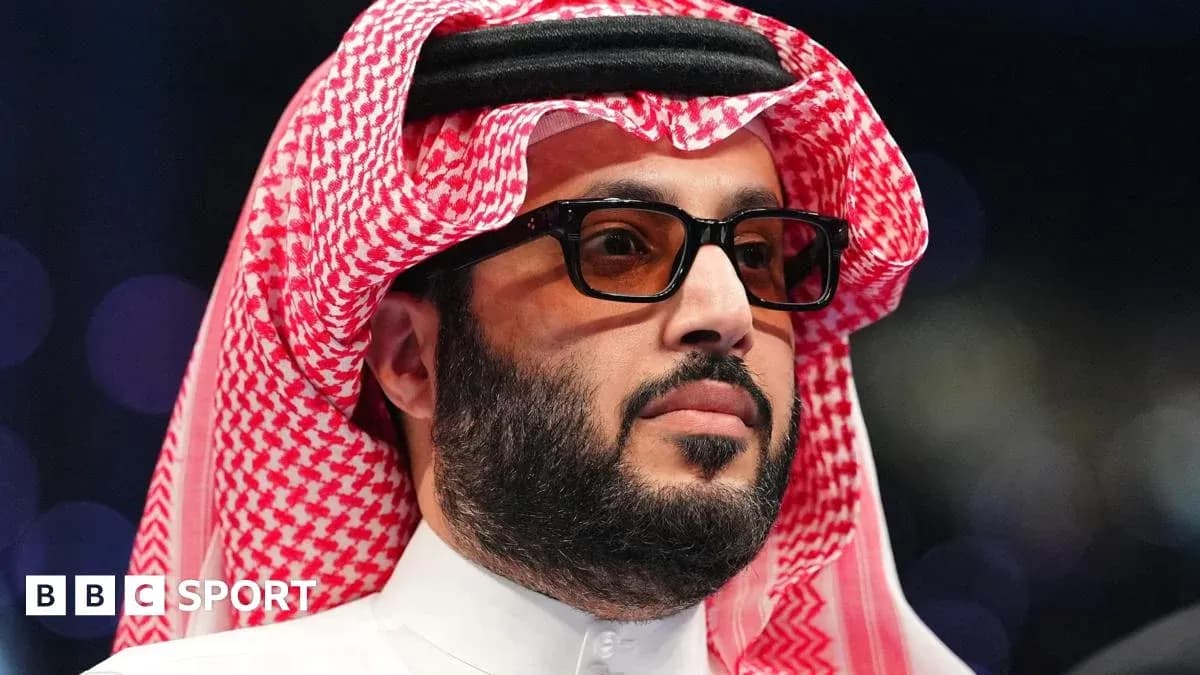
Turki Al-Sheikh, one of the most powerful figures in Saudi sport and entertainment, wants in at Derby County.
The 44-year-old chairman of Saudi Arabia’s General Entertainment Authority, a close ally of de facto ruler Mohammed bin Salman and a central figure in the country’s high-profile boxing boom, is attempting to buy a stake in the Championship club. On paper, it is another ambitious investor circling a grand old name. In reality, it is a collision between English football’s future governance and Saudi Arabia’s contested global sporting project.
A new regulator, an early crossroads
Any deal will need the approval of the Independent Football Regulator (IFR), the body created last year with a bold brief: safeguard the game’s future and protect its integrity. Until now, the English Football League handled owners’ and directors’ checks for Championship clubs. The IFR has taken that power on and rewritten the test for owners, directors and senior executives.
This is no dry procedural matter. Amnesty International has already framed it as a moment of truth.
“This is a defining test for English football's new independent regulator,” said Felix Jakens, head of campaigns at Amnesty International UK. He posed the question starkly: will the regulator allow “a senior representative of a government directly implicated in mass human rights violations to take control of one of the country's oldest football clubs?”
The demand from Amnesty is clear – the regulator must not just probe, but “answer them transparently”.
The IFR, the EFL and Derby County have all declined to comment on Al-Sheikh’s interest. So have Al-Sheikh’s representatives. Silence, for now, while the storm gathers.
Saudi footprint grows
Saudi Arabia’s presence in English football is no longer hypothetical. Newcastle United are already majority-owned by the country’s Public Investment Fund, a deal that drew sustained criticism from human rights groups and sparked fierce debate about “sportswashing” – the use of sport and culture to soften a nation’s image abroad.
Any stake in Derby for Al-Sheikh, Amnesty argues, would “mark a significant expansion of Saudi Arabia's footprint in English football”.
Human rights organisations say Saudi Arabia executed 356 people last year – a record figure that has drawn international condemnation. For them, the Derby story is not a local ownership saga; it is part of a much wider pattern.
“The serious questions surrounding Saudi involvement in sport anywhere in the world are just as relevant here,” Jakens said. “Al-Sheikh is not a private businessman. He is the chairman of Saudi Arabia's General Entertainment Authority.”
That distinction matters. It goes to the heart of whether English clubs are becoming extensions of state power, rather than merely attractive assets for wealthy individuals.
Multi-club concerns and Premier League red lines
Al-Sheikh has been here before. Talks with Bristol City, previous interest in Southampton and Millwall – his name has hovered around English football for several years without a deal landing. His current move towards Derby comes with another layer of complexity.
Newcastle’s ownership by Saudi Arabia’s Public Investment Fund means any fresh Saudi-linked investment elsewhere immediately raises questions about multi-club control. The Premier League’s owners’ and directors’ test explicitly forbids any individual or entity from directly or indirectly determining the management of more than one English league club.
Derby, as a Championship side, fall under the EFL and now the IFR rather than the Premier League. Even so, the web of relationships between powerful Saudi figures and English clubs will be scrutinised. The regulator cannot afford to look naive.
Derby at a crossroads of its own
While the governance debate rages, Derby County have their own, very human, set of dilemmas.
This is a club that has stared down the abyss. Administration, points deductions, the threat of liquidation – the Rams’ recent history has been a warning to the rest of the pyramid. Local businessman David Clowes stepped in during the summer of 2022, buying the club out of administration and stabilising the ship.
Clowes has since been open about the need for new investment. Since 2024 he has been looking for partners and has said he could be willing to sell upwards of 80% of his share in the club. The door, effectively, is ajar.
Into that space walks Al-Sheikh, a billionaire with a taste for spectacle and a track record of delivering lavish events.
A fanbase split between dream and discomfort
As ever, supporters sit right on the fault line between ethics and ambition.
The Derby fanbase is divided. Some can already see the possibilities: serious money, major signings, a rapid push back towards the Premier League after almost two decades away. Others look at Saudi Arabia’s human rights record, its treatment of women, its use of the death penalty and anti-LGBT stance, and want no part of it.
Rams fan Nick Webster, speaking on BBC Radio Derby’s Sportscene at Six, did not pretend this was a marginal debate. There is “no skirting around” how split the fanbase will be, he said. For some, the lure of “billions that potentially could be invested” is irresistible. For others, “the human rights and all the other issues that are going on” are impossible to ignore. Many, he suggested, will be left in an uneasy middle ground.
“It will make a lot of people uncomfortable,” Webster admitted.
That discomfort is precisely what has accompanied Saudi involvement in sport across the globe. Glamour and growth on one side. Deep moral unease on the other.
The boxing showman and the Derby dream
If the ethical arguments are fierce, the sporting sales pitch around Al-Sheikh is equally forceful.
Derby supporter Sam Jones, a boxing manager who has worked with Al-Sheikh, felt something very different when he heard the news. The 37-year-old said he was “excited straight away” at the prospect of the Saudi powerbroker helping bankroll Derby’s climb.
Jones points to the boxing extravaganza staged at the Pyramids of Giza in May, where Oleksandr Usyk headlined a world title fight against Rico Verhoeven and Jones’ own fighter Jack Catterall boxed on the undercard. It was, he suggested, a window into Al-Sheikh’s capacity to turn grand ideas into reality.
“In my 10 years in boxing I've been to some very mad places, and my fighter Jack has just won a world title [WBA 'regular' welterweight belt] on the foot of the pyramids,” Jones told BBC Radio Derby.
Half an hour before Catterall’s ring walk, a sandstorm whipped up around the ancient site. Chaos, drama, theatre. “It was completely crazy,” Jones said. To him, that night summed up Al-Sheikh’s “serious ambition” and willingness to push boundaries.
Jones believes that if Al-Sheikh “does take over the club or invest heavily in the club, whatever he's doing,” and applies even “a quarter of the effort that he has done with boxing,” then Derby fans “need to be very excited.”
That is the allure. A club that has been scarred by financial crisis suddenly backed by a man who can stage title fights at world heritage sites.
A test that reaches far beyond Derby
All of this now lands on the desk of the IFR.
Its mandate is to protect English football from reckless ownership, opaque funding and existential risk. Yet this case goes further. It asks whether the regulator is prepared to draw a line on state-linked money, or whether it will accept that the global game has already moved beyond such distinctions.
For Derby, the stakes are clear enough: a potential injection of vast wealth, weighed against the discomfort many feel about where that money comes from and what it represents.
For English football’s new regulator, the stakes are even higher. Its response to Turki Al-Sheikh will tell the game – and the world – whether it is prepared to challenge the most powerful forces now circling the sport, or simply learn to live with them.