.svg&w=384&q=75 "Pitchgist logo")
Tuchel's England Faces DR Congo: A Critical Knockout Chapter
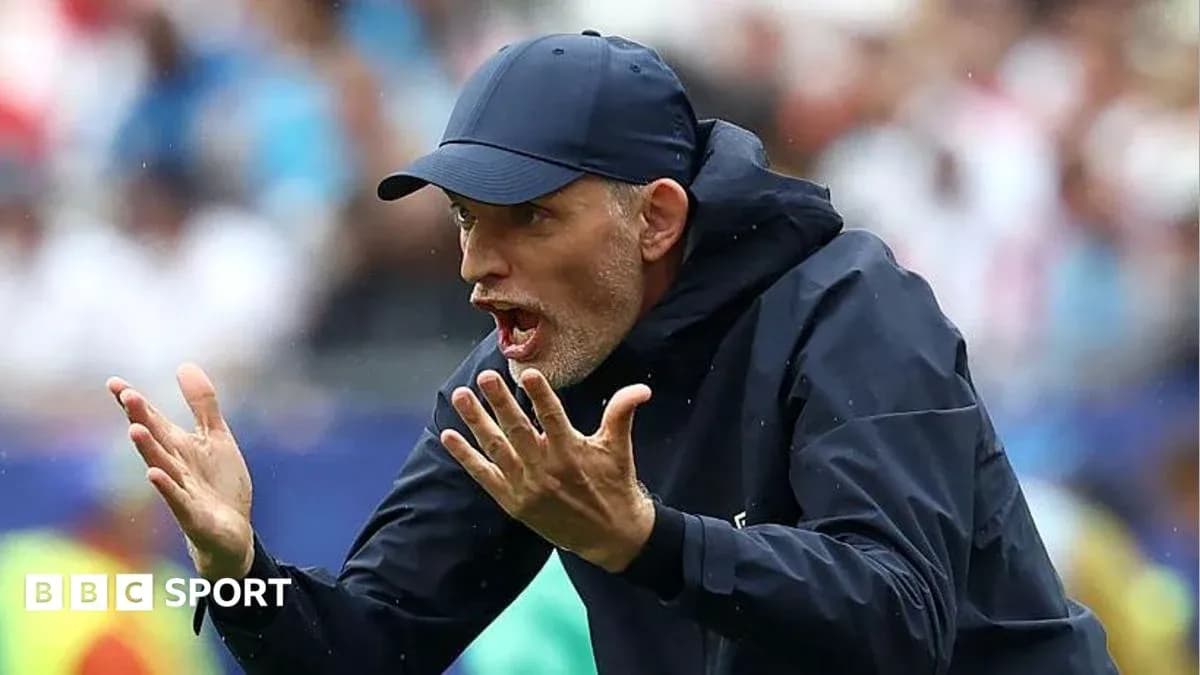
Thomas Tuchel talks about this World Cup as a book. Miami was the prologue, the group stage Chapter Two. Now comes what he calls “the third chapter” – the part where stories usually turn dark for England or, just once in history, turn to gold.
This is where one bad touch, one lapse at the back, can rip the final pages out of his script.
A knockout with teeth
England meet DR Congo in Atlanta on Wednesday, under a closed roof and controlled air, spared the suffocating Georgia heat. The conditions will be kind. The tournament will not.
Tuchel’s side have done what they had to so far. Top of Group L, through with a game to spare, wins over Croatia and Panama wrapped around that grey, goalless grind against Ghana. It has been efficient rather than exhilarating. Job done. Nothing more.
Now every game is sudden death, and the World Cup has already sharpened its knives for the favourites. Germany are out, floored by Paraguay on penalties. The Netherlands, rich with Premier League talent, have gone the same way against Morocco, Ronald Koeman gone within a day. Brazil only survived Japan thanks to Gabriel Martinelli in stoppage time.
The message is everywhere Tuchel looks: no one is safe.
A story with a weak spine
Strip away the optimism and one weakness glares back at England. The defence.
“The area of the pitch you want stability in is your goalkeeper and back four,” Wayne Rooney told BBC Sport. “With the back four we haven’t had that.” He is right.
The alarm bells were ringing before a ball was kicked. Tino Livramento never made it to the World Cup. Reece James arrived with a medical file as thick as a novel. His hamstring went again against Croatia, to Tuchel’s surprise but not to anyone who has followed his career.
Then came another blow. Jarell Quansah, James’ deputy at right-back, injured against Panama. Two right-backs gone, the plan shredded.
Both James and Quansah will miss DR Congo. Tuchel insists they are “getting closer and closer”, with Quansah a touch ahead, but that is talk for another day. For now, Djed Spence stands alone as the only specialist right-back. The alternative is to drag Ezri Konsa across from centre-back and reopen the door for John Stones.
That back line has never settled. Jordan Pickford is the one fixed point; everything in front of him keeps moving. Stones and Konsa started the 4-2 win over Croatia. Then Stones was out, Konsa paired with Marc Guehi. Tuchel has to calculate around Stones’ lack of football – just five Premier League starts before he left Manchester City – and James’ limited minutes at Chelsea.
Tuchel’s fondness for versatility, for defenders who can cover both flanks and central roles, has left England light on specialists when it matters most. If the draw brings Brazil and Vinicius Jr in a quarter-final in Miami, that is not a night for compromise at full-back. It is a night for a pure defender, in rhythm, in one position. Tuchel can only hope James is more than a hopeful bulletin by then.
Rice, Kane, Bellingham – and the one England cannot lose
Tuchel’s selection headaches do not end at the back. Bukayo Saka, given his first World Cup start against Panama, lasted 63 minutes while managing an Achilles tendon issue. The temptation to unleash him again against DR Congo is obvious. So is the risk.
The calculation is even more brutal with Declan Rice.
Tuchel left him out against Panama, a sensible call with qualification secure and Rice on a yellow card, also nursing a hamstring problem and carrying a kick to the calf from the Ghana game. England coped on the scoreboard. They did not cope in control.
Panama took 13 shots. England looked wide open on the break. Elliot Anderson was left to plug gaps on his own in central midfield, stretched and overworked as Jude Bellingham and Morgan Rogers went hunting higher up the pitch.
A better side than Panama would have punished that imbalance.
The lesson was blunt. Rice now sits in the same bracket as Harry Kane and Bellingham – players England simply cannot replace. He is the shield in front of a fragile defence, the organiser, the tempo-setter, the set-piece taker. He locks the door and still finds time to pick it from the other side.
Without him, England’s structure wobbles. With him, they have a platform to play. In a tournament where one mistake can end everything, that security is priceless.
Tuchel walks the tightrope
Tuchel’s England do not look like a side about to drift into complacency. The German is too driven, too scarred by knockout football, to allow that. Any lingering comfort has been stripped away by the sight of Nagelsmann under siege back home and Koeman already out of a job.
“The games in the round of 32 speak a very clear language,” Tuchel said in Atlanta. “It is very narrow margins. It actually makes me more calm than nervous.”
He knows what is coming: opponents well-drilled, happy to suffer, waiting for England to over-commit. DR Congo will not care for the script Tuchel has in his head. They will have their own.
Tuchel also knows the weight of expectation. “We are the favourites,” he said. “We play against our own expectations. We expect to go further than the round of 32, so why should the public not expect that?”
That is the tightrope. England are expected to beat DR Congo. They are expected to reach the latter stages. They are expected, by their coach and their country, to look like contenders.
Yet Tuchel cannot afford a single misstep in selection or strategy. Not at right-back. Not with Rice’s fitness. Not with Saka’s Achilles. Every call now shapes the next chapter.
This World Cup is already littered with the wreckage of plans that looked solid a week ago. Tuchel has framed England’s campaign as a story. On Wednesday in Atlanta, we find out whether it still has a champion’s ending in sight – or whether the third chapter is where the book slams shut.