.svg&w=384&q=75 "Pitchgist logo")
Southampton's Play-off Victory Overshadowed by Controversy
The celebrations at St Mary’s never quite sounded like a team booking a ticket to Wembley.
Southampton’s players applauded their supporters, Middlesbrough’s stared back at theirs with the hollow look of a group who had given everything and lost. On the scoreboard, the story was simple enough: Saints 2, Boro 1 after extra time, Shea Charles the unlikely match-winner with a cross-shot that crept in late on. On the touchline, the emotions were real. On the wider stage, nothing feels settled at all.
Because this play-off tie may not be over. Not yet.
A classic play-off, overshadowed
On the pitch, this was the kind of night the Championship does better than any other division. Tension, mistakes, courage, legs turning to lead as the clock dragged towards penalties. Middlesbrough struck first, through Riley McGree, and for a while it felt like Kim Hellberg’s side had the tie exactly where they wanted it.
They had drawn the first leg 0-0, kept things tight, then landed the first punch at St Mary’s. They pressed, they ran, they frustrated. Hellberg had done his homework, hours and hours of it, he later admitted. It showed.
But play-off games rarely obey the script. As the first half ticked towards stoppage time, Boro’s grip loosened. Ross Stewart, quiet until then, found the moment he has been chasing since his return from injury, levelling just before the break. From that point, the night tilted towards Southampton.
Boro’s energy began to drain. Saints sensed it. Wave after wave of red and white shirts pushed them back, yet the winner still refused to come. Extra time arrived, legs cramping, minds fogging. Penalties loomed.
Then Charles struck. A ball whipped in, neither quite a cross nor a shot, found its way into the net. St Mary’s erupted. It felt like the decisive act of a tie that had stretched both teams to the limit.
Only it might not be.
A semi-final that could be settled in a courtroom
Southampton’s win should have booked them a place at Wembley against Hull City on 23 May, in what is habitually described as the richest game in English football. Instead, the club sits under a cloud of suspicion and the entire play-off structure waits for clarity.
The charge is stark: spying. The EFL has formally accused Southampton of sending someone to watch and film Middlesbrough’s training session at Rockliffe Park last Thursday. The club has not denied that an individual was present. An internal review is under way. The football world is now waiting for the consequences.
This is the 40th season of the play-offs. Across four decades, the drama has always been decided by players, managers, and the occasional referee’s whistle. Now there is a very real possibility that an independent disciplinary panel, rather than a late goal or a shootout, could decide who reaches Wembley.
Southampton have asked for more time to respond to the charges. Under normal circumstances, they would have 14 days. The EFL, though, has pushed for speed, asking the independent commission for a hearing “at the earliest opportunity”. A spokesperson confirmed on Tuesday night that the commission is working through the legal process and cannot yet put a date on it.
The range of potential sanctions is wide and brutal. A fine. A points deduction. Even expulsion from the play-offs. Every one of those options changes the shape of this semi-final.
No wonder the celebrations felt muted.
There was no surge of supporters onto the pitch at full-time, no long, lingering party in the stands. Saints fans cheered, but they also know there is a question mark hanging over everything that happened out there.
Hellberg’s heartbreak
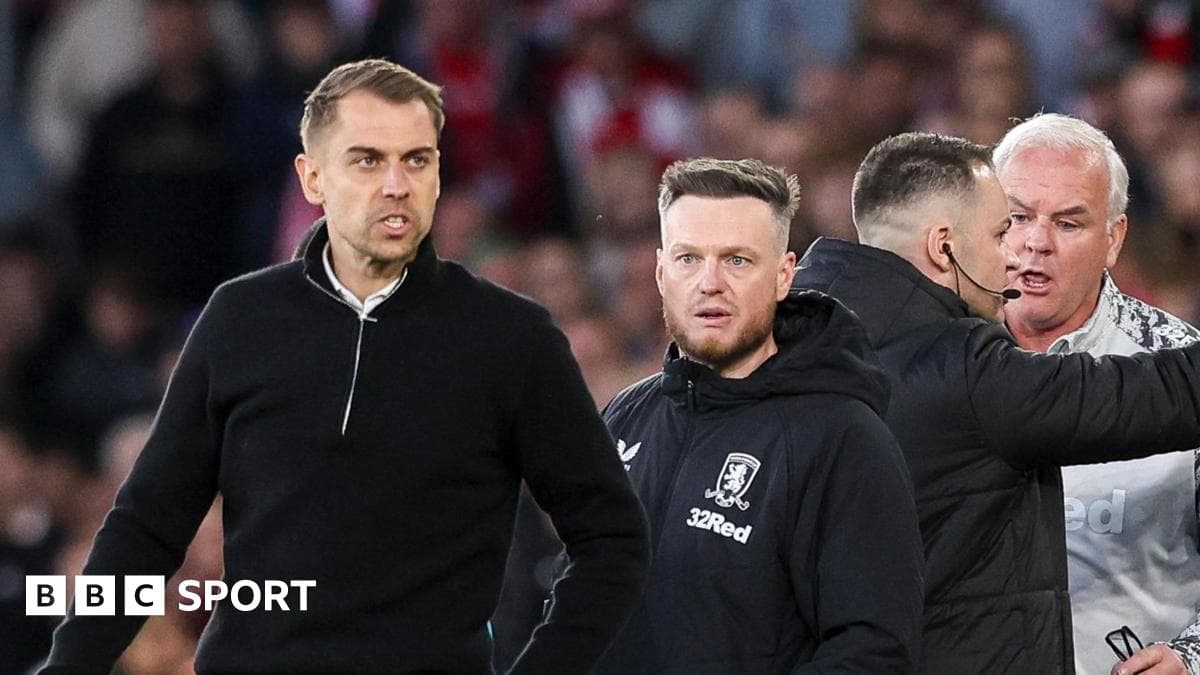
If Southampton’s joy felt cautious, Middlesbrough’s pain was raw.
Hellberg, in his first job in English football, has been open about what this chance means to him. The Premier League, he said, has been his dream for 15 years as a coach. He spoke of late nights, of endless video sessions studying Southampton, of time stolen from his young family to prepare for these two games.
After Saturday’s goalless first leg, he did not hide his anger about the alleged spying at Rockliffe Park. “There’s someone who makes decisions to go and try to cheat,” he said then. The word hung in the air.
In the aftermath of the defeat at St Mary’s, that sense of injustice had only deepened. Hellberg talked about the core of his job: the tactical edge, the details, the hours spent trying to find an advantage against teams with bigger budgets, deeper squads, parachute payments to fall back on.
“What you have as a coach is the tactical element of the game and where we can beat the opponent,” he said. “You have to find a way of getting an advantage. That’s what you always try to do as we can be better in that element. And when that is taken away from you…”
He left the sentence hanging. He didn’t need to finish it.
Hellberg painted a stark picture. If the alleged spy had not been caught, he argued, the narrative would have been very different. Southampton’s tactical display might have been praised, his own work quietly dismissed. He would have gone home feeling he had failed, never knowing why.
“If we hadn’t caught that man that they sent up five hours to drive, you would sit there and say well done in the tactical aspect of the game and I would go home and feel like I’ve failed,” he said. “When that is taken away from you… it breaks my heart in terms of all the things I believe in.”
For a coach trying to build something against the financial odds, the idea that his one true weapon – preparation – might have been compromised cuts deep.
A season on hold
Middlesbrough’s season should be over. Beaten over two legs, they ought to be scattering to summer holidays, nursing knocks and regrets. Instead, they fly back to Teesside on Wednesday not quite knowing whether to switch off or stay ready.
Their form deserted them at the worst possible time. A poor run in the final stretch cost them automatic promotion on the last day. The play-offs offered a second chance, and for long spells across both legs, they looked capable of taking it. A strong first half at St Mary’s, a lead in the tie, control of the tempo.
Then it slipped away. Fatigue set in, the game stretched, and luck deserted them at the crucial moment. A season that promised so much has ended, for now, in heartbreak and uncertainty.
Southampton, meanwhile, should be plotting how to stop Hull City under the arch, how to handle the pressure of a one-off game that can transform a club’s finances and future. Instead, they wait for lawyers, not analysts.
The play-offs were designed to deliver drama on the grass. This year, the decisive battle might yet be fought in a hearing room, with the entire Championship watching to see whether the most valuable place in English football is won by a late goal – or lost by a line in a rulebook.