.svg&w=384&q=75 "Pitchgist logo")
South Korea’s Tactical Triumph Over Czechia: A 2-1 Comeback
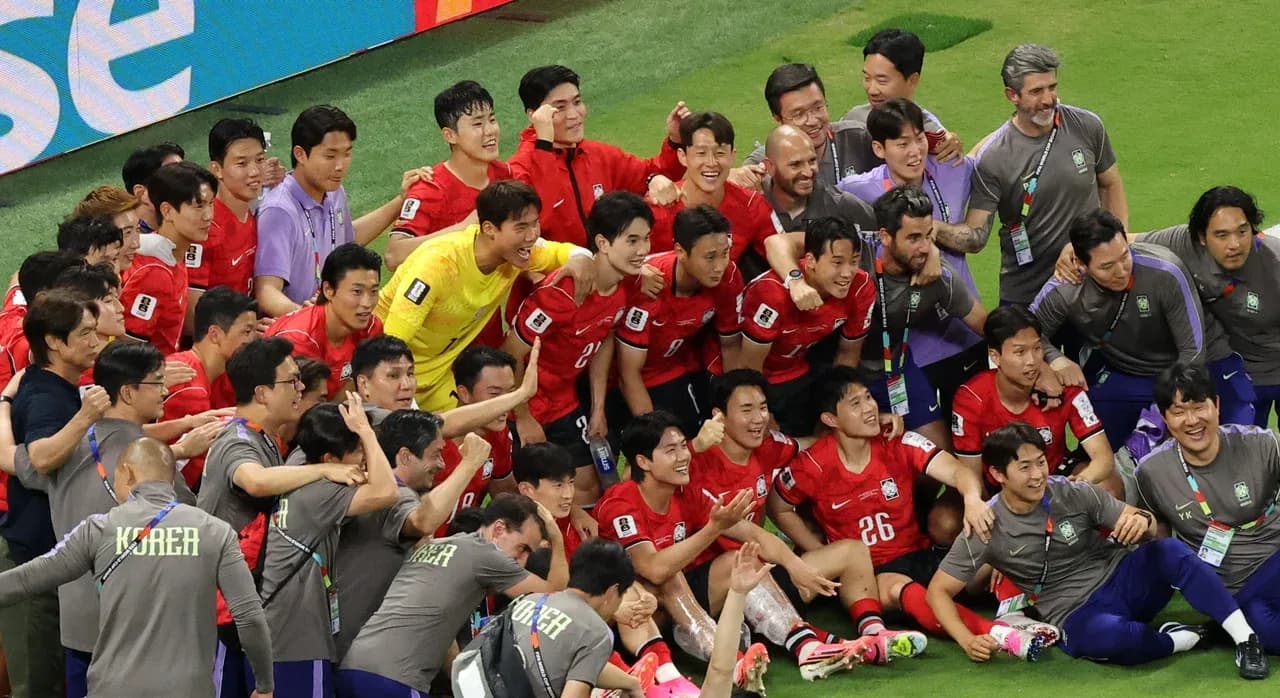
South Korea’s 2-1 comeback win over Czechia at Estadio Akron was built on structural control from their 3-4-2-1, superior possession, and a decisive shift in the attacking zones after the hour. Both sides mirrored each other’s base shape on paper, but South Korea, under Myung-Bo Hong, turned the symmetry into an advantage through cleaner build-up, better occupation of the half-spaces, and more aggressive wing use, especially once the substitutions reshaped the front line.
Out of possession, South Korea’s back three of Gi-Hyuk Lee, Kim Min-jae and Han-Beom Lee held a relatively high line, trusting Kim Seung-gyu’s sweeping and the team’s compactness. With 62% of the ball and 542 passes (469 accurate, 87%), they consistently built through the central pivot of Hwang In-beom and Seung Ho Paik. Both midfielders operated as press-resistors, drawing out the Czech first line of Patrik Schick, Pavel Šulc and Lukáš Provod and then punching vertical passes into Kang-in Lee and Jae-sung Lee between the lines.
The wing-backs were critical. Young-woo Seol on the right and Lee Tae-seok on the left (before his substitution) pushed high to pin Czechia’s wide midfielders Vladimír Coufal and Jaroslav Zelený. This stretched Miroslav Koubek’s 3-4-2-1 horizontally, opening pockets for Son Heung-min to drop and combine or threaten depth from the last line. The shot profile reflects this territorial dominance: 15 total shots to 8, with 10 inside the box versus Czechia’s 5, and 4 blocked shots showing sustained pressure around the area rather than speculative efforts.
Czechia’s approach was more direct and transitional. With only 38% possession and 323 passes (228 accurate, 71%), they accepted long stretches without the ball, relying on Tomáš Souček and Alexandr Sojka to screen and break, then play early into Schick and the two supporting forwards. Their 8 shots (4 on goal) came largely from faster, more vertical attacks, often beginning from turnovers or second balls. The 16 fouls committed, compared to South Korea’s 9, underline how much defending they had to do, frequently breaking rhythm to slow Korean combinations.
The key structural battle was in central midfield. Souček’s physical presence was designed to disrupt Hwang In-beom’s rhythm, but once Hwang began to find Kang-in Lee between the lines, Czechia’s central box was repeatedly stretched. The equaliser at 67 minutes, with Hwang In-beom scoring after a pass from Lee Kang-in, was a direct product of this pattern: interior overload, quick combination, and a midfielder arriving high in the right half-space.
Substitutions shifted the tactical picture decisively. At 62 minutes, Hwang Hee-chan (IN) came on for Jae-sung Lee (OUT), adding more direct running and depth on the left channel. Czechia responded at 64 minutes with a triple change: Adam Hložek (IN) for Pavel Šulc (OUT), Tomáš Chorý (IN) for Patrik Schick (OUT), and Michal Sadílek (IN) for Lukáš Provod (OUT). Koubek effectively moved towards a more physical, target-oriented front with Chorý, looking to contest long balls and crosses, while Hložek attacked second balls and Sadílek offered more legs in midfield.
Hong’s decisive move came at 69 minutes, when Eom Ji-sung (IN) replaced Lee Tae-seok (OUT) and Hyeon-gyu Oh (IN) replaced Son Heung-min (OUT). This subtly rebalanced the 3-4-2-1 into something closer to a 3-4-1-2/3-4-3 hybrid, with Oh Hyeon-gyu providing a true penalty-box reference and Hwang Hee-chan and Kang-in Lee working off him. The winning goal at 80 minutes – Oh Hyeon-gyu finishing from a Hwang In-beom assist – perfectly illustrated the reconfiguration: a midfielder stepping up to play the final pass, and a classic number 9 attacking the central channel between tiring Czech centre-backs.
Defensively, South Korea maintained reasonable control despite conceding first. Czechia’s opener at 59 minutes, finished by Ladislav Krejčí from a Vladimír Coufal assist, came from one of the few moments when South Korea’s back three were drawn out and the far-side defender was late to cover the back post. After that, however, the Koreans tightened distances, and Kim Seung-gyu (South Korea) made 3 saves, dealing with Czechia’s 4 shots on goal without panic. At the other end, Matěj Kovář (Czechia) registered 4 saves against 6 shots on goal, with his 0.02 goals prevented suggesting he was beaten more by volume and quality of chances than by clear errors.
The VAR intervention at 77 minutes – when a potential goal by Tomáš Souček was disallowed for offside – highlighted Czechia’s main offensive route: set-piece and second-phase chaos, exploiting Souček’s aerial threat. Structurally, though, they struggled to create consistent open-play pressure, in part because South Korea’s first line of pressure from Oh Hyeon-gyu and Hwang Hee-chan, backed by aggressive stepping from Kim Min-jae, limited clean progression.
Discipline also played into the tactical story. Only one card was shown: at 90+6 minutes, Lee Gi-Hyuk (South Korea) — Roughing. It underlined South Korea’s willingness to commit a late, tactical intervention to protect their narrow lead, but overall they managed their fouling more efficiently than Czechia’s 16 infringements.
Statistically, South Korea’s xG of 2 versus Czechia’s 0.84 mirrors the 2-1 scoreline and confirms that Hong’s side not only controlled the ball but also generated the better chances. Their high pass accuracy and territorial dominance translated into repeated entries into dangerous zones, while Czechia’s more modest xG reflects a reliance on moments rather than sustained pressure. With both goalkeepers credited with 0.02 goals prevented, the match outcome was decided less by shot-stopping heroics and more by structural superiority and the timing and impact of South Korea’s attacking substitutions.