.svg&w=384&q=75 "Pitchgist logo")
Sevilla Edges Espanyol 2–1 in La Liga Relegation Clash
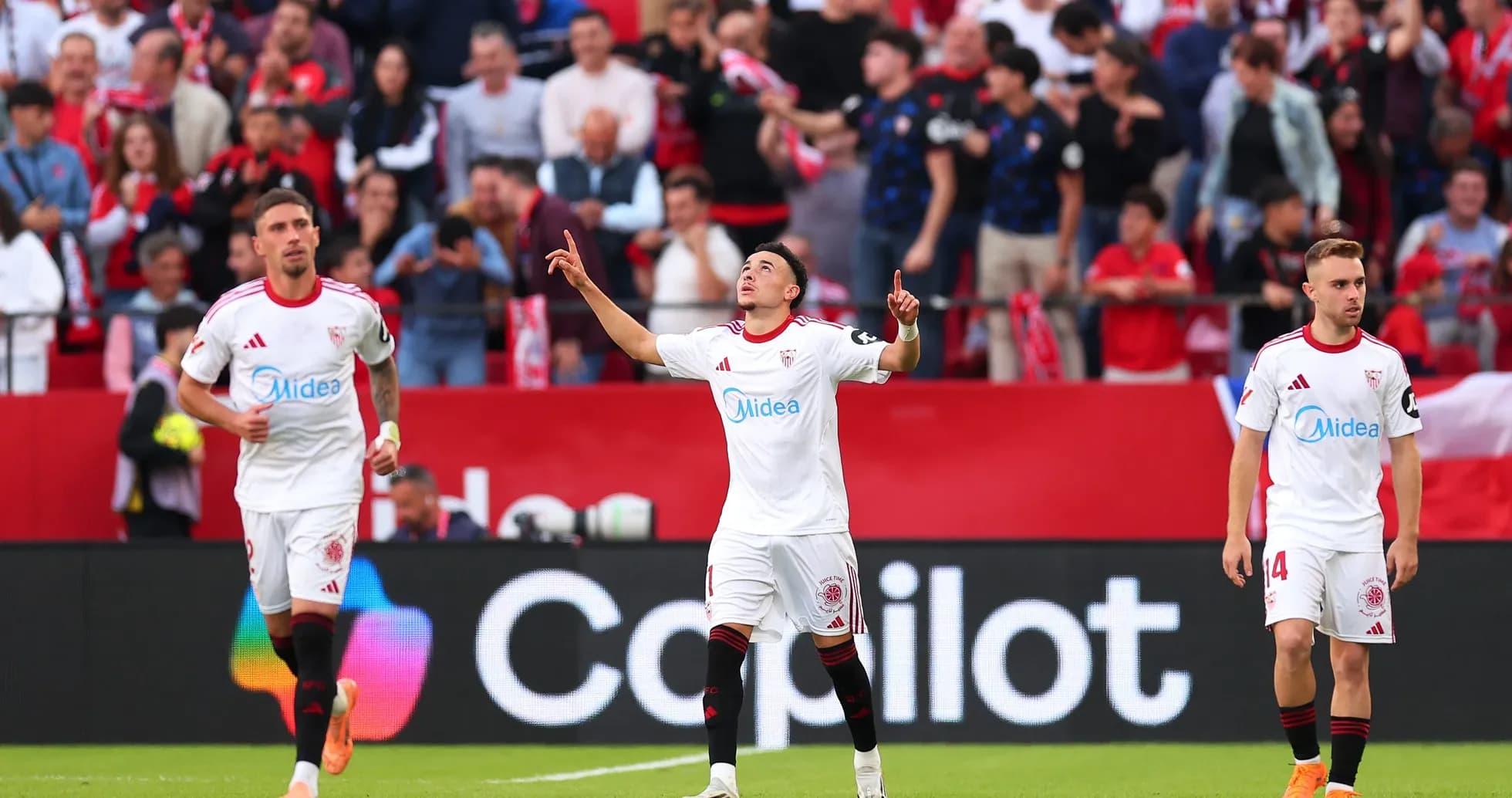
The afternoon at Estadio Ramón Sánchez Pizjuán closed on a cathartic note for Sevilla. Under the gaze of Javier Alberola Rojas, the hosts edged a tense La Liga relegation skirmish 2–1 against Espanyol, a result that subtly but significantly reshapes the lower mid-table landscape.
Following this result, Sevilla sit 13th on 40 points, Espanyol 14th on 39, both after 35 matches. The margins are thin, but the trajectories are not. Sevilla’s overall record now reads 11 wins, 7 draws, 17 defeats, with 43 goals scored and 56 conceded – a goal difference of -13 that underlines a chaotic campaign. Espanyol, on 10 wins, 9 draws and 16 defeats, have scored 38 and allowed 53, leaving them at -15. This was less a mid-table dead rubber than a survival inflection point.
I. The Big Picture – A Team Recast in a Different Shape
Luis Garcia Plaza turned away from Sevilla’s season-long comfort zones. Across the campaign, Sevilla’s most-used shape has been 4-2-3-1 (11 matches), with three-at-the-back variants (3-4-2-1 and 3-4-3) also prominent. Here, he chose a more orthodox 4-4-2, pairing N. Maupay and Isaac Romero up front and trusting the wide industry of R. Vargas and C. Ejuke.
The shift spoke to context. At home, Sevilla have been volatile but relatively productive: 18 matches, 7 wins, 4 draws, 7 defeats, with 24 goals for and 24 against. An average of 1.3 goals scored and 1.3 conceded at home hints at a side that trades blows rather than controls. Against an Espanyol outfit whose away profile is similarly open – 18 away games, 4 wins, 5 draws, 9 losses, 20 scored and 30 conceded, averaging 1.1 for and 1.7 against on their travels – the game always threatened to become a duel of imperfect structures.
Espanyol, by contrast, leaned into their season-long identity. Manolo Gonzalez set them up in their staple 4-2-3-1, the formation they have used 17 times in La Liga. M. Dmitrovic anchored a back four of O. El Hilali, F. Calero, L. Cabrera and C. Romero, with U. Gonzalez and Exposito as the double pivot. Ahead of them, R. Sanchez, R. Terrats and T. Dolan floated behind lone forward R. Fernandez Jaen. On paper, it was a classic 4-2-3-1 vs 4-4-2 clash: Espanyol seeking overloads between the lines, Sevilla looking to stretch the pitch vertically and horizontally.
II. Tactical Voids – Absences and Discipline
Both sides arrived shorn of important pieces. Sevilla’s defensive depth was thinned by the absences of M. Bueno (knee injury) and Marcao (wrist injury), forcing Garcia Plaza to lean on Castrin and K. Salas in central defence, shielded by the experience of N. Gudelj and the athleticism of L. Agoume. That pairing, untested at this intensity, made the choice of a compact back four logical: reduce space, keep distances short, and let G. Suazo and J. A. Carmona manage the flanks.
Espanyol’s attacking options were clipped by knee injuries to C. Ngonge and J. Puado, removing two profiles capable of attacking depth and unsettling a vulnerable Sevilla back line. Without them, the creative burden fell heavily on R. Fernandez Jaen’s movement and the supporting cast behind him.
Disciplinary trends also framed the contest. Sevilla’s season-long card profile reveals a combustible side in the closing stages: 18.81% of their yellow cards arrive between 76-90 minutes, and a further 19.80% in added time (91-105). Red cards are spread but significant, with 20.00% in the 61-75 and 76-90 windows. Espanyol are even more volatile late on, with 29.89% of their yellows in the 76-90 window and 16.09% in 91-105, plus a notable red-card spike between 46-60 and 76-90 (40.00% of their reds in each of those ranges). This match, inevitably, tilted towards a tense, fractured finale as fatigue and fear set in.
III. Key Matchups – Hunter vs Shield, Engine Room Battles
In the absence of formal top-scorer data, the “Hunter vs Shield” narrative is best read through structure rather than individual numbers. Sevilla, at home, average 1.3 goals for and 1.3 against; Espanyol, away, concede 1.7 on average. The onus was always on Sevilla’s front two to exploit that vulnerability.
N. Maupay’s role was as the irritant and connector, dropping off the line to link with Gudelj and Agoume and dragging centre-backs into zones they did not want to occupy. Isaac Romero, whose season has included 4 goals and a red card in La Liga, brought a more direct, vertical threat. His willingness to run channels and attack the box gave Sevilla a reference point that Espanyol’s back line struggled to pin down, especially when full-backs advanced.
For Espanyol, the “Shield” was not just the back four but the double pivot. U. Gonzalez and Exposito had to compress the central lane, prevent Gudelj from dictating tempo, and cut off service into Maupay’s feet. Exposito, one of the league’s most productive creators with 6 assists, 75 key passes and 925 total passes at 76% accuracy, had to balance his usual progressive instincts with defensive responsibility. His 46 tackles and 22 interceptions this season underline that he is not merely a luxury playmaker; he is the hinge between transition and control.
The true “Engine Room” confrontation, though, lay between Agoume and Espanyol’s midfield core. Agoume’s campaign – 31 appearances, 29 starts, 2481 minutes, 1219 passes at 80% accuracy, 62 tackles and 47 interceptions – paints him as Sevilla’s central metronome and enforcer. Up against Exposito and, from the bench, the combustible P. Lozano and the physical C. Pickel, he had to manage both the ball and the battle. Lozano’s 10 yellow cards and 1 yellow-red underline his edge; Pickel, with a red card and a yellow-red of his own, is another high-risk presence. Their introductions tilted the match towards a more fractured, stop-start rhythm that suited a Sevilla side already in front.
On the flanks, the duel between Carmona and G. Suazo against Dolan and R. Sanchez was equally decisive. Carmona, who has accumulated 12 yellow cards this season and blocked 7 shots, plays on a disciplinary tightrope but brings aggression and front-foot defending. His timing and positioning were vital in preventing Dolan from isolating him in one-on-ones, while Suazo’s overlaps gave Ejuke licence to drift inside and overload Espanyol’s half-spaces.
IV. Statistical Prognosis – A Match Sevilla Were Built to Edge
Even before a ball was kicked, the numbers suggested a narrow home advantage. Heading into this game, Sevilla’s overall scoring rate stood at 1.2 goals per match, with 1.3 at home, while Espanyol’s overall average was 1.1, both home and away. Defensively, Sevilla conceded 1.6 per match overall (1.3 at home), Espanyol 1.5 (1.7 away). In a notional xG framework, that profile points to a contest hovering around the 1.3–1.1 expected goals band in Sevilla’s favour, with variance driven by defensive lapses and set pieces.
Sevilla’s six clean sheets overall and Espanyol’s nine hinted that either side could lock the game down in phases, but the away side’s tendency to concede more heavily on their travels – 30 away goals against versus Sevilla’s 24 at home – made a clean sheet for Dmitrovic statistically unlikely. The 2–1 scoreline ultimately mirrored those structural imbalances: Sevilla’s home attacking baseline nudged slightly above expectation, Espanyol’s away defence performing roughly in line with their season trend.
Following this result, Sevilla can frame the performance as a vindication of Garcia Plaza’s bolder, more vertical 4-4-2 approach. The front two stretched a fragile Espanyol back line, Agoume and Gudelj controlled enough of the central traffic, and the full-backs managed the risk-reward equation just well enough. For Espanyol, the narrative is harsher: a side capable of five-match winning streaks but undermined by late-game volatility and disciplinary fragility, again leaving Andalusia with their away averages confirmed rather than defied.
In a season defined by fine margins and flawed structures, this was a match that unfolded almost exactly as the numbers whispered it might – only this time, Sevilla listened, and imposed their will.