.svg&w=384&q=75 "Pitchgist logo")
Pedri's World Cup Challenge: Balancing Expectations and Performance
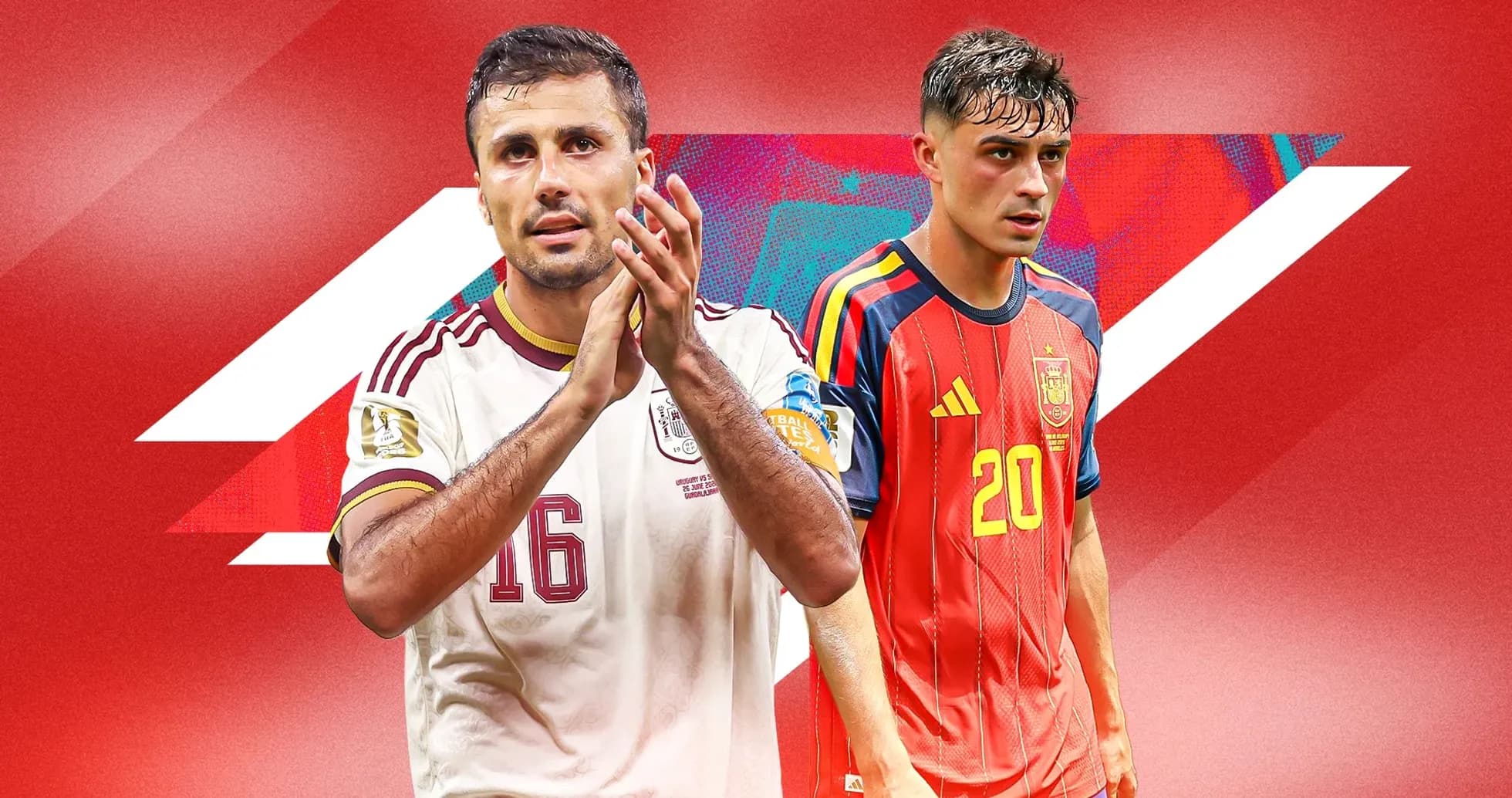
Spain arrived in North America with a midfield blueprint that seemed almost unfair. Rodri and Pedri, side by side, were supposed to be the axis that turned a European champion into a world champion. One has lived up to that billing. The other has become the story.
Rodri has slipped seamlessly back into his Ballon d'Or-winning rhythm, dictating games with the calm authority of a man who sees danger three passes ahead. Pedri, though, has walked into a storm of expectation and scrutiny that refuses to die down back home.
A Different Standard for Pedri
The numbers from Spain’s opening draw with Cape Verde should have insulated him. Five chances created, more than any other player on the pitch, in a match that quickly felt like a tactical puzzle rather than a showcase. Yet the reaction in Spain was unforgiving. The complaint wasn’t about what he did. It was about what he didn’t do.
Cape Verde’s subsequent run has softened the view of that 0-0, but not the questions around Pedri. As the tournament has stretched on, the focus has narrowed: no goals, no assists, no decisive moments to match the reputation of Barcelona’s chief creator.
Across the divide in Madrid, the comparison has been relentless. Jude Bellingham and Pedri are not like-for-like players, and Pedri has been operating from deeper positions, but nuance rarely survives a World Cup. Bellingham is deciding games, scoring, creating, dragging England forward. Pedri is not. For many, that is the beginning and the end of the argument.
It is, of course, a crude way to judge a midfielder. Yet this is the age of the headline contribution, and right now Bellingham owns them. Pedri doesn’t.
Dropped – But Not Discarded
That is why Luis de la Fuente’s decision to take Pedri out of the starting XI still jolted, even after five straight World Cup starts in 2026 and nine in a row dating back to Qatar. Pedri has been a fixed point for Spain. Suddenly, he wasn’t.
De la Fuente framed it differently. This is not a team that leans on one or two stars; this is a squad overflowing with midfielders who would start for almost anyone else. The coach even argued that Mikel Merino had more reason to feel aggrieved than Pedri after being left out again, despite scoring a late winner against Portugal in the previous round.
Merino’s response underlined the culture De la Fuente has built. No sulking, no noise, just another late winner, this time in the 2-1 victory over Belgium. The coach called it “unfair” that Merino didn’t start, then immediately pointed out the obvious: it would be just as unfair on whoever he replaced.
Only 11 can start. Everyone else has to live with it and be ready.
Inside the camp, there has been no hint of tantrums from Pedri. Unai Simon laid it out after the Belgium game: the disappointment is universal. If world-class goalkeepers like David Raya and Joan Garcia can accept watching from the bench, then so can an elite midfielder. The shared obsession is the World Cup, not the team sheet.
Two Pedris, One Problem
The real intrigue now lies in what Pedri is supposed to be for this Spain. De la Fuente has been clear that he sees two versions of the player: the Barcelona Pedri, and the Spain Pedri.
For Barcelona, he floats higher, closer to the final third, threading passes through tight lines and combining in one-twos around the box. For Spain, the picture is more complex. The presence of Rodri changes everything. With the Manchester City man anchoring midfield, every partner he has must adjust their game.
De la Fuente insists Pedri can operate as a 6, an 8, or a 10, but he also stresses that every selection is tailored to the opponent. This is not a system built to mimic Barcelona. Spain’s structure, personnel and rhythm are different, and Pedri has to bend to that reality.
The coach still calls him a “class player, one of the best in the world, if not the best.” He says the same about Fabian Ruiz. That is the point. Spain’s midfield is a collection of “best in the world” arguments squeezed into three shirts.
France Looms, Questions Mount
Now comes France, and with it the sharpest tactical dilemma of Spain’s tournament. What does De la Fuente do with Pedri?
His cameo against Belgium did not help his case. Spain broke late, the game stretched, the opportunity there to kill it. Pedri mis-hit the key pass, an uncharacteristically loose moment from a player usually so precise in transition. It was a small action, but in this climate, small actions echo.
Fabian Ruiz, by contrast, strengthened his grip on a starting spot. He scored Spain’s opener in Los Angeles and earned glowing praise from Simon, who described him as an “immense talent” and reminded everyone that the Paris Saint-Germain midfielder has just won two Champions Leagues in a row. That kind of pedigree carries weight in a semi-final.
One option is obvious on paper: Rodri flanked by both Fabian and Pedri, as against Cape Verde. If Spain have an area where they can genuinely claim superiority over France, it is in the middle of the pitch. Fielding three technically gifted midfielders would give La Roja their best chance of smothering the ball, slowing France’s devastating front four and turning the game into a passing exercise.
But football is never just about paper. That trio would likely come at the cost of Dani Olmo, who has quietly grown into the No.10 role during the knockout rounds. His final ball still frustrates at times, yet his movement between the lines and his work without the ball have been vital.
De la Fuente has said he prefers Pedri “closer to the opposition box,” where his feints and flicks can hurt teams most. He also values the way Pedri “always sets a very good tone, whether he's in top form or not.” Those are not the words of a coach who has lost faith.
Still, his comments after Belgium hinted at a plan: Fabian to start, Pedri to arrive. Let Fabian do the heavy lifting early, stretch the game, tire France’s midfield. Then unleash Pedri into the spaces that appear. “Pedri could benefit from Fabian's work,” De la Fuente said. “It's essentially teamwork.”
A Luxury Problem With High Stakes
This, more than anything, defines Spain right now. Ego has been pushed to the edges. The squad’s selflessness is their greatest strength, and if that means a player of Pedri’s stature rotating in and out, so be it.
De la Fuente knows what awaits. He has already called France’s potential “extraordinary” and “exceptional,” but he believes Spain have shown the same. He expects a game that demands energy, freshness, and the best version of every player he picks.
The question is whether that best version of Pedri turns up in red or stays the one that dazzles weekly in Blaugrana. Against France, in a World Cup semi-final, Spain may not get many more chances to find out.