.svg&w=384&q=75 "Pitchgist logo")
Osasuna vs Atletico Madrid: Tactical Analysis of the 2-1 Defeat
Osasuna’s 2-1 defeat to Atletico Madrid at Estadio El Sadar was defined by contrasting tactical identities: Osasuna’s volume-and-territory approach against Atletico’s ruthless efficiency and game management, even after going down to ten men.
Alessio Lisci set Osasuna up in a 4-2-3-1 that was clearly designed to pin Atletico back and flood the box. The structure was orthodox on paper, but extremely aggressive in practice. Both full-backs, Javi Galán on the left and V. Rosier on the right, pushed high to create a five-man attacking line with the three advanced midfielders behind Ante Budimir. That approach is visible in the shot profile: 23 total shots, with 18 from inside the box, and 8 corner kicks. Osasuna’s 58% possession and 477 passes, 415 accurate (87%), underline a side comfortable circulating the ball and sustaining pressure.
The double pivot of J. Moncayola and L. Torro initially provided balance, but as the game wore on and Osasuna chased the scoreline, their roles tilted forward. Moncayola stepped higher to connect with Rubén García and M. Gomez between the lines, while Torro was often left as the lone screening midfielder. That aggressive staggering helped Osasuna generate a strong xG of 2.16, but also exposed the centre-backs Alejandro Catena and Enzo Boyomo to Atletico’s transitional threat.
Atletico Madrid, under Diego Simeone in a 4-4-2, accepted a lower-possession, high-impact role. With 42% of the ball and only 5 total shots (4 on target), they still produced 1.64 xG and scored twice. The front pairing of Antoine Griezmann and A. Lookman initially looked built for mobility and pressing rather than aerial presence. Early on, Atletico’s plan revolved around quick vertical access from the midfield four—T. Almada, R. Mendoza, Koke, and O. Vargas—into the channels, where Griezmann and Lookman could attack the space behind Osasuna’s high full-backs.
First Key Tactical Hinge
The first key tactical hinge came at 13', when a penalty for Atletico was confirmed by VAR for a foul involving Griezmann. Two minutes later, at 15', Lookman converted the penalty. That early lead allowed Simeone to fully lean into a compact mid-block. The back four of M. Ruggeri, D. Hancko, Marc Pubill, and Marcos Llorente narrowed significantly, funneling Osasuna’s attacks wide and trusting central density to deal with crosses.
The substitution pattern shows Atletico’s responsiveness to game state and physical demands. At 18', R. Mendoza (OUT) was replaced by Robin Le Normand (IN), effectively reinforcing the defensive line and hinting at an early injury or tactical recalibration towards greater solidity. At 46', T. Almada (OUT) made way for A. Sorloth (IN), shifting Atletico towards a more direct 4-4-2 with a classic target man. That change proved decisive: with Osasuna pushing higher, Sorloth became the outlet for long balls and early crosses, and in the 71' he scored a normal goal, assisted by Marcos Llorente, after a transitional move that exploited Osasuna’s stretched shape.
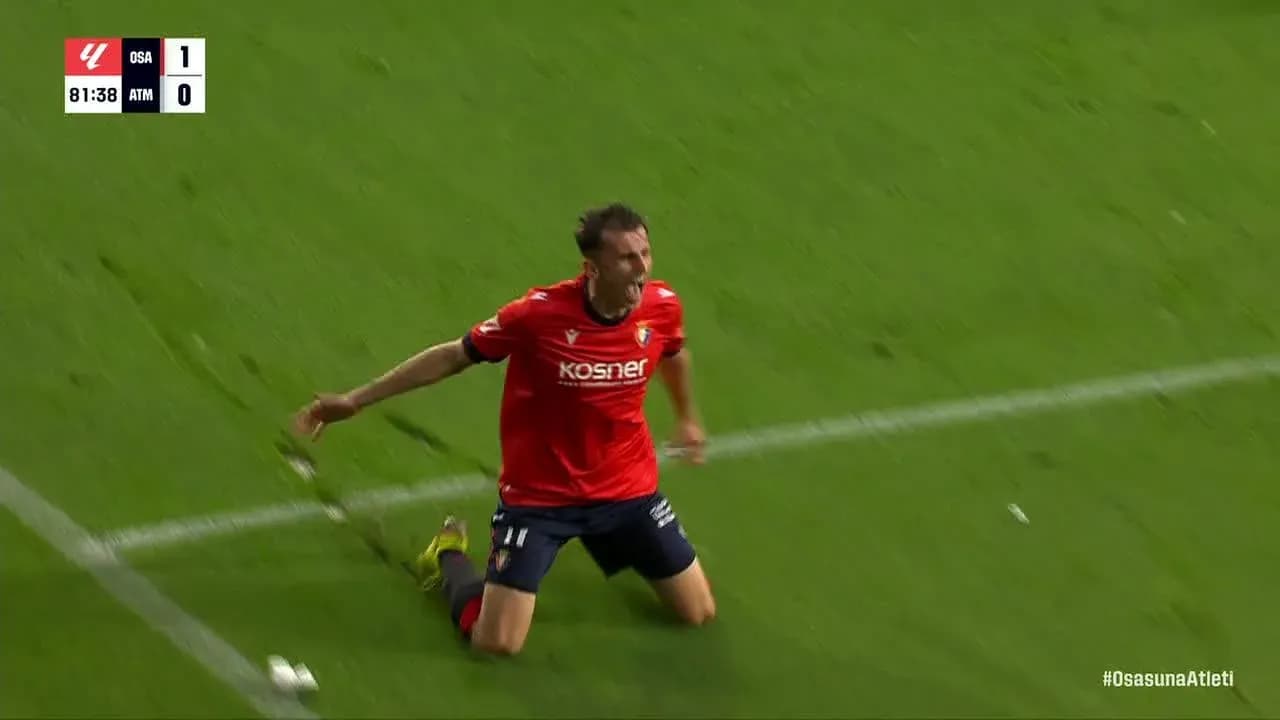
Osasuna’s bench usage was about adding width, energy, and attacking numbers. At 37', R. Moro (OUT) was replaced by Kike Barja (IN), who later scored Osasuna’s only goal at 90', assisted by R. Garcia (Forward, shirt 9). That change increased direct running and one-versus-one threat on the flank. On 60', Rubén García (Midfielder, shirt 14) (OUT) came off for R. Garcia (Forward, shirt 9) (IN), effectively morphing the 4-2-3-1 into a more attacking 4-2-4 in possession. Simultaneously, Javi Galán (OUT) was replaced by A. Bretones (IN), keeping the left flank aggressive while refreshing legs.
Further, at 72' Lisci doubled down: L. Torro (OUT) was replaced by A. Oroz (IN), and M. Gomez (OUT) by A. Osambela (IN). This stripped away a holding midfielder for another creative presence, increasing central overloads but leaving transitions even more vulnerable. The late goal from Kike Barja was a product of this attacking density, but it arrived too late to alter the outcome.
Defensively, Osasuna’s approach was front-footed but fragile. With 15 fouls and 6 yellow cards, their attempts to counterpress and break Atletico’s rhythm often spilled into indiscipline, especially as frustration grew. The back four were repeatedly asked to defend large spaces, and while A. Fernandez in goal made 2 saves and had 0.32 goals prevented, the penalty and the high-quality chance for Sorloth were beyond his control.
Atletico’s defensive structure, by contrast, was compact and cynical in the classic Simeone mould. They committed 12 fouls, received 5 yellow cards and 1 red card, but largely succeeded in forcing Osasuna into crowded central zones before clearing crosses. Juan Musso’s 4 saves, matching his 0.32 goals prevented, underline a performance where the goalkeeper was well-protected yet decisive when called upon.
Turning Disciplinary Moment
The turning disciplinary moment came at 79', when Marcos Llorente picked up a yellow card for Foul and then a straight red for Foul in the same minute. Down to ten men, Atletico retreated into an even deeper block, with C. Lenglet (IN) replacing A. Lookman (OUT) at 82' to form a reinforced back line. Despite the numerical disadvantage, the compact 5-3-1 shape they adopted in practice limited Osasuna mostly to crosses and long shots, reflected in the fact that only 5 of Osasuna’s 23 efforts were on target.
Statistically, the match tells a story of volume versus efficiency. Osasuna led in possession (58% to 42%), total shots (23 to 5), corners (8 to 4), and passing (477 passes, 415 accurate, 87%, versus Atletico’s 358 passes, 287 accurate, 80%). Their xG of 2.16 suggests they created enough to take at least a point. Yet Atletico’s 1.64 xG from just 5 shots, coupled with clinical finishing and a well-drilled defensive block, was enough to secure a 2-1 away win.
In tactical terms, Osasuna’s high-risk, high-pressure 4-2-3-1 produced territory and chances but left them exposed to Atletico’s transitions and set-piece pressure (notably the early penalty). Atletico’s 4-4-2, then reshaped by substitutions into a more direct and later more defensive structure, maximized their strengths: compactness, verticality, and game management under duress, especially after Llorente’s dismissal.