.svg&w=384&q=75 "Pitchgist logo")
Darwin Nunez's Future at Liverpool: A Shift in Style
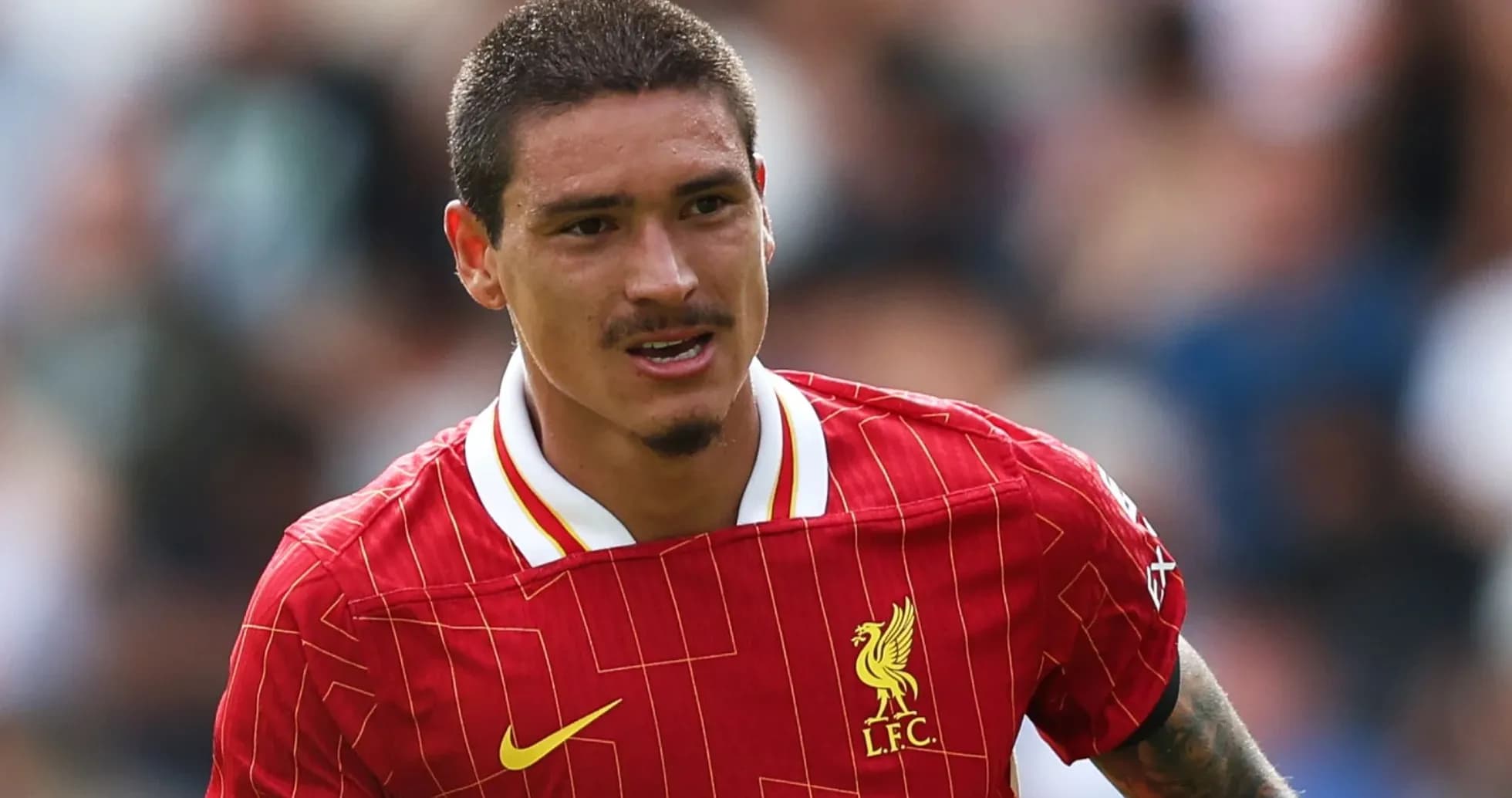
The soundtrack has changed at Anfield. The “heavy metal” that once rattled the Kop under Jurgen Klopp has faded, replaced by a search for a new rhythm under Andoni Iraola. Caught somewhere between those eras is Darwin Nunez – the £64 million forward who once looked like the perfect frontman for Klopp’s chaos, and now finds himself on the outside looking in.
Nunez arrived from Benfica in 2022 as the embodiment of Klopp’s high-octane ideal: raw, relentless, unpredictable. He left with 40 goals in 143 games, a blur of missed chances, wild runs and moments of genuine brilliance. He never quite became a conventional Anfield hero. He became something stranger – a cult figure, adored for effort as much as end product.
By the summer of 2025, that was no longer enough. A lucrative move to the Middle East took him to Saudi Arabia, to Al-Hilal and into the orbit of Cristiano Ronaldo and a new footballing gold rush. It looked like a fresh start. Instead, it has turned into a dead end.
Foreign-player limits have seen Nunez cut from Al-Hilal’s domestic squad. For a 26-year-old who was once one of Europe’s most coveted forwards, being told to find a new club is a brutal comedown. His next step may yet lead him back towards England, but the door at Liverpool is anything but wide open.
Barnes draws a line under the Klopp era
John Barnes, a voice that still carries weight on Merseyside, is clear: any Nunez return would not be about nostalgia. It would be about Iraola – and Iraola alone.
Asked whether Nunez could still have a role at Anfield, Barnes, speaking in association with viagogo and their “World Cuts” campaign, cut straight through the sentiment. If Iraola doesn’t want that kind of forward, there is no story. If he does, then perhaps there’s a conversation. But Liverpool, he stressed, cannot be run by ghosts.
“It’s not Jurgen Klopp,” Barnes pointed out, noting that Nunez actually left while Klopp was still in charge. The past, in other words, had already started to move on from the Uruguayan before the present did.
For Barnes, the central issue is not whether Nunez fits some romantic idea of what Liverpool used to be. It is whether the club is prepared to stop measuring every decision against the Klopp blueprint. He argues that the new manager’s style – whether quick or slow, chaotic or controlled, “heavy metal” or something far more measured – has to become the only reference point.
That stance even extends to Mohamed Salah’s recent comments about “non-negotiables” in how Liverpool should play. Barnes believes no player, however decorated, should be setting tactical red lines for a new coach. The manager chooses the style. The club backs it. Or it goes nowhere.
A warning from Arsenal and United
Barnes doesn’t just talk in theory. He points to examples.
Mikel Arteta, he reminds, finished eighth, then eighth again, then fifth with Arsenal. The club held its nerve. The payoff is now visible to everyone. That is the model of patience he wants Liverpool supporters to absorb.
He contrasts that with Manchester United’s post-Ferguson churn. David Moyes arrived as a respected manager and was discarded when he failed to be Ferguson. Louis van Gaal, then Jose Mourinho, found themselves judged against the same impossible standard. Each time, United reached for the past and tore up the present.
Barnes fears Liverpool could repeat that mistake with Klopp. If Iraola loses a couple of games early on, does the crowd turn? Does the board panic? Does the conversation immediately revert to “Klopp would have done it differently”?
“If you’re going to hold on to Jurgen Klopp’s legacy,” Barnes warns, “we’re not going to get a manager who is going to come to Liverpool and be successful.” The message is stark: either let go, or get used to disappointment.
Transfers, departures and a squad under scrutiny
All of this plays out against a summer of upheaval. Mohamed Salah has gone. So too Ibrahima Konate and Andy Robertson, all leaving as free agents. Those are not fringe figures slipping quietly away. They are pillars of a title-winning side suddenly removed in one sweep.
The instinct in such moments is always the same: spend. Replace big names with bigger fees. Barnes, again, pushes back.
He recalls how, when Arne Slot arrived, Liverpool signed Federico Chiesa and Wataru Endo – and then won the league without either playing a decisive role. The conclusion he draws is blunt: signing players is not, in itself, a strategy.
Liverpool, he argues, already have enough quality. If they need a centre-back, they should get one. But he does not see a shopping spree as the cure-all. He raises the example of Yan Diomande as a potential arrival and immediately asks what that would mean for Rio Ngumoha. Would another signing simply block a pathway and stunt a talent the club already owns?
Barnes is not against recruitment. He simply refuses to treat it as a magic button. If better players are available and the manager wants them, fine. But the core belief, in his view, has to be that the current group is good enough – provided the manager is trusted to shape them.
Nunez at a crossroads
Which brings the story back to Nunez, now at the 2026 World Cup sporting braided hair and a career in limbo. His situation is a reminder of how quickly football can turn. Two years ago, he was the symbol of Liverpool’s next attacking wave. Today, he is surplus to requirements in Saudi Arabia and a hypothetical option for a club that has already moved on once.
Liverpool’s recruitment team will weigh the numbers, the age profile, the cost. Iraola will weigh the fit. Does he want a forward who thrives in chaos when he may be trying to build something more controlled? Or does he see in Nunez’s running power and relentlessness a weapon he can refine rather than reject?
Barnes has laid down his challenge, not to Nunez, but to the club and its supporters: stop asking what Klopp would have done. Start asking what Iraola wants to do.
Somewhere in that answer lies Nunez’s fate – and a clearer picture of what Liverpool are willing to become without the man who gave them their heavy metal soundtrack.