.svg&w=384&q=75 "Pitchgist logo")
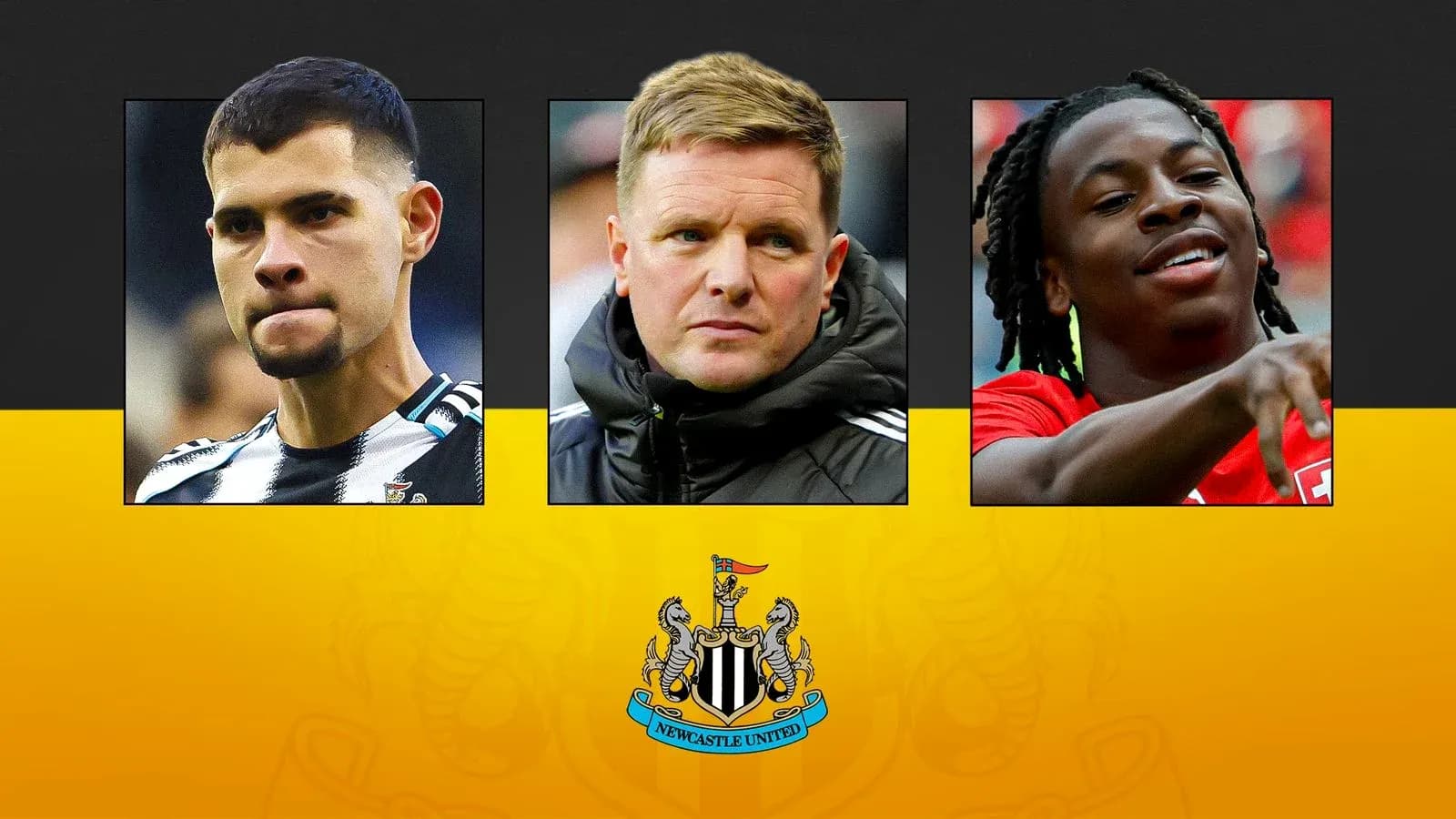
Newcastle’s Summer of Upheaval: Youth, Risk, and Transfers
The mood around St James’ Park this summer is not one of gentle evolution. It is upheaval. Newcastle are ripping up last year’s script, cutting deep into a squad that once promised a rapid rise into the elite, and betting heavily on a younger, leaner model.
Big names have already gone. More could follow. And one, in particular, hangs over everything.
Bruno at the Crossroads
Bruno Guimaraes has not submitted a transfer request. He has, though, been brutally clear with Newcastle.
If Arsenal put serious money on the table, he wants to go.
This is not a pay-day play. Bruno already sits at the top of Newcastle’s wage bill and would, at best, only nudge that up slightly in north London. At 28, turning 29 later this year, his calculation is simple: he wants to win titles, now. He does not believe Newcastle can deliver that in the next couple of years, on or off the pitch, and sees Arsenal as the platform to chase the trophies he craves.
Crucially, he does not intend to walk away cheaply. Those close to the situation are clear: if he leaves, he wants Newcastle to collect a premium fee. Inside the club, the tipping point is understood to be around £80m. If Arsenal reach that level, Newcastle will be forced to listen.
But Arsenal have not picked up the phone.
There has been no formal contact, no bid, not even a conversation between the clubs. Newcastle are stunned at how much noise surrounds Bruno’s future when everything so far has been driven through agents. Until a concrete offer lands, they insist there is no decision to make. Publicly and privately, they remain desperate to keep him and still regard him as not for sale.
For now, it is a stand-off built on hypotheticals. The tension comes from the fact everyone knows what happens the moment Arsenal turn talk into a number.
Manzambi Chase: Hope, Caution and a Hint of Déjà Vu
While Bruno’s future drifts in limbo, Newcastle have moved aggressively at the other end of the market.
They have an agreement in place with Freiburg to sign Johan Manzambi for £49m, one of their headline targets of the window. A Newcastle delegation flew to Germany this week, verbally shaking hands on a fee. The player has also given a verbal nod to personal terms.
On paper, it is done. On paper, Newcastle thought Victor Munoz was done too.
That late hijack by Liverpool still stings. It explains the caution now. Manzambi is currently with Switzerland at the World Cup, nursing a slight knee issue but still driving his country into the quarter-finals. He has been clear: he will not sign anything until after the tournament.
So Newcastle wait. And worry.
They have done the groundwork, they believe they have the player’s commitment, but the longer Switzerland stay in, the more time there is for a heavyweight rival to pounce. The stakes are obvious. Manzambi has five goal involvements at this World Cup, the best return of any player his age since records began. That kind of form does not stay secret for long.
Newcastle think he will wear black and white next season. Until the ink dries, they know that belief counts for very little.
Rebuilding the Squad: Holes, Targets and Contingencies
Manzambi is only the start. Once that deal is over the line, Newcastle expect three or four more signings.
A midfielder sits high on the list, especially if Bruno’s exit becomes reality. A new No 1 goalkeeper is also a priority. James Trafford remains a long-standing target, and Newcastle are preparing to move for the Manchester City keeper in this window.
They want a full-back who can operate on either flank, ideally on the left. The wide areas could also be reshaped if Jacob Murphy, a decade at the club behind him, decides the time is right to move on. Lose him, and another winger jumps up the agenda.
Up front, there is a sliding scale. If one of Nick Woltemade or Yoane Wissa leaves, a striker search begins. If both stay, Newcastle are content to go into next season with a front line of Wissa, Woltemade and Will Osula.
Every decision is tied to another. Every outgoing creates a new problem to solve.
A New Transfer Doctrine
Behind the noise, there is a clear shift in how Newcastle operate.
The club’s new transfer framework is blunt: target players between 18 and 24, and keep most deals between £20m and £40m. There will be exceptions at both ends – Ewen Jaouen has already arrived for £18m, and Manzambi at £49m would sit just beyond the upper edge – but the days of £80m-plus punts are off the table.
Do not expect Newcastle to fling £90m or £100m at a single player. The owners and recruitment team see this as a new way of working: cheaper, younger, high-ceiling talents who can be developed on the training pitch by Eddie Howe and then, in time, potentially moved on for profit.
The inspiration is clear. This is closer to a Borussia Dortmund model than a traditional Premier League super-spender: buy early, polish hard, sell smart, and still try to compete for trophies in the middle of that cycle.
It is a gamble, but it is a defined one.
Who’s Heading for the Exit?
For that model to work, some familiar faces will almost certainly leave.
Nick Pope is expected to move on. Interest from Ipswich has cooled, but the general feeling is that his time at Newcastle is drawing to a close as the club reshapes its goalkeeping department.
Murphy, after ten years of service, could be allowed to go if the right offer arrives. Joe Willock is in a similar bracket. There are no bids on the table for any of them yet, but Newcastle would be prepared to sanction exits to accelerate the rebuild.
If Pope, Murphy and Willock all depart, each will need replacing. The churn would be significant, but that is the point. This is not a tweak; it is a reset.
Steur, Toure and the Long Game
Not every signing is being judged on what they can deliver in August.
Sean Steur, 18, arrives as one firmly marked “for the future”. He will train with the first team, he will get opportunities, but he is not walking straight into Howe’s starting XI. The club expects him to begin life on the bench, then try to force his way into the side over time.
The lack of European football helps that plan. Without midweek fixtures clogging the calendar, Howe will have full training weeks to work with Steur, Bazoumana Toure, Manzambi and the rest of the new generation. Physical development, tactical education, adaptation to the Premier League – all of it can be drilled, patiently, on the training ground.
Newcastle believe that by this time next year, Steur could be featuring regularly. That is the type of profile they want now: not ready-made Premier League stars, but young players they can shape.
They think they already have enough of the former. The ceiling of the latter is what excites them.
Howe’s Buy-In After a £250m Hangover
Eddie Howe is not fighting this change. He is driving it.
After last summer’s disastrous window – £250m spent, too many signings failing to deliver, and the Alexander Isak saga casting a shadow over the season – Howe, sporting director Ross Wilson and chief executive David Hopkinson have aligned on a different approach.
They do not want another frantic, late scramble. They want deals done early, a coherent squad built around youth, and a clear pathway for development. This is Howe’s sweet spot: improving players day after day on the grass.
The absence of European football stings from a prestige point of view, but it brings a hidden advantage. Fewer games, more freshness, more time to coach. Howe sees a chance to mould this squad in his image, to squeeze more from players like Steur, Toure and, if it goes through, Manzambi.
The club are realistic. A top-four or top-five finish looks unlikely. But they believe a push for the European places is still within reach, and that the lack of midweek travel and fatigue could be a quiet weapon across the season.
PIF, PSR and the Ceiling Above Newcastle
All of this unfolds under the watchful eye of Saudi Arabia’s Public Investment Fund.
PIF remains committed to Newcastle. There is no suggestion of wavering support. Yet from the outside, questions grow when fans see Sandro Tonali, Anthony Gordon, Alexander Isak – and potentially Bruno – leaving for clubs with bigger commercial muscle and deeper historical pull.
That is Newcastle’s reality. Breaking into the Premier League’s established top six has proved far harder than the takeover rhetoric once suggested. Financial rules bite. Profit and Sustainability Regulations have already led to a breach and a fine. The owners have no interest in repeating that.
So they walk a tightrope: spend as much as they can, but stay inside the lines.
The only way to truly change that picture is off the pitch. Newcastle’s commercial revenues sit at roughly half the level of the so-called big six. Grow those streams – more sponsorships, bigger deals, potentially a new stadium – and the club can finally trade punches with the elite in terms of fees and wages.
Progress is being made, but not fast enough to close the gap overnight. Hence the pivot to smart recruitment, development, and a more sustainable model.
The money is still there. The ambition is still there. The question now is whether this younger, hungrier Newcastle can climb while selling some of their brightest stars – and whether they can convince Bruno Guimaraes, and players like him, that the trophies he wants might yet be won in black and white.