.svg&w=384&q=75 "Pitchgist logo")
Matheus Cunha: The Key to Brazil's World Cup Success
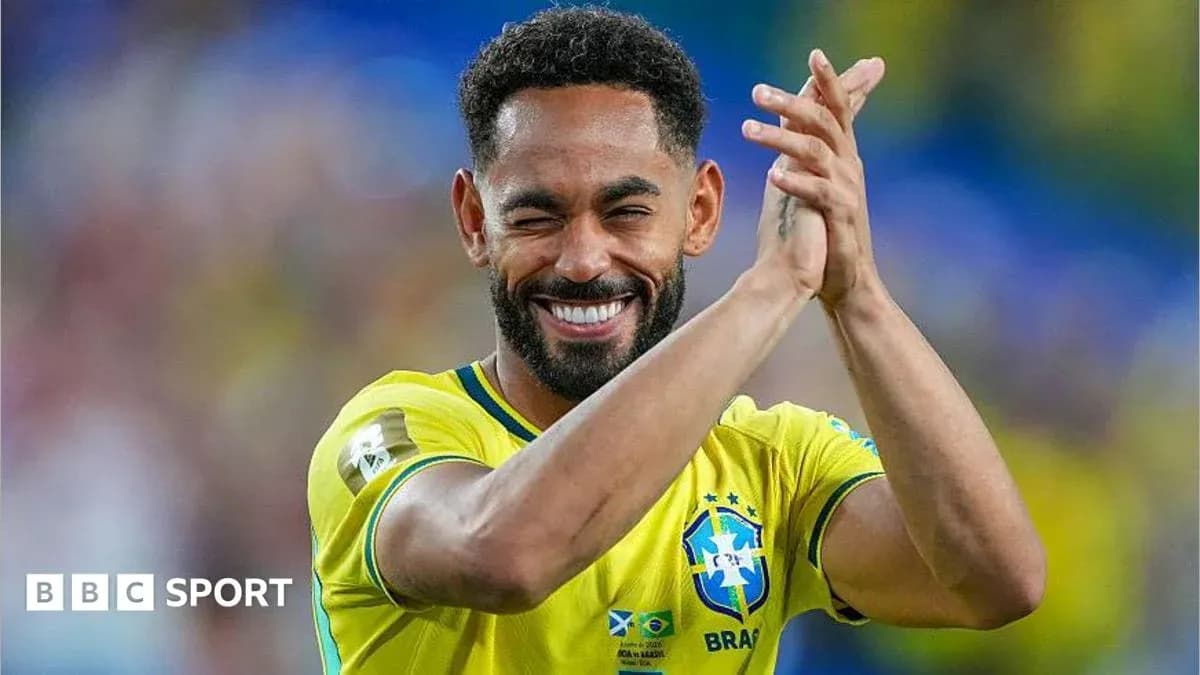
Brazil’s World Cup machine is finally humming – and at the heart of it, unexpectedly, stands Matheus Cunha.
For once, Brazil have reached the knockout stage not on a wave of early euphoria, but through steady, deliberate construction. Carlo Ancelotti has spent the group phase tinkering, testing, discarding. Now, as the last 32 looms and Japan wait with their usual blend of speed and precision, it feels like he has his team. His Brazil.
The timing could hardly be better.
Cunha, the “nine-and-a-half” who changed the picture
Brazilian number nines used to be a simple story. Ronaldo. Romario. Adriano. A line of pure finishers, living on the shoulder of the last defender, built to end moves rather than start them.
Cunha breaks that line.
He is not the classic reference point the Brazilian public expect. He is what coaches like to call a “nine-and-a-half” – someone who can lead the line, but also drop into the pocket like a 10, link play, drag defenders into places they hate. He is not a pure playmaker, because he scores – three goals already at this World Cup – but he is not a traditional striker either.
That in-between role has given Brazil something they have rarely had from a centre-forward: a creator-finisher hybrid who bends the geometry of the game in their favour.
Watch him off the ball and the resemblance to Roberto Firmino is striking. He drops into midfield, then darts away again. The centre-back marking him never quite knows whether to follow or hold the line. When they step out, space opens for Vinicius Jr on one flank and Rayan on the other. When they stay put, Cunha has time to receive between the lines, turn, and either slide passes through or shoot himself.
He is not just embracing the role; he looks energised by it. He initiates the press, sometimes defending as high as a number six, screening passes into midfield, setting the trigger for Brazil’s collective squeeze. That defensive work has become part of the team’s balance, the hidden glue that lets the flair players stay higher and fresher.
From confusion to clarity up front
It was not meant to be this clear. Not this quickly.
Brazil came into the tournament without a nailed-on number nine – an almost unthinkable situation for a country that usually arrives with at least two superstars fighting for that shirt. Even as late as the Scotland game in the group, nobody could say for certain who would start at centre-forward.
Ancelotti had looked at everything. Cunha, Igor Thiago, Endrick, Joao Pedro, Richarlison – a carousel of options, each with a slightly different profile. It did not feel like a solved puzzle.
Then football did what it so often does: it forced a decision.
Raphinha, a roaming, unpredictable attacker who had been used as a 10 behind Igor Thiago against Morocco and can operate on either wing, pulled up with a hamstring injury in that opening match. His replacement, Rayan, is a very different type of wide player – more disciplined in his positioning, far more likely to hold the right flank than drift inside.
That one change altered the entire front line. With Vinicius Jr wide on the left and Rayan stretching the pitch on the right, the central spaces opened up. Cunha suddenly found himself with room to operate exactly where he likes: between lines, between markers, in the blind spots.
He has thrived in that emptiness.
Ancelotti still has other tools. Igor Thiago brings more physicality and can pin centre-halves if Brazil need to go more direct or chase a game. The point now is not that Cunha is the only option, but that he has become the reference point. The shape makes sense around him.
Back home, the mood has shifted. The debate about the number nine is not over – it never really is in Brazil – but more and more voices are settling on the same conclusion: for this team, in this system, Cunha looks like the answer.
Ancelotti’s Brazil: control without obsession
Strip away the romance and you get to the core of this Brazil: they are a side built on Carlo Ancelotti’s pragmatism.
He has carried the same calm, chameleon-like approach that has served him across Europe into international football. People love to talk about his man-management, his ability to handle stars and soothe egos, but that can overshadow something else: he is a sharp tactician who reads games, not ideologies.
The clearest sign is how comfortable this Brazil are without the ball.
This is not a team chasing 70% possession for the sake of it. Ancelotti is happy to hand the ball to the opposition and turn it into their problem. When his players get into the right positions and press at the right moment, they do not just win the ball back – they spring traps.
That plan was on full display against Scotland. Brazil often sat off, inviting passes into certain areas, then snapping forward as a unit. The first goal came from that structure. So did the second, harshly disallowed, which followed a similar pattern. These were not accidents. Brazil had scored comparable goals in warm-up games against Panama and Egypt. The blueprint was already there.
They ceded possession but never lost control. They dictated where Scotland could play, then punished them when they stepped into the wrong corridor. It was Ancelotti’s idea of domination: less about how long you have the ball, more about where the game is being played and on whose terms.
A new identity, without betraying the old one
Talk about Brazil and identity always surfaces. Are they still Joga Bonito if they are not flying forward in waves? Are they still Brazil if the full-backs are not tearing down the touchline?
This version offers a firm answer: yes, but in a different way.
This is the first World Cup in a long time where Brazil’s full-backs are not relentlessly bombing on. There is no Roberto Carlos, Cafu, Maicon, Marcelo or Dani Alves figure hugging the line and living in the final third. With Douglas Santos and either Roger Ibanez or Danilo, the flanks are more measured, more conservative.
That restraint has a purpose. It lets Vinicius Jr stay higher, closer to goal, conserving energy for the moments that matter. The back four looks sturdier. The team feels less stretched.
Midfield has undergone a similar recalibration. In the opening game against Morocco, Casemiro was left alone at the base, asked to patrol impossible distances. The criticism that followed ignored the reality: this has never been his game, and certainly not at 34. He is a destroyer and organiser, not a one-man pressing machine.
The response was swift. Brazil shifted from a 4-2-3-1 to a 4-3-3. Now, when Bruno Guimaraes surges forward as the advanced midfielder, Casemiro is not abandoned. Lucas Paqueta tucks in alongside him, sharing the defensive load and giving Brazil a stronger platform.
The difference has been obvious against Haiti and Scotland, and it will matter even more against Japan, whose movement and fluid attacking patterns pose a far greater test than either of those sides.
The numbers underline the transformation: one goal conceded, seven scored. The performances are not perfect, but they are coherent. The pieces fit.
From anxiety to anticipation
The emotional arc back in Brazil has mirrored the team’s evolution.
Before the first game, there was tension. After it, genuine concern. The old doubts resurfaced: wrong system, wrong balance, wrong choices. Three games later, the tone has flipped. The same public that watched nervously at kick-off are now leaning forward, eager for the next act.
They see a team that knows what it is trying to do. They see a coach unafraid to adapt. They see a centre-forward who does not look like the ones they grew up idolising, but who might just be the one this side needs.
Japan will test all of that. Their movement will probe the spaces between Brazil’s lines. Their intensity will examine the discipline of those more conservative full-backs. Their awareness will challenge Cunha’s freedom between the lines.
Brazil arrive at that junction with momentum, a settled core, and a plan that finally looks like it belongs to them.
Now the question is simple: is this “new Brazil” just a promising idea, or the version that can carry a nation all the way?