.svg&w=384&q=75 "Pitchgist logo")
Manchester City at a Crossroads: The Future of Rodri
Manchester City stand at a crossroads.
A decade of Pep Guardiola has given way to Enzo Maresca, and the handover is anything but gentle. This is not just a change in the dugout. It is a dismantling and rebuilding of a Treble-winning core.
Four starters from that 2022-23 side have gone: Manuel Akanji, Nathan Ake, Bernardo Silva and John Stones. Players who defined an era, stripped out in one summer. In their place, City have pushed £116m towards Elliot Anderson and handed a pathway to 17-year-old Jeremy Monga. It is bold. It is risky. It is also only half the story.
Because the biggest question of all is about the man who has not left. Not yet.
Rodri: the pillar under scrutiny
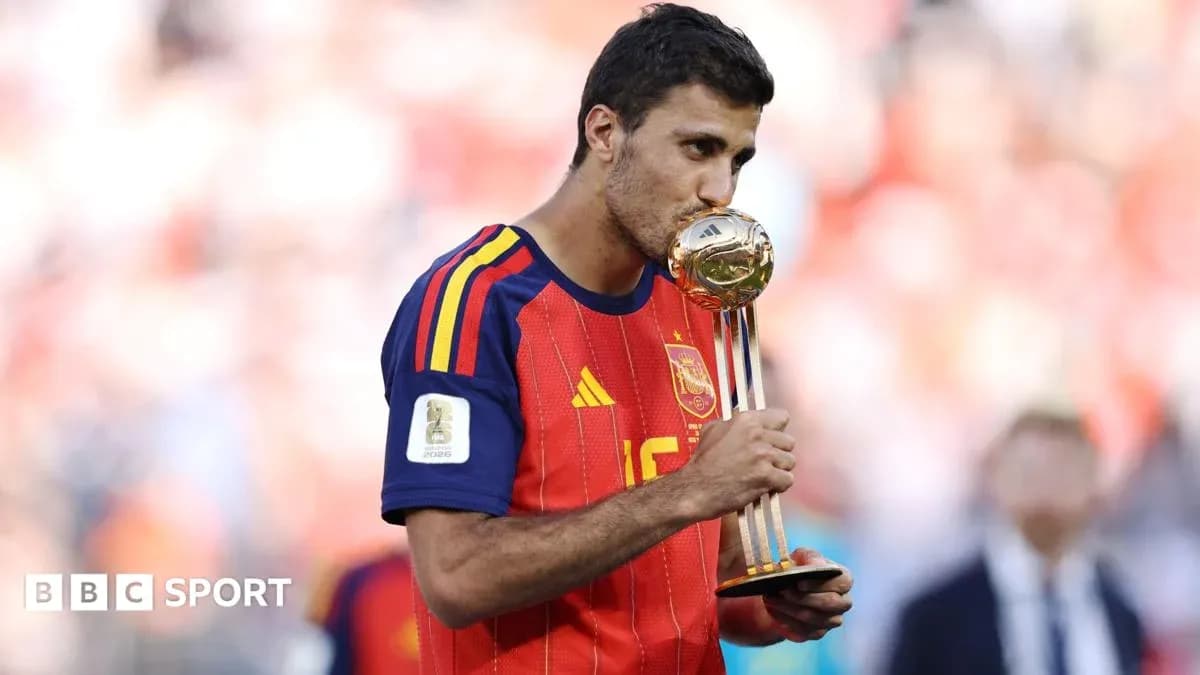
Rodri, fresh from captaining Spain to World Cup glory and winning the Golden Ball as the tournament’s outstanding player, will undergo back surgery on Monday. He has a year left on his contract. Real Madrid are, according to reports, “operating on the basis” that he will eventually join them.
That is the tension running through City’s summer.
Maresca made his stance plain in his first news conference. He wants Rodri. He values him as every manager would.
“I think every manager wants to have Rodri because he is a top player,” Maresca said. “But now, surgery on Monday... he needs a holiday... he needs to rest and recover and then he will be back with us.”
The message was clear: the plan is to keep him, not cash in. Yet the market does not always respect plans, and neither do back injuries. City must live in both realities at once — the one where Rodri returns to anchor their midfield, and the one where the post-Rodri era arrives faster than anyone expected.
A world-class reference point
When Rodri came back from his anterior cruciate ligament injury last year, there were doubts. Could he hit the same Ballon d’Or-winning heights? Guardiola, the man Maresca now follows, was adamant.
“In the World Cup, he will be the best Rodri, and next season he will be the best Rodri,” he said last October.
He was right about the first part. Rodri did not just play at the World Cup; he owned it. He led Spain, dictated games from deep, dropped into the backline when Aymeric Laporte surged forward, and stepped into midfield pockets when space appeared. He was both shield and spear, the fulcrum around which everything turned.
That is the player Maresca is desperate to keep. That is the standard against which any successor will be judged.
Maresca’s board, Rodri’s squares
To understand what comes next, you have to understand how Maresca thinks.
He is a disciple of positional play, obsessed with structure and movement. He openly compares his football to chess.
“There are a lot of similarities,” he has said. “The most important is positional play and strategy. For a coach, it's important to have the mentality of a chess player: develop a plan, study counter-moves, choose the arrangement of the pieces.”
His teams often build in a 3-2-2-3 when they have the ball. The elegance lies in how they arrive there.
Under Guardiola, with Maresca as assistant, City defended in a 4-4-2, then morphed into that 3-2-2-3 as Stones stepped out of centre-back to join Rodri in midfield. At Chelsea, Maresca tried something different: Moises Caicedo starting at right-back, defending in a back four, then sliding inside to become one of the holding midfielders once possession was secured.
The pattern is clear. The base shape stays. The routes into it change.
Rodri fits this model perfectly. He can drop into the back three, hold the centre as a single pivot, or drive into more advanced zones when the space opens. He reads risk, tempo and spacing at a level that few midfielders can match. In a system that demands players move between predefined positions, he is the rare anchor who can also be the extra piece.
That is why losing him would hurt City not just technically, but structurally.
Anderson, Bouaddi and the contingency plan
City cannot wait for clarity. They have to build contingencies now.
One is already in the building. Elliot Anderson, signed for £116m, will be asked to grow quickly into a role that demands tactical intelligence as much as talent. Another could follow. The club are monitoring 18-year-old Lille midfielder Ayyoub Bouaddi, who impressed for Morocco at the World Cup.
Neither has Rodri’s experience. Neither will instantly see the pitch as he does. That understanding took Rodri himself years to refine, under the guidance of Fernandinho and within the strict demands of Guardiola’s system.
So Maresca may need to do what he has done well before: reimagine roles.
He saw Stones as a midfielder before many did. He turned Caicedo into a hybrid full-back. He pushed Marc Cucurella into attacking midfield. He finds players who can step into spaces they have not yet occupied and reshapes them to fit the puzzle.
If Rodri stays, Maresca can build his structure around the best holding midfielder in the world and allow Anderson, Monga and any new arrival to learn around him. If Rodri goes, the Italian will have to lean hard on that eye for reinvention, using his wider squad as a set of interchangeable pieces rather than a fixed first XI.
A bigger squad, a different philosophy
One significant shift from the Guardiola years is already apparent. Maresca is open to operating with a larger squad.
Guardiola preferred a tight group, trusting a core of players and leaning on their rhythm. Maresca wants more options, more profiles, more combinations. For a coach who thinks in patterns and rotations, that matters.
Whether Rodri signs a new deal or walks away to Madrid next year, that depth could prove decisive. It gives Maresca room to experiment, to trial different versions of his 3-2-2-3, to find out who can step into which zone when the game demands it.
City are in flux, yes. But flux is not always chaos. Sometimes it is just the moment before a new shape emerges.
The only question now is whether that new shape is still built around Rodri, or whether Maresca is about to play the most complicated game of chess of his career without his most reliable piece.