.svg&w=384&q=75 "Pitchgist logo")
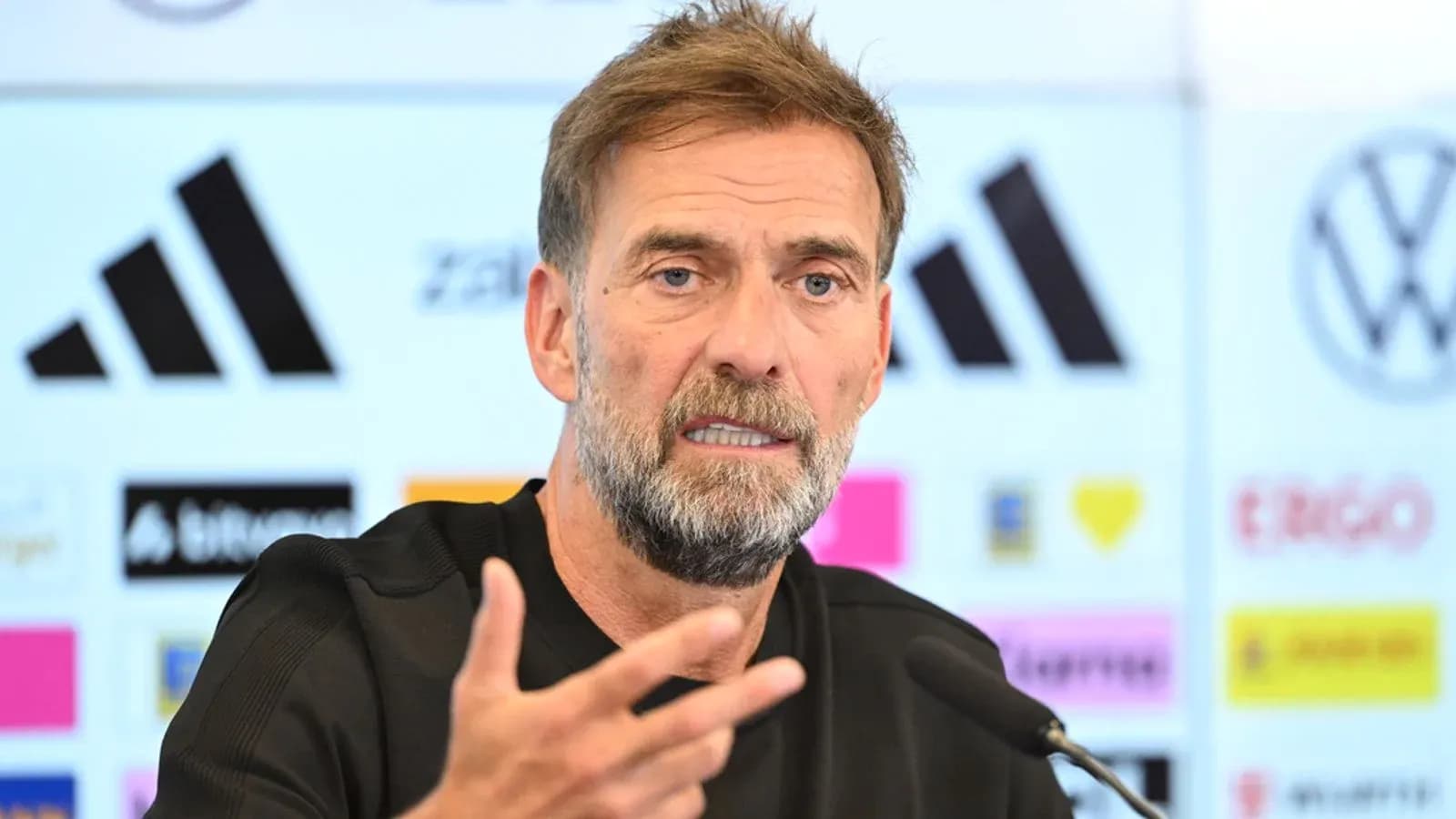
Jurgen Klopp Takes Charge of Germany National Team
Jurgen Klopp has walked back into the technical area – and straight into the hottest seat in German football.
The former Liverpool manager has been appointed head coach of Germany on a deal running until the end of the 2030 World Cup, a seismic move for a national team still searching for its identity after years of drift. For Klopp, 59, it is the job he openly calls the pinnacle of his coaching life. For Germany, it is a bet that his energy, ideas and personality can jolt a fallen giant back among the elite.
From burnout to the biggest job of all
Klopp stepped away from Liverpool in 2024, admitting he was “running out of energy” after nine relentless years that brought six major trophies, including the Champions League, Premier League, Club World Cup, FA Cup and two League Cups. He then disappeared from the dugout, taking a six‑month break before resurfacing in a more distant role as Red Bull’s head of global soccer.
From there, he insisted he had no appetite to return to the grind of club management. The next step, if there was to be one, would have to be different. Bigger. Final.
Now it is. And he is treating it exactly that way.
“Jurgen Klopp is not going to have any ‘career’ after the national team,” he said at his unveiling on Friday. “This is the pinnacle, the high point of my footballing career as a coach. I will give everything I've got, and I have the best possible assistant coaching team.”
A warning shot on day one
This was no soft launch. Klopp, smiling but steely, used his first public appearance to lay down clear lines – not about tactics, but about respect.
He made it plain that he will not cling to the job if the atmosphere around it turns toxic, especially for his family.
“I will be remunerated very graciously and if tomorrow Jurgen Klopp is s***, I will be gone,” he said. “But if the DFB says let us discontinue the job, then that's it. And if you behave badly and don't let my family in peace, I'll be gone. I'll just turn away. I know there are other countries where national team head coaches are treated even worse. I love this job but I am also ready to call it quits if needs be.”
That is not the language of a man desperate for status. It is a coach who knows his worth, knows his limits, and is ready to walk away if the trade-off becomes too high.
“I’m doing it for you”
On the pitch, Klopp framed his mission in simple terms: make Germany better, deepen the pool, restore pride.
“It is my mission to make the national team squad a better team and hope the pool for me to choose from will be bigger, but it is not something I am doing against you, I am doing it for you. It is an honour,” he said.
The tone matters. Germany have been bruised by recent tournaments, the bond between team and public frayed by early exits and flat performances. Klopp, with his ability to connect, is already trying to pull supporters back into the story.
But he refused to sell a fairy tale.
“Jurgen Klopp being in the job doesn't automatically mean we're going to be world champions,” he warned.
Resetting expectations, not lowering them
Klopp went straight at the question that has hovered over Germany for years: where do they sit in the modern hierarchy?
“Success is performance vs expectations. We need a new set of expectations,” he said. “Many people have asked themselves, are we as good as France? If the answer is no, then that is not necessarily true. If the question is, do we have players like Dembele, Barcola, Mbappe? Then the answer is no, we don't, but we can still beat them.”
That line cuts to the heart of his philosophy. He knows Germany lack the sheer individual firepower of some rivals. He also knows that organisation, intensity and belief can close gaps that on paper look wide.
“We don't want to play like Argentina, Spain, England or France. We want to play like Germany, do it the German way but very intense. Are we the number one team at the moment? No, we aren't; I accept that. Would we be happy to be the number two team? Then people would say we aren't number one.
“At the moment, we have 11 teams ahead of us. Yes, we can beat them, but for this to happen, you need to play very good, intense football.”
It is classic Klopp: no excuses, no inferiority complex, but no illusions either.
The first call after Nagelsmann
When Julian Nagelsmann resigned after a dismal World Cup that ended with a last‑32 penalty shoot-out defeat to Paraguay, the German federation did not hesitate. Klopp was the first name on their list.
They have not just hired a coach. They have hired a project.
His first test comes quickly. Germany face the Netherlands in the Nations League on September 24, a fixture heavy with history and emotion. It will be the first glimpse of what “German, but very intense” actually looks like under Klopp in a national-team context.
A familiar inner circle
Klopp has moved fast to surround himself with trusted lieutenants. Former Liverpool assistants Pep Lijnders and Peter Krawietz join the staff, along with Sven Bender, who played under him at Borussia Dortmund.
Lijnders arrives after a brief spell at Manchester City following Pep Guardiola’s departure, while Krawietz – long dubbed “the eye” in Klopp’s backroom teams – brings his forensic attention to detail. Bender adds the player’s perspective from inside Klopp’s high-energy system.
Off the pitch, another World Cup winner returns to the fold. Per Mertesacker, who left his role as Arsenal’s academy manager at the end of last season after eight years in north London, will become Germany’s sporting director in January, replacing Andreas Rettig. It is a structure built around experience, clarity and shared ideas.
The last great chapter
Klopp’s club career already reads like a modern epic: the revival of Borussia Dortmund, the transformation of Liverpool, the nights when his teams ran on emotion and pressing and a sense that something bigger was happening.
Now comes the final act, by his own admission. No next job. No safety net.
He has the country he wanted, the stage he craved, the authority he commands. He has also set his own conditions, publicly and bluntly.
Germany, wounded but proud, have handed him the keys. The question now is not whether Klopp can change them.
It is how far he can take them before that 2030 finish line comes into view.