.svg&w=384&q=75 "Pitchgist logo")
Ibrahim Mbaye: The Youngest African to Score at a FIFA World Cup
There is a version of 16 June 2026 that history will try to forget.
France 3, Senegal 0 at MetLife Stadium, the clock bleeding into the 85th minute, the game apparently gone. The cameras are already hunting for cutaways: Kylian Mbappé’s expression, Didier Deschamps’ handshake, Senegal’s disappointment.
Then a teenager steps off the bench and refuses to accept his role as background noise.
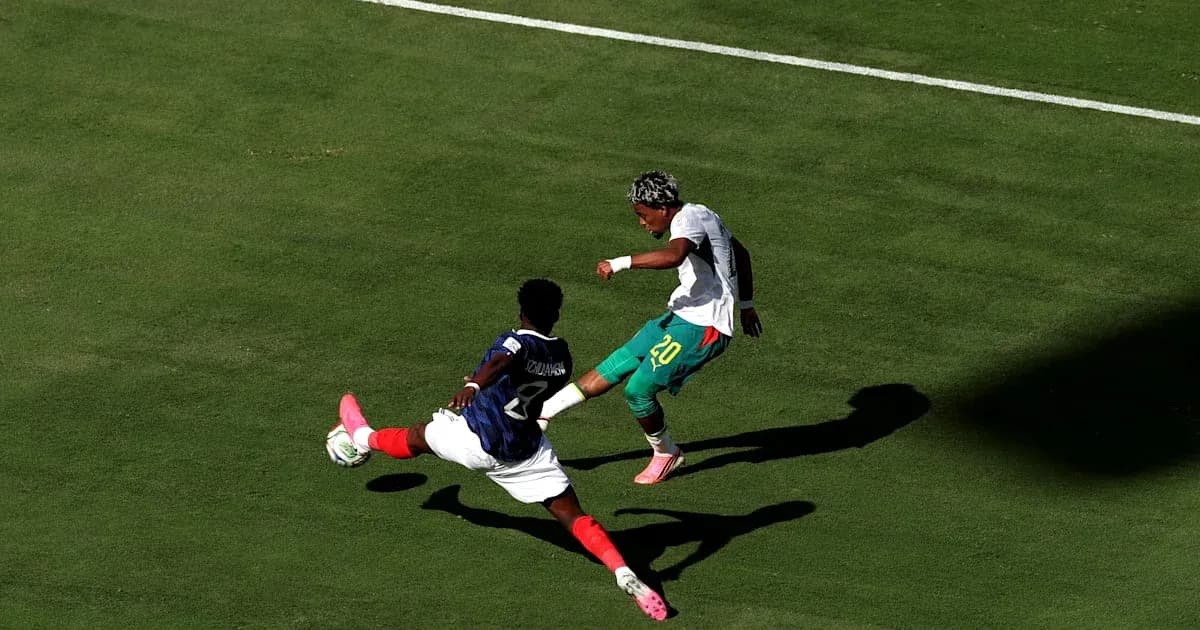
Ibrahim Mbaye collects the ball wide on the right. One feint, one roll of the foot, and Théo Hernandez is suddenly heading in the wrong direction. Mbaye doesn’t hesitate. He lashes his shot past Mike Maignan and into the France net in the 95th minute.
France 3, Senegal 1. On the night, it changes nothing.
On the record, it changes everything.
At 18 years and 143 days, Mbaye becomes the youngest African ever to score at a FIFA World Cup, taking down a mark once owned by his compatriot Moussa Wagué in 2018. Stretch the frame further and the list he joins is tiny and glittering: Pelé, Mexico’s Manuel Rosas, Spain’s Gavi and Lamine Yamal. That is the company.
C’est du sérieux. Serious business. And Mbaye has been conducting serious business long before MetLife ever learned to pronounce his name.
Books, then Ballon d’Or dreams
Rewind ten months.
Paris Saint-Germain are heading to Marseille for a Ligue 1 fixture. The squad boards the plane. One name is missing. Not because of injury, not because of form.
Mbaye, then 17, is sitting his baccalauréat.
While his teammates stretch and sleep, he spends the afternoon in an exam hall, working through equations and essays. Only after that does he travel separately to join the squad for an 8pm kick-off.
For most players, that would be the story they dine out on for years. For Mbaye, it was just another day.
This is how PSG’s academy operates now. The same pipeline that has produced Warren Zaïre-Emery and Senny Mayulu insists that textbooks matter as much as tactics boards. Academy director Yohan Cabaye points to a 95 per cent baccalauréat pass rate among the club’s youngsters and treats academic discipline as non-negotiable.
In Mbaye, that philosophy has its most persuasive poster boy. The nutmeg and finish against France was not a flash of chaos. It was a problem solved in real time, the same calm logic that carries him through an exam paper surfacing in the 95th minute of a World Cup opener.
He does not rush. He does not panic. He simply chooses the right answer.
The boy from Trappes who said no to France
Mbaye’s story begins in Trappes, the Paris suburb that gave football Nicolas Anelka and a generation of street-hardened talent. His father is Senegalese, his mother Moroccan, and his football education has been pure bleu: France’s youth teams, France’s system, France’s expectations.
Inside Clairefontaine and beyond, few truly believed he would play for anyone else.
Then November 2025 arrived, and Mbaye picked Senegal.
There was no tug-of-war played out in public, no last-minute pressure from federation officials. The decision was his. Entirely his. He later told Senegalese broadcaster RTS, after lifting the Africa Cup of Nations trophy in January, that he would “never regret” choosing Senegal, calling it a decision “from the heart”. Months on, reflecting again, he went further: “If only you knew… it’s the best decision I’ve ever made in my life. The Senegalese have such huge hearts; it’s incredible.”
That is why his goal against France carried a weight the scoreboard could never show. A boy raised in the Paris banlieues, polished in the country’s most storied academy, scoring his first World Cup goal against the nation that shaped him — while wearing the green of Senegal.
Quelle histoire. Scriptwriters would have been told to tone it down.
A career on fast-forward
Look at the numbers and Mbaye’s career reads like someone has leaned on the fast-forward button.
He made his Ligue 1 debut at 16 years, 6 months and 23 days, becoming PSG’s youngest-ever league starter, taking a record from Zaïre-Emery. By February 2025 he had signed his first professional contract. Weeks later, he scored his first senior goal.
The milestones kept coming. By August, he was the youngest Frenchman ever to play in a UEFA Super Cup, surpassing a mark set by Ryan Giggs back in 1987. In May 2026, his stoppage-time strike away at Lens sealed PSG’s 14th Ligue 1 title. Still a teenager. Already a closer.
The international timeline is just as breathless. A debut for Senegal against Brazil in November 2025. A goal three days later on his second cap. The youngest player ever to feature at the Africa Cup of Nations in December. Then, in January, he broke his own record by becoming Senegal’s youngest AFCON goalscorer, on the way to lifting the trophy before CAF later ruled to award the victory to Morocco after the match.
Even stripped of the drama, the numbers speak loudly enough: four goals in twelve caps before his nineteenth birthday. The comparisons with Kylian Mbappé no longer feel lazy. They feel inevitable.
Coaches, though, talk less about the headlines and more about the habits. They point to his decision-making: the instinct to know when to drive with the ball and when to slip a pass, when to slow the game and when to tear into space. He does not need twenty touches to announce himself.
Sometimes he needs one.
“Mbaye is world class, and he is ours, he did not choose France – he chose Gaindeyi,” Senegalese journalist Wahany Johnson Sambou told Olympics.com in January, referencing the Wolof name for the national team. “He’ll do great things, just watch.”
The warning has been issued.
Dakar, then LA: a new Olympic chapter
Senegal’s Olympic football story is still in its prologue. One appearance in the men’s tournament so far — London 2012 — but what an appearance. That squad launched Sadio Mané, Idrissa Gueye and Cheikhou Kouyaté into the wider spotlight.
They have not returned to the Games since.
Now Dakar is preparing to host the Youth Olympic Games this October, and the country can feel the gaze of the sporting world drifting toward West Africa. There is a sense of timing here, a feeling that Senegal’s broader Olympic moment, football included, is about to arrive.
Mbaye, born in January 2008, will be 20 when Los Angeles stages the Olympics in 2028. Perfectly placed for an Under-23 tournament that has given a global stage to Lionel Messi, Neymar and Mohamed Salah. Olympics.com has already circled his name among Africa’s brightest prospects for LA 2028. It is not a stretch.
What makes that prospect so compelling is not just the medals he has already lifted or the records he has already broken. It is the temperament that runs beneath it all — the same unflustered clarity that allowed him to sit a baccalauréat exam on a matchday afternoon, then step into a World Cup cauldron at MetLife and finish like he was back in the classroom.
For now, Mbaye keeps doing what he has always done: arriving early to moments everyone else thinks are still years away, taking the ball, taking responsibility, and taking his place in games that are supposed to belong to his elders.
The world can choose when to look up. He won’t wait.