.svg&w=384&q=75 "Pitchgist logo")
Hearts on the Brink of Scottish Championship Glory
For Heart of Midlothian, the bare, almost ridiculous truth is this: on Wednesday night, after 66 long years, they could be champions of Scotland.
There is, of course, a giant asterisk hanging over that possibility. Hearts must beat Falkirk at Tynecastle. Celtic must lose to Motherwell at Fir Park. Two results, 90 minutes apart, holding decades of history in their grip.
Most people don’t see it falling that way. Celtic, under Martin O’Neill’s steadying hand after the turbulence of Wilfried Nancy’s reign, have clawed their way back into the race. Motherwell have already schooled Celtic once this season, but that was a different Celtic, a different time. A relative lifetime ago.
And yet, here we are. Hearts, with their formidable home record and their stubborn refusal to bow to the old order, stand one point clear at the top with two games left. One slip from O’Neill’s side against Jens Berthel Askou’s dangerous, well-drilled team, and the title could tilt in a direction Scottish football has almost forgotten.
The bookmakers still back Celtic. They always have. The cold-eyed odds-setters never truly bought the Hearts fairytale, convinced the Glasgow machine would eventually grind its way back to the summit. Perhaps it still will.
But the mere fact that Hearts have dragged this title race to the brink is dizzying. Thirty-six games, 3,240 minutes, 10 months of football. Top since September. Punching, counter-punching, and still standing.
This is their greatest league campaign since the trauma of 40 years ago, when the dream died on the final day. They were mocked when Tony Bloom arrived and talked about splitting the Old Firm in a single season. They were doubted in December when they dropped points in four straight matches. The scepticism turned to sniggers when they lost to two of the bottom six and then drew with Livingston, rock bottom of the Premiership.
Injuries bit then, as they do now. The squad creaked. The run threatened to crack. Hearts refused. The word “Believe” has become more than a slogan at Tynecastle; it is Derek McInnes’ doctrine, the creed that has carried this team through every wobble.
Walk into the Tynecastle Arms on a quiet Monday and you feel that history pressing in on you. It’s a pub, yes, but it’s also a shrine. John Robertson’s first pair of boots sit in a glass case. A plaque celebrates the 5-1 Scottish Cup final demolition of Hibs. The walls drip with photographs, frozen moments of joy and defiance.
Will they soon have new ones to hang?
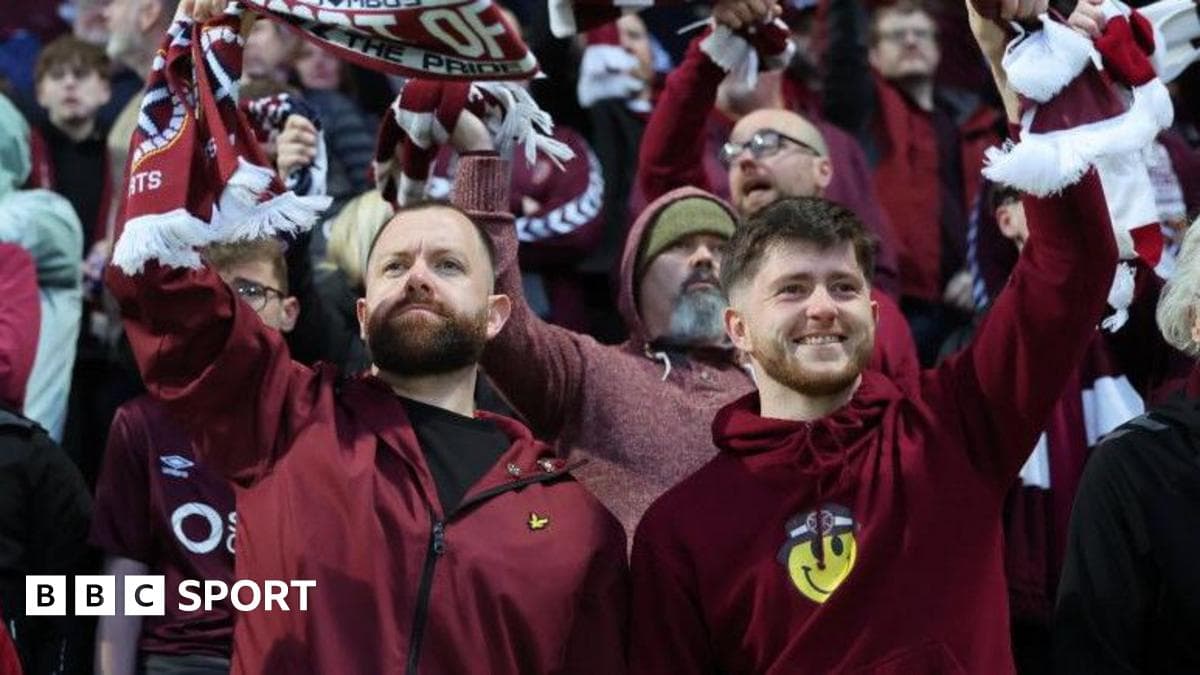
The regulars nursing their pints aren’t sure. They want to believe, desperately. But they’ve lived too much hurt to give in easily to hope. Heartbreak is part of the furniture here.
Some of them were at Dens Park in 1986, when Hearts watched the title evaporate in front of their eyes. One man’s father stood in the crowd in 1965 when they were denied again. The scars have been handed down like family heirlooms.
“I didn’t know what to do with myself afterwards,” recalls Mark of that day in ’86, when Dundee shattered the dream. He remembers the goals, the numbness, the instinct to get out of the place as fast as his legs would carry him. He remembers the long walk to the bus, the sight of grown men in tears, being held by their sons and daughters.
Children comforting fathers. Not the other way round. That image never left him.
Mark believes again now, or at least he’s trying to. But Saturday at Fir Park shook him. It shook a lot of people in maroon.
At 1-1, Alexandros Kyziridis went down in the box under a challenge from Tawanda Maswanhise. Referee Steven McLean waved away the penalty claims. VAR asked him to look again. He did. He stuck with his call. Hearts fans erupted in disbelief.
McInnes says Willie Collum, the head of referees, has since admitted an error was made. That admission will not change the table.
The lads in the Tynecastle Arms have their own, unprintable view on it all. They do not, to put it mildly, feel that the playing field is entirely level when an east-coast club threatens to upend a giant from the west. Think Alex Ferguson’s rants about west-coast bias in the 1980s, then turn the volume up several notches.
Maybe Celtic will snuff out the dream. Maybe this story ends the way so many others have in Scotland: with the Old Firm on top, the rest applauded for their plucky effort and sent back to their place.
But this dream has already lasted far longer than anyone outside Gorgie thought possible. It has been a season-long epic.
At first, the interest from beyond Scotland was a curiosity, nothing more. A few outlets in England and Ireland wanted to know about Hearts’ flying start, the wins over Celtic and Rangers, the Bloom investment, the mystery of Jamestown Analytics and Radio Braga. A quirky subplot to the usual Glasgow drama.
Then Rangers and Celtic both stumbled under Russell Martin and Nancy. Hearts kept winning. The story grew legs.
Soon the calls came from France, Germany, Portugal, Spain. Austria, Belgium, Greece, the Netherlands, Sweden. Newspapers, magazines, radio shows, podcasts. Everyone wanted to know about the club daring to poke at one of world football’s most entrenched duopolies.
As the weeks passed and Hearts refused to budge from the top, the trickle became a flood. Bloomberg and ESPN rang from the United States. Revista Balompie from Mexico. Radio Vitoria from Brazil. The Financial Review from Australia. Then Uganda, Kazakhstan, Nigeria. The boys from Gorgie Road had gone global.
No wonder. The scale of what they are chasing is staggering. Sixty years since Hearts last won the league. Forty-one years since anyone outside the Glasgow two lifted the title. Celtic and Rangers sit on 55 championships apiece. No other club has more than four. Around 85% of all Scottish league titles have gone to one of those two giants.
And yet here is a team that finished seventh last season, 42 points behind Celtic, now threatening to redraw the map.
The numbers underline the gulf. Hearts have 15,500 season ticket holders. Rangers boast around 45,000, Celtic 53,000. In the past 20 years of European competition, Celtic have banked somewhere between £370m and £420m. Rangers’ estimate lies between £235m and £270m. Hearts’ figure? Around £25m. Their latest turnover was £24m. Rangers’ was £94m. Celtic’s, £143m.
On those figures alone, this title race should never have existed. For months, the debate has swung like a pendulum. Hearts will win it. No, Celtic or Rangers will inevitably run them down. Back and forth, week after week.
With two games left, one thing is certain: Rangers are out of the picture. Motherwell wounded them. Hearts deepened the damage. Celtic finished the job on Sunday. The blue half of Glasgow is watching the run-in from the canvas.
So it comes down to this. With 180 minutes remaining, Hearts sit where they have sat almost all season: top of the league. One point ahead of Celtic. Three better on goal difference.
They have lived on the edge and thrived there. Wins in the 86th, 87th, 88th minute. Three victories secured beyond the 90th. Four straight wins against the Old Firm, a feat that belongs in club folklore. Celtic, Rangers and Hibs beaten home and away. Top at Christmas, a rare sight for a club outside the Glasgow behemoths.
Seventy-seven points, the highest tally ever recorded by a non-Old Firm team in the Premiership era. New ground broken. Old certainties rattled. The biggest guns in the land forced to look over their shoulders.
Wednesday night might be the moment it all comes together. It might be Saturday. Or the dream might stop just short of immortality.
Whatever happens, Hearts have already dragged Scottish football to the edge of a question it has spent generations avoiding: what if the old order really can be broken?