.svg&w=384&q=75 "Pitchgist logo")
Guillermo Ochoa Retires: A Legacy in Mexican Football
Guillermo Ochoa has finally taken off the gloves.
One of Mexico’s defining footballing figures announced on Tuesday that he is retiring from elite competition, drawing a line under a career that stretched across continents, eras and six World Cups. He had long pointed to the 2026 tournament as his last dance. Many still clung to the idea of a short-term deal, one more contract, one more season. That hope is gone now, replaced by something heavier and far more permanent.
He chose to speak directly. No staged press conference, no sponsor backdrop. Just a message to millions who had watched him grow from a skinny kid at Club América into a global reference point for Mexican goalkeeping.
“I gave it my all; I left everything on the field for my clubs and the national team, and today I hang up my gloves,” Ochoa wrote on social media. “Being a goalkeeper means knowing you might wait 90 minutes for a single moment when everything depends on you. And when that moment arrives, you cannot hesitate.”
Those moments defined him. Brazil 2014, when he flung himself across the goalmouth to claw away Neymar’s header. Russia 2018, when he seemed to grow an extra arm every time Germany shot. Qatar 2022, where yet another penalty save went straight into Mexico’s World Cup folklore. The reflexes, the spring, the outstretched right hand – all part of a catalogue that made his name far beyond Mexico’s borders.
The numbers alone are staggering. Six World Cups, a mark shared only with Ronaldo and Messi. At first, he was the understudy, a young goalkeeper travelling more to learn than to play. Then came the handover. From Brazil 2014 through Russia 2018 and Qatar 2022, the No. 1 shirt belonged to him. He did not simply keep goal for Mexico; he came to embody the position.
His final tournament told a different story. At the 2026 World Cup, Ochoa ceded the starting role to Raul Rangel, serving mostly as the veteran presence in the dressing room and on the training pitch. But manager Javier Aguirre understood what this farewell meant to a country and a generation.
So, with Mexico’s final group game against Czechia drifting towards its conclusion, Aguirre made the change. Thirteen minutes remained when Ochoa stepped onto the Estadio Azteca pitch, the stadium that had seen his first steps as a professional and now hosted his last. The roar rolled down from the stands, not for a save or a result, but for a lifetime.
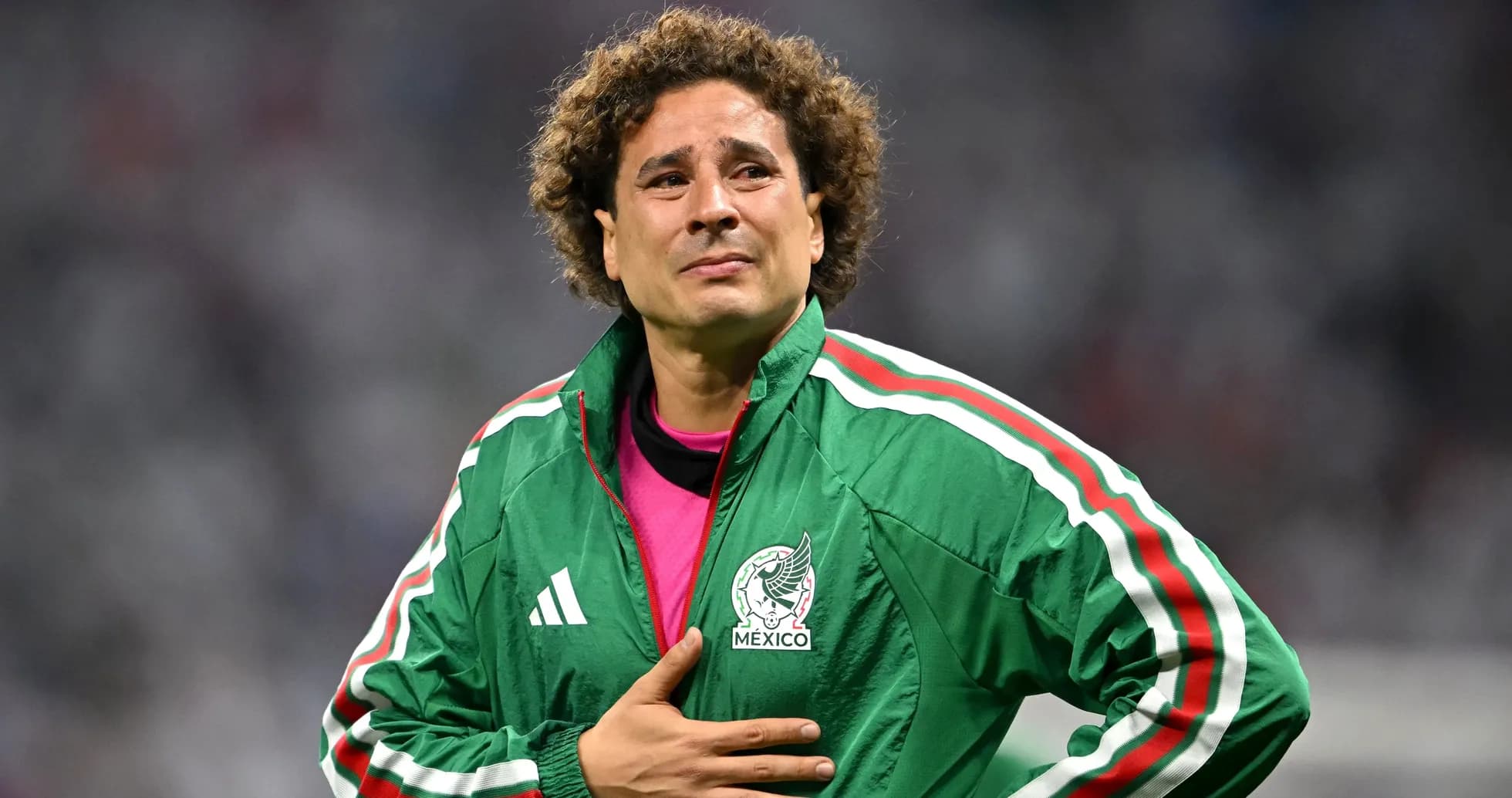
At the final whistle, emotion took over. Ochoa walked to his goal, pressed his lips against each post, and lingered. These were the frames of his youth, the same white metal that had witnessed his debut back in 2004. Teammates gathered around him in a tight embrace, a guard of honour in green shirts, as the Azteca saluted one of its own.
The crowd eventually filtered away. The lights dimmed. Yet Ochoa stayed. He walked alone to the centre circle, turned slowly, and let the moment sink in. One last look at the grass, at the stands, at the stadium that had been both launchpad and sanctuary. Then he left it behind.
His résumé justifies the reverence. A league title with Club América in the 2005 Clausura, the first major piece of silverware in a career that would stretch far beyond Mexico’s borders. A Belgian Cup with Standard Liege, proof that his impact travelled with him.
The journey began in earnest in February 2004, when a young Ochoa made his top-flight debut for Club América. He did not take long to convince anyone watching. The reactions were instant and explosive, his shot-stopping bordering on instinct. Within seven seasons, he had gone from promising reserve to undisputed starter and fan favourite.
Then came the leap. In 2011, Ochoa joined French side Ajaccio, becoming the first Mexico-born goalkeeper to play in Europe. It was more than a transfer; it was a statement that a Mexican keeper could carry the weight of a European club, week after week, under relentless scrutiny.
His European chapter sprawled across leagues and languages. Ajaccio in France. Malaga and Granada in Spain. Standard Liege in Belgium. Salernitana in Italy. Later, AVS Futebol and AEL Limassol added fresh stamps to a well-travelled passport. Each stop brought different demands, different styles, different pressures. He kept adapting. He kept playing.
Between those adventures, he came home. In 2019, Ochoa returned to Club América for a high-profile three-year spell, welcomed back as more than just a signing. He was a symbol, a living link between generations of supporters. In those years, he reinforced his status not just as a former prodigy, but as a club legend who had gone out into the world and come back with stories, medals and scars.
Through it all, he never lost sight of where it started.
“I never imagined how far a dream could take me. Today, I can only look back with pride and say: Thank you,” he wrote in his farewell. “I take with me the affection of millions and the peace of mind that comes with knowing I gave everything for Mexico.”
That, in the end, is the legacy. Not only the saves or the tournaments, but the sense that every dive, every scream, every second in goal carried the weight of a country that expected miracles and often got them.
The gloves are off now. The posts stand empty. Mexican football must find its next guardian.