.svg&w=384&q=75 "Pitchgist logo")
Enzo Maresca Takes Charge at Manchester City: A New Era Begins
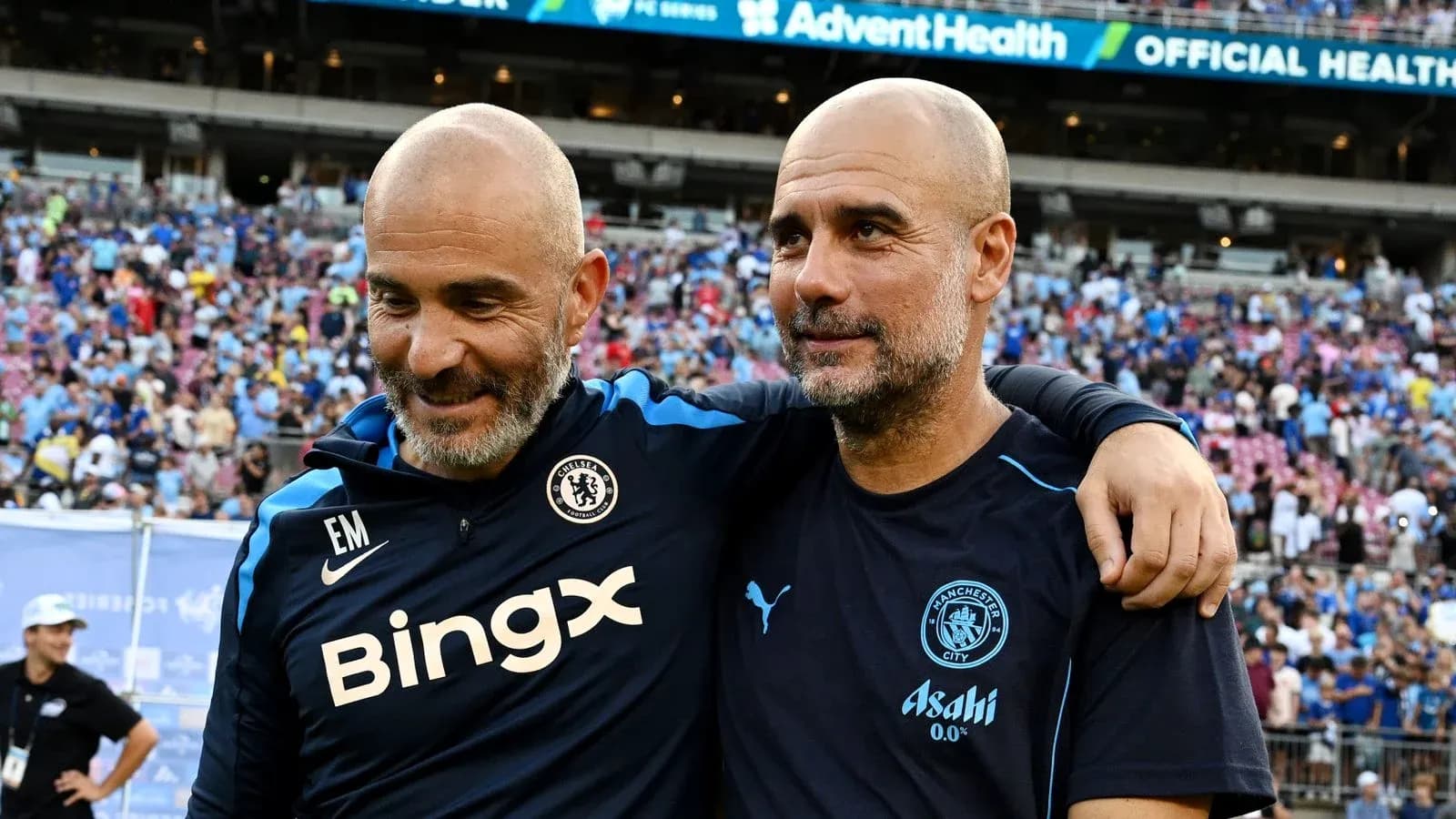
Enzo Maresca steps into the light at Manchester City with a familiar badge on his chest and an unfamiliar weight on his shoulders.
For years, everything at the Etihad pointed towards one man. The training ground, the academy, the recruitment, even the language on the walls – all of it was built to lure and then sustain Pep Guardiola. That era is over. The question now is brutally simple: what does Manchester City look like when the man they built the club around has gone?
Maresca is the answer they have chosen.
A soft landing – on paper
If you were designing a debut run for a new City manager, it would look a lot like this. Bournemouth, Crystal Palace, Coventry City. No early trip to Anfield, no opening-day derby, no title rival staring you down before the ink is dry on your contract.
It’s a sympathetic start, and it matters.
Those first three games buy Maresca time to breathe, to impose ideas, to get a tune from a squad still shaking off World Cup fatigue. They also give City’s core the chance to recover properly. Rodri, the metronome of Spain’s triumphant campaign and the heartbeat of Guardiola’s City, is the one most at risk of breaking down. He has played too much football, for too long, at too high a level.
These fixtures should allow City to phase him back rather than throw him straight into the fire. On paper, they can win all three without him. On grass, that’s still the expectation.
But there’s a flip side. When your opening run looks this winnable, anything less than near perfection is a problem. Maresca cannot afford early slip-ups, not with Manchester United and Liverpool looming in two of the next three league games in September. Those matches will be about more than points; they will be about power, about narrative, about who controls the new landscape of the Premier League.
The Italian knows it. When he called this a “dream situation” on arrival, he wasn’t wrong. He inherits an elite, balanced squad with depth and quality in almost every position, built meticulously by Guardiola and the hierarchy. It gives him structure. It gives him weapons.
It also strips away excuses.
The demands are unchanged: win, and win with style. The difference is that Maresca will not enjoy the almost unique job security Guardiola earned over years of transformation. He has a strong relationship with chairman Khaldoon Al Mubarak, but he is not Pep. He will be judged quicker, and more harshly, if the machine stutters.
Guardiola’s echo – and Maresca’s twist
Tactically, City are not ripping anything up. This is evolution, not revolution.
Maresca’s football is cut from the same cloth as Guardiola’s. He wants the ball. He wants control. He wants his team to hunt aggressively when they lose it. The principles are familiar.
The details are not.
Under Guardiola, City often looked like a moving puzzle. Defenders stepped into midfield, midfielders drifted into full-back zones, wingers tucked inside to overload central spaces. Rodri stood at the centre of it all, the pivot around which the entire structure turned.
Maresca leans towards a more defined 4-2-3-1. Roles are clearer, positions more traditional. He prefers wingers who stay high and wide, stretching the pitch, pinning full-backs. The No 10 becomes crucial, the connector between midfield and attack, the player who knits everything together.
At Chelsea, that player was Cole Palmer. At City, Maresca can turn to Phil Foden, already a symbol of the club’s modern era, or Rayan Cherki, a different profile but another option between the lines if the Italian wants to mirror that setup.
The shift will not be seamless. City’s wide players have been drilled to come inside, to rotate, to flood central zones. Asking them to hug the touchline, to resist the urge to drift, changes their habits and their reference points. The back line, too, will feel the difference of a more rigid structure, with less constant role-swapping and more defined zones.
How quickly this group adapts will define Maresca’s first months. The ideas will be familiar; the patterns, less so.
A younger core, an older expectation
Behind the scenes, City have been quietly reshaping their squad. Under sporting director Hugo Viana, the average age has dropped dramatically, from 29 to just over 25. The squad is fresher, hungrier, built to run for years.
The cost is obvious: leadership.
Bernardo Silva and John Stones have gone this summer. Kevin De Bruyne departed before them. Between those three, City lose experience, personality, and players who understood exactly what it meant to carry the team through difficult spells.
The dressing room is not empty, though. Rodri and Ruben Dias remain central figures, both on the pitch and in the inner circle. Erling Haaland took on more responsibility last season, growing from pure finisher into a more vocal presence. Marc Guehi and Josko Gvardiol bring authority and calm at the back, Mateo Kovacic adds know-how in midfield. The spine is still strong, still capable of winning titles.
Recruitment has been aggressive. Elliot Anderson has arrived from Nottingham Forest for huge money, a statement investment in a midfielder who can add durability and long-term value. Jeremy Monga has been taken from Leicester, another move with one eye firmly on the future.
City want more. A right-back is on the list, a winger too. They are tracking Ayyoub Bouaddi, the Lille teenager who impressed for Morocco at the World Cup, though Arsenal are in that race as well. That is the market City now operate in: competing for the best young talent as much as the finished article.
Sales will shape the rest of the window. The club are open to moving on several players if the price is right: Savinho, Omar Marmoush, Nico Gonzalez, Jack Grealish, Tijjani Reijnders and Rico Lewis are among those who could depart if suitors meet City’s valuation. With the World Cup now over, the expectation is that business will accelerate.
Maresca will need clarity quickly. His system is specific; his training ground work relies on repetition and defined roles. A squad in flux is the last thing he needs deep into August.
A club of certainty enters an age of questions
This is the first time since the Abu Dhabi takeover that Manchester City step into a season without a clear long-term plan already mapped out.
For a decade, everything was geared towards Guardiola. The style of play, the academy philosophy, the staffing, even the architecture of the training complex – all roads led to him. That mission has been completed. Now the club must decide what comes next.
What has not changed is the culture. City have built an environment where anything short of silverware is treated as failure over time. Supporters come to the Etihad expecting entertainment, but above all they expect victory. The bar is unforgiving.
Maresca discovered at Chelsea how hard it is to balance those two demands. His team showed flashes, but the blend of style and substance never quite held. At City, the margin for error is slimmer, the scrutiny sharper.
Yet he is not alone in this new era. The Premier League’s traditional hierarchy is in flux. Andoni Iraola at Liverpool, Xabi Alonso at Chelsea, Michael Carrick at Manchester United – all are stepping into or consolidating roles at major clubs with their own uncertainties and growing pains. This is not a settled landscape; it is a league in transition.
City see opportunity in that. While others figure themselves out, they believe their squad depth, infrastructure and winning muscle memory give them a head start. Maresca’s task is to harness that advantage before anyone else stabilises.
Sink or swim. There is no middle ground at this level.
The shadow of 115 charges
Hovering over all of this is a story that has nothing to do with tactics or team selection.
The 115 Premier League charges against Manchester City still hang over the club. They are unresolved, and until a verdict arrives, they will colour every discussion about City’s success, every trophy, every surge of dominance.
Maresca cannot control the process, but he will have to live with the noise. Guardiola became an expert in managing that spotlight. He knew when to confront, when to deflect, when to shut down a line of questioning entirely. Years at Barcelona, Bayern Munich and City hardened him for that role.
Maresca’s experience is different. At Chelsea, he faced criticism and pressure, but it was largely about football – results, performances, selections. The off-field storm at City will be more complex. How he handles those press conferences, those inevitable questions, will shape the perception of his first year as much as his substitutions on a Saturday.
If a verdict lands within the next 12 months, his response will be scrutinised in minute detail. If it doesn’t, he will still be the man fronting up to the cameras, carrying a story that predates him and may outlast him.
He inherits a squad good enough to win the league, a structure designed for dominance, and a fixture list that hands him early momentum. He also inherits a legend’s shadow and a legal cloud no manager would choose.
Manchester City built a decade around one man’s vision. Now they must discover whether the machine can keep winning when the architect has gone – and whether Enzo Maresca is the one to prove it.