.svg&w=384&q=75 "Pitchgist logo")
England's World Cup Journey: Second-Best Campaign Yet
Here’s the thing England don’t really want to hear: it still probably isn’t coming home.
Cold, hard probability points elsewhere. The likelier story is England finishing fourth after losing to Argentina and France than parading a trophy after beating Argentina and Spain. That’s the maths of elite football, the blunt edge of tournament reality.
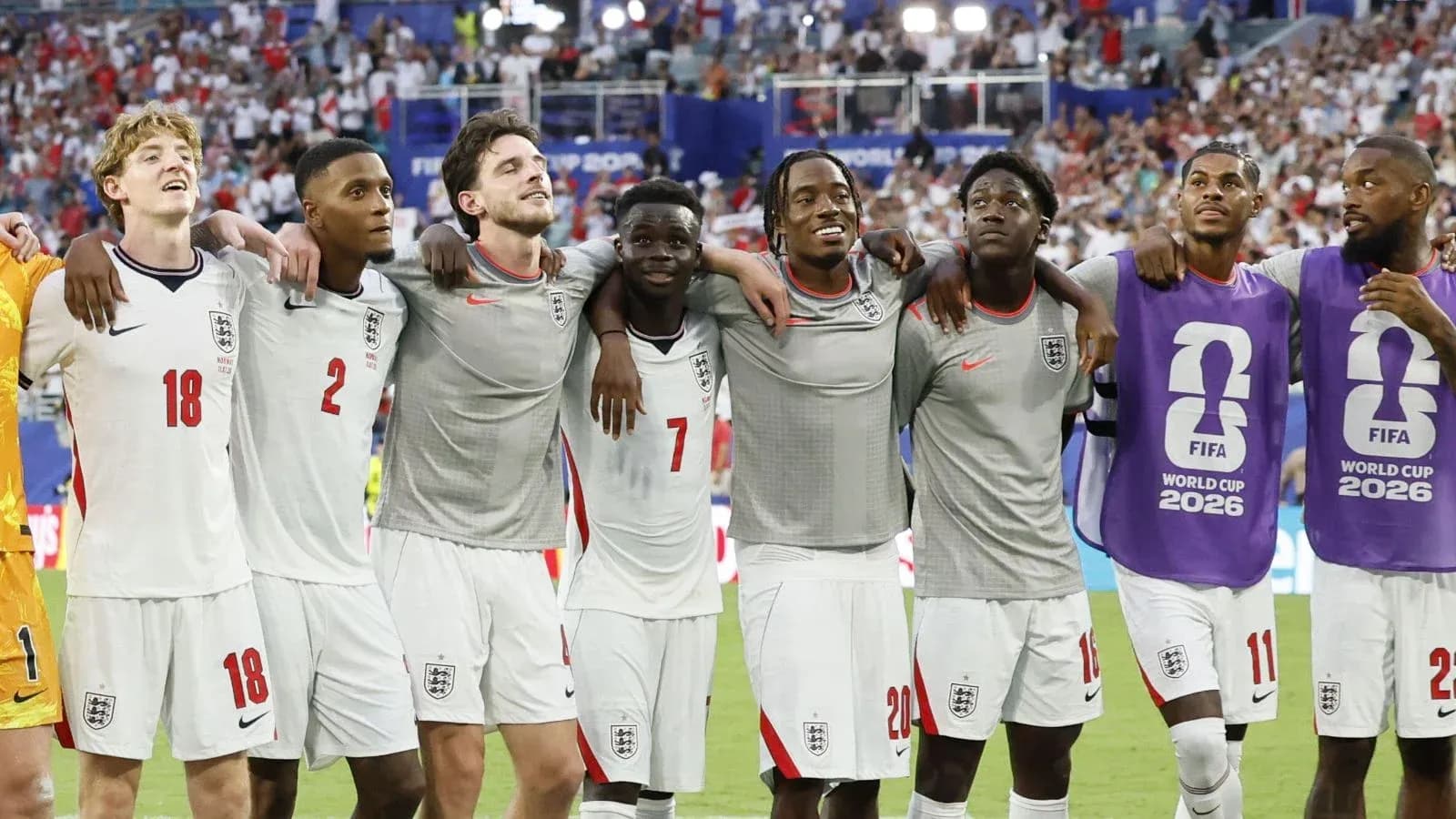
But step back from the noise for a moment. Strip away the gallows humour, the fatalism, the reflexive eye-rolls. Whatever happens in Atlanta against Argentina, this is already England’s second-best men’s World Cup. Ever.
And almost nobody is talking about it.
A tournament that quietly rewrote the script
This was a campaign that, at first glance, carried the familiar scent of a classic England World Cup: play within themselves, stumble in the quarters, appoint a national scapegoat and dine out on the post-mortem for four years.
They’ve already smashed through that ceiling.
No, it hasn’t been relentlessly convincing. The football hasn’t always been pretty. There have been laboured spells, flat spells, spells where England looked more functional than fluent. But that’s the story of every major tournament for almost every team. The difference is that when it’s England, the microscope is bigger, the noise louder.
You remember every sideways pass. Every heavy touch. Every nervy clearance. It’s what happens when you watch your own team with your heart in your throat. Or, in some cases, watch them from Scotland with your blood pressure rising for entirely different reasons.
But look at the field. England have not once sunk to the depths Spain plumbed against Cape Verde. They’ve only occasionally reached the levels of disarray France managed for an hour against Senegal, and across an entire semi-final. The bar for “underwhelming” at this World Cup is not a low one. England are nowhere near the worst offenders.
Argentina, for their part, have had a smoother, softer route through the knockouts. They’ve been helped by a bracket that has not asked the same awkward questions England have already answered. England have earned their place in the last four the hard way.
England don’t do collapses
Only a full-scale humiliation at the hands of Lionel Messi and company can really alter the legacy of this run. And history suggests that is not how England exit tournaments.
They can be embarrassed. They can be humbled by a minnow on a bad night. They can lose to teams they really should beat. But a proper thrashing? A game where the contest is dead long before the final whistle? That is not England’s usual way of losing.
Ignore the third-place play-off, because everyone sane does. It’s a television event, not a tournament match. Strip that out and England have lost by more than one goal in a major tournament exactly once since 1988.
Once.
Even that day, when Germany took them apart in the last 16, the scoreline should have read 2-2 at half-time. Only an officiating howler of such magnitude intervened, a mistake so glaring it helped drag football into its current era of technological obsession.
Think about that record. Really think about it. Since the start of the 1990s, England have missed only two major tournaments. They’ve failed to win any of the 17 they’ve played in. Yet only once have they been truly, irredeemably outclassed on the scoreboard before the end.
They go out, yes. They just don’t tend to go out on their knees.
The second-best World Cup, hiding in plain sight
And yet it doesn’t quite feel like this is England’s second-best World Cup, does it? That’s not how it’s framed, not how it’s discussed. The conversation is still dominated by what they haven’t done, not what they quietly have.
Strip away the sentiment and look at the facts. Objectively, reaching a semi-final outside your own confederation is a bigger achievement than doing it on familiar continental soil. This is already the furthest England have ever travelled in a World Cup hosted beyond Europe.
By that measure alone, this campaign sits behind only 1966.
You wouldn’t know it from the discourse. Maybe that’s the weight of history. Maybe it’s the expectation that anything less than a trophy now feels like failure. Or maybe, just maybe, it’s the latest wave of Scottish coping washing over the border.
Scotland, the draw, and selective outrage
No-one in England needs telling how painful it is to watch your team go home early. Scotland have now watched the same tournament end their hopes four times. That bruises. It lingers.
So the complaints come. About the draw. About the paths. About who had to face whom and when.
Scotland were unlucky, no question, to land both Brazil and Morocco in their group. That is a brutal combination. But that’s what happens when you sit in the lower pots. You are far more likely to be dropped into a group with heavyweights. That’s the system.
The true misfortune in a seeded draw falls on the top sides who hit another top-10 team in the groups, as Brazil did. The more common outcome for seeds is exactly what England had: a group with no other top-10 nation.
And here’s the detail that cuts through the noise. At the time of the draw, Croatia were ranked 10th in the world. Panama were the highest-ranked pot-three side England could possibly face. Only Norway sat above them, and the draw mechanics meant Norway couldn’t be placed with both England and Croatia anyway.
So the narrative that England somehow glided through a featherbed group doesn’t quite hold up. Nor does the idea that their path has miraculously opened up since.
The absence of an official top-10 opponent is a quirk of the rankings, not a conspiracy. Croatia are firmly in that tier. Mexico at the Azteca are, by any reasonable football measure, a top-10 level test. And nobody with a straight face can insist there are 10 better international teams than Norway right now.
The truth is simple: England’s route has been exactly what you’d expect for a side with their seeding. Group win, third-placed side in the last 32, Mexico in the last 16. Nothing soft. Nothing freakish. Just the bracket doing what the bracket is designed to do.
Norway’s win over Brazil stands out precisely because it broke that pattern. A better-drilled, better-organised team beat a giant on merit. In a tournament that has largely gone by the book, that almost counts as a shock.
Glorious or not, this failure is different
So here England stand. On the brink of something improbable. To win this World Cup, they will likely have to outlast the tournament-hardened, streetwise defiance of Argentina and then out-think the club-level cohesion and structure of Spain.
The odds are against them. Of course they are. Very few teams run that gauntlet and emerge with a trophy.
But if it does end in defeat, it will be a different kind of failure. Not the timid quarter-final fade. Not the familiar script of regret and recrimination. This would be the most glorious failure England have known in 60 years of hurt.
And if that’s the floor of what this team can be, what does that say about the ceiling still to come?