.svg&w=384&q=75 "Pitchgist logo")
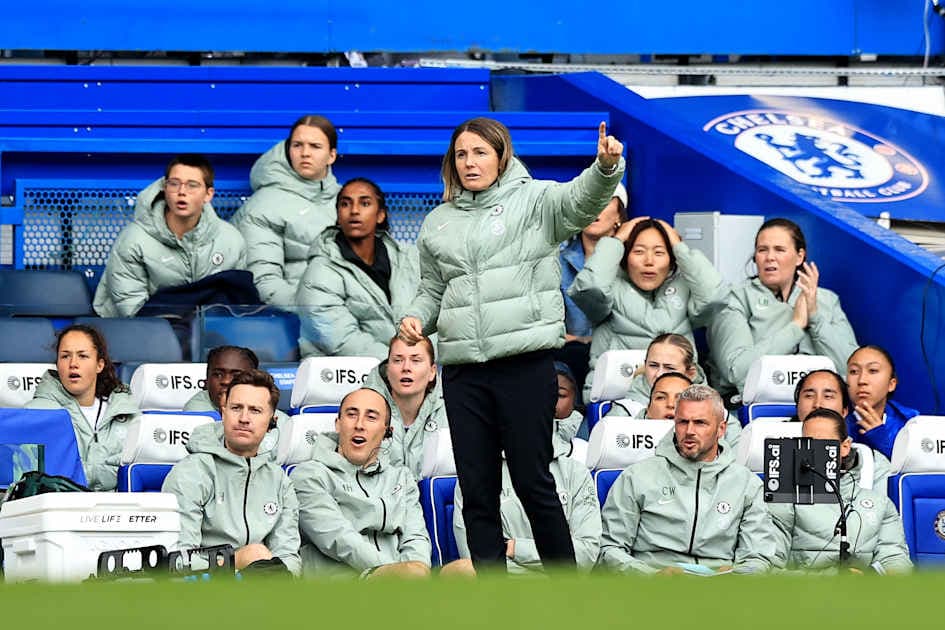
Chelsea's Transitional Season Under Sonia Bompastor
Chelsea know what dominance looks like. Sonia Bompastor walked through the door in the summer of 2024 and promptly delivered a domestic Treble in her first season. That kind of start hardwires a certain expectation into a club.
This year has felt different.
Chelsea have still retained the Women’s League Cup, booked a return to the Women’s Champions League with a third-place finish in the WSL and pushed into the Women’s FA Cup semi-finals. That is a strong season by almost any measure. At Chelsea, it counts as a comedown.
Bompastor is under no illusions about that.
“If you reflect in terms of results, for sure, we have been so used to winning so many games, trophies, and titles,” she said. “But this season we couldn't achieve as much as we did previously.”
The honesty is deliberate. The club has already started what she calls “a lot of reflections” on where Chelsea stand and where they need to go. The sense inside Cobham is that both of Bompastor’s campaigns, even the trophy-laden first one, have been transitional.
The landscape around them has shifted. Quickly.
“The competition is becoming bigger and bigger,” she said. The gap that once separated Chelsea from the rest of England – and much of Europe – has narrowed. Clubs across the continent are investing properly in their women’s teams, in squads deep enough and sharp enough to go toe-to-toe with the serial winners from west London.
Chelsea were the benchmark. The club that “have been showing the pathway,” as Bompastor put it. Now, as she sees it, rivals are catching up, building structures and squads that mirror the model the Blues helped establish.
“So, it’s for us as a club to have a vision around, ‘okay, how can we maintain the success in the long term at a club like Chelsea?’ That's the question we need to ask ourselves.”
One change is already locked in. New rules mean that Chelsea’s qualification for next season’s Champions League automatically removes them from the League Cup in 2026/27. A four-front campaign drops to three competitions.
On paper, that lightens the load. In reality, it changes how the club must build and manage a squad packed with internationals who barely get a breather across a calendar year.
“You build a squad to have the depth to compete in every competition,” Bompastor said. “Because when you have this level of quality in the team, you have a lot of international players, and they play many games in the season.”
Her reference point is Lyon, where she learned what sustained dominance looks like but also how different the English game is.
“When I was at Lyon, 80 per cent of the games, we could play at 60 per cent, and it was enough for us to win,” she explained. “I could play some of the games with players coming from the academy and still win games. That's not the case here.”
The WSL offers no soft landings. No weeks off.
“Here, you have to compete in every league game because every match brings you a challenge in different ways,” she said. Sometimes it’s physical, sometimes it’s the weight of a big-club occasion, sometimes it’s a tactical puzzle. Often it’s all three at once.
Drop your level even slightly, you drop points. Or you lose. Simple as that.
So the work now is not about ripping anything up. It is about sharpening, adjusting, deciding. Where to strengthen. How to manage minutes. How to ensure that when Chelsea stride back into Europe, they do so with the tools to stay there and to go deep.
“Our job is to reflect and to make sure we make the right decisions for the future,” Bompastor said.
Chelsea have shown everyone else the path. The real test now is whether they can stay in front on a road they helped build.