.svg&w=384&q=75 "Pitchgist logo")
Canberra United's New Era: ASG Takes Charge
Canberra United have been pulled back from the brink, and their new owners aren’t wasting time.
Australian Sports Group (ASG), confirmed on Friday as the club’s first private owner, has already started plotting a permanent football home at McKellar Park and mapping a path to an A-League Men side by 2028-29. After two years of anxiety over whether Canberra would even keep its A-League Women licence, the conversation has flipped from survival to ambition.
A new era, same home
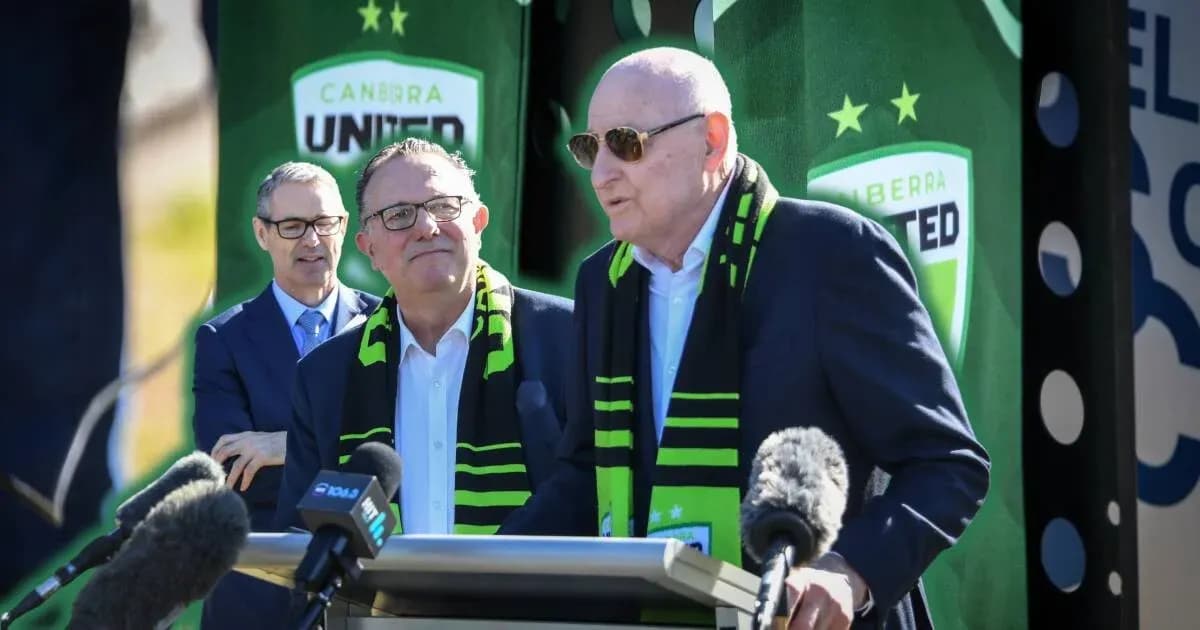
ASG chief executive Theo Fotopoulos and chairman Morris McAlister fronted McKellar Park to confirm the takeover that guarantees Canberra United’s place in the upcoming A-League Women season. Behind them, the club’s spiritual home stretched out – and that’s exactly where they plan to stay.
Fotopoulos was clear: United will keep playing at McKellar Park. The neighbouring Belconnen Soccer Club will become a “strategic partner”, and ASG is now exploring whether the ground can evolve into a full-time training base.
That’s no small shift. Capital Football and the ACT government once pinned their hopes on a purpose-built facility at the Throsby Home of Football, only for the project to collapse when the federation couldn’t afford it. Now, Fotopoulos is eyeing McKellar’s six hectares as the canvas for a new vision.
“It’ll come down to what we can get approved in terms of the facility here,” he told The Canberra Times, pointing to the advantage of working with one of the few private grounds in the city. The discussions, he said, are “very positive”.
The message was blunt: “Football needs a home and it'd be great to be able to develop that here.”
Coaching, continuity and the clock
The takeover has landed late in the off-season, and the clock is ticking. Pre-season is due to start in six weeks. The A-League Women draw drops next month. The first ball of the new campaign is scheduled for October 16.
ASG has already moved on the most important football decision of all: who leads the team. They’ve held talks with current coach Antoni Jagarinec, who has steered United to the finals in each of the past two seasons and become the steady hand in a turbulent period.
Fotopoulos made no secret of where his instincts lie.
“It’s never a no-brainer,” he said, “but yeah, look, I think [Jagarinec’s] results speak for themselves. We’re looking for continuity and consolidation. We’ll have those announcements out pretty soon.”
The players are next. The PFA is working with the squad, and ASG wants contracts sorted “quicker than later”. Fotopoulos said the reaction from players so far has left him “very confident” they can move at speed.
The pressure is real. So is the intent.
The men’s team question
Canberra’s pursuit of an A-League Men side has dragged on for the best part of two decades, littered with bids, promises and false dawns. So when it emerged ASG holds only an option – not a full licence – for a men’s team starting in 2028-29, there was understandable unease.
This was not the one-year transition many in the capital had hoped for. The gap is three seasons.
Fotopoulos didn’t flinch.
“Well, we’re here today, so that’s your best guarantee,” he said. “That is part of our twin strategy. When we started speaking to the APL … that was part of our mix. We believe the strength comes from both.
“It would be almost discriminatory not to work with the men. It’s always been part of our plans.”
For now, the paperwork says “option”. The rhetoric sounds firmer. Canberra has heard big talk before; this time, the difference is that the women’s team is already in private hands and locked into the league’s future.
United by name – and something more?
One thing ASG will not touch is the badge at the heart of Canberra’s football identity.
“The name will remain the same, Canberra United,” Fotopoulos said. “You’ve got 18 years of Canberra United. Why would you change it? Unless somebody or the general public have got a negative view towards the team – I don’t think that’s the case.”
The twist lies elsewhere. Fotopoulos wants the city to help craft a nickname, a tag that can bind both the women’s side and the future men’s team. He floated the idea of a public campaign – possibly through The Canberra Times – to let fans choose their banner.
The Cosmos? Arrows? Greens? Lakers? Or something that hasn’t yet been shouted from a McKellar terrace? “Green Machine, whatever they come up with,” Fotopoulos said. The history stays. The identity can grow.
Who’s behind the rescue?
ASG isn’t a household sporting brand in Canberra, but its two leading figures are no strangers to Australian football.
Chairman Morris McAlister comes from a commerce background. He is governing director of Petron Plus 7 Australian and New Zealand, a company dealing in engine and machine products such as lubricants and grease, and a senior consultant with MEC Team Consultants, which connects Australian businesses with Chinese markets.
Fotopoulos is a marketing executive and chief executive of FOS Group Australia. On the football side, he and McAlister have long histories: they were involved with Sydney Cosmos, where Fotopoulos served as chief executive, and with Newcastle Breakers in the old NSL. Fotopoulos also previously held the chief executive role at Sydney Olympic.
This time, they step into a landscape where private ownership is the norm – but in Canberra, it’s a first. Capital Football had run United since 2008, carrying the cost of the women’s programme until it became too heavy to bear. Last season was its last in charge. The licence has now been sold, with industry belief that the overall deal – including the men’s option – sits around $15 million, and that ASG has guaranteed up to $3 million to underwrite Canberra United over multiple years.
The A-Leagues will formally unveil ASG as Canberra United’s new owner, confirming the club’s place in the 2026-27 A-League Women season and beyond.
Pathways, infrastructure and long-term play
Fotopoulos has tied ASG’s arrival to a broader rebuild of the game’s foundations in the capital. The first pledge: restore the academy pathways that Capital Football controversially axed three years ago.
“We’re excited to be part of growing the A-Leagues and building a strong club focused on community engagement, football excellence, commercial growth, new infrastructure and strengthening the football development pathways for boys and girls in the territory and the capital region,” he said.
That ambition extends to bricks and mortar. The push for a training base at McKellar is part of a wider plan to invest in football infrastructure in Canberra – the kind of commitment local fans have been desperate to see matched to the city’s participation numbers and passion.
APL chair Steve Conroy framed the decision to back ASG as a turning point.
“Following a competitive process, we’re excited to announce the Australian Sports Group as the new owner of Canberra United – securing the future of the women’s team and establishing a pathway to introduce a new A-League Men’s team in Canberra,” he said.
“This is an exciting next step for professional football in the ACT and highlights the growth opportunity for the A-Leagues and football in Canberra.”
The end of the bid – and the start of something else?
For Canberra bid leader Michael Caggiano, who has spent eight years trying to drag an A-League Men licence to the capital, this moment may finally close one chapter. The APL named Canberra as a preferred expansion location almost three-and-a-half years ago, alongside Auckland. Auckland’s club is already a champion; Canberra has been stuck waiting.
That wait now has a date: 2028-29. It also has a structure, a private owner, and a women’s team secured after a period where even that looked in doubt.
Fotopoulos captured the stakes in one line: “Canberra is home to a thriving football community – a huge participant and passionate supporter base who have made Canberra United one of the most strongly supported A-League Women teams for the last 18 years.”
The licence is saved. The name is staying. The men’s team has a target season. A training base and academy are back on the agenda.
The question now is not whether Canberra belongs in the A-Leagues. It’s whether this new regime can turn long-suffering hope into a club – and a football home – worthy of the city’s patience.